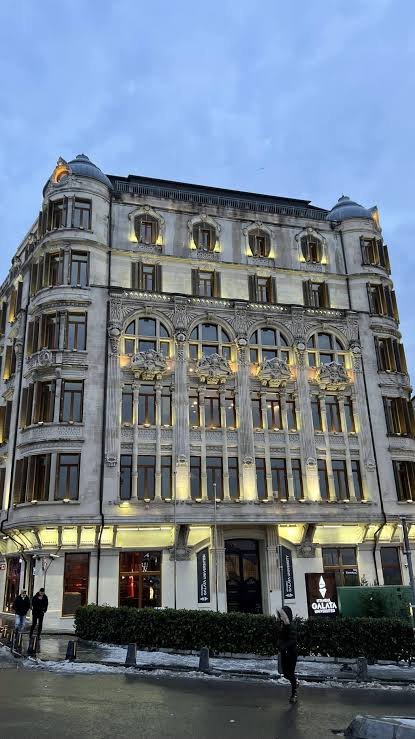
In Istanbul, multi-storey masonry buildings and apartments were first introduced - and quickly spread around the Galata and Pera regions. New construction methods and materials were brought from Europe, and applied first in this region of the city. One of these buildings was Frej Apartment, which catches the eye with its dashing façade, on the corner of Büyük Hendek and Okçu Musa streets. It takes its name from the Levantine Frej (Freige) family, one of the prominent families in Istanbul’s high society.
Its exact date of construction is unknown. Based on its architectural style, Afife Batur estimates it to be from late 19th or early 20th century, while Çelik Gülersoy states that it might have been built in 1905 or in 1906. The architect was Konstantinos Kyriakidis (1881-1942), an Ottoman Greek who left Istanbul for Athens in 1922. Word has it that the children figures on the building were representing the children of the Frej family.
The stones for the façade were brought from Malta, and marbles for the stairs from Italy. When completed, the building had a gas heating system, the latest luxury of the era. During the Constitutional Period, electricity was connected.
Although Frej Apartment is considered by many as a cultural asset that should have been protected carefully with all the antiques in it, it was classified as a second-class historical building, and its interior was gutted and rebuilt between 1987 and 1989. This controversial restoration left only the façade in its original form: the design of the lobby and the floors have changed, the original plaster ceiling decorations, doors, and many other details were destroyed. The Frej Apartment was bought by Sarkuysan Group in 1983, and has been used as the service building of the company for long years. In 2011 the building changed hands again, purchased by Park Elektrik, a company in the Ciner Group. As of the time of writing, this 11-storey, 3,850-sqm building is again under restoration.
Splendid Life Ends Tragically
The Frej (Freige) Family, who once owned the glorious Frej Apartments at the intersection of Büyük Hendek and Okçu Musa Streets on Şişhane Square, was a wealthy Levantine family from Beirut. Reportedly, the paternal side of the family was of Maronite origin. The family’s wealth was vast enough to seek 99-year coasting trade rights for the Ottoman Empire’s ports in the Eastern Mediterranean, including Haifa and Tripolitania.
Selim Hanna Frej, the son of the family, married to the daughter of Glavanis, a wealthy family of Galata. (Çelik Gülersoy refers to Glavanis as the “owner of the Tepebaşı Square.”) He had three children from this marriage: Jan, Alfred, and Anjel (Angel). When the mansion of Glavanis was sold a short while after the birth of Anjel, Selim Hanna Bey had Frej Apartment built, and moved with his family to the second floor after the construction. Frej Family lived there for two years.
By the time Anjel Hanım had reached the age of marriage, the Ottoman Empire had become history and the new Turkish Republic Selim had been formed. At the time, the reputation of Dukaginzâde Mehmed Feridun Bey (1894-1976), a handsome staff officer who made a name as the captor of Greek commander Trikopis during the Independence War, had reached to the ears of young girls in Pera. Ultimately, the families of both sides agreed to the marriage of Anjel Frej Hanım and Feridun Bey.
As a staff captain of the Turkish Army, Feridun Bey (1894-1976), worked for a while as a teacher of tactics, and, later, of war history, at the War Academy. However, he had to leave the Army in 1927 upon the passing of a law that forbid marriage of officers to persons of foreign origin.
In the young Turkish Republic, origins and last names were always an issue. Therefore, Angel became Aysel, while Dukaginzâde Feridun Bey took Dirimtekin as his last name. Nevertheless, “Monsieur and Madame Dirimtekin” became the most distinguished faces in Istanbul’s high society. They were the most sought-after figures of official and diplomatic parties. At such parties, Aysel Hanım was wearing elegant hats only to be found in the most expensive stores of Europe, while Feridun Bey, now a historian by hobby, was posing in his sash and foreign decorations, and showing off with his intellectual personality to a crowd who were happy to chat with him. Coming from a noble Albanian family, Feridun Bey was proudly wearing his cornelian signet ring of Dukaginzâdes.
After his discharge from the Army in 1927, Feridun Bey took administrative positions in various institutions (Turkish Aeronautical Association, Istanbul Directorate of Physical Education and Sports, Eminönü Community Center, Turkish Touring Foundation, etc.). When he retired in 1948, the couple sold the Frej Apartment for 150 thousand lira and moved to an apartment flat in Nişantaşı. As an amateur historian, Feridun Bey published several articles on various research subjects, including the Conquest of Constantinople. He even worked as the director of Hagi Sophia Museum between 1955 and 1971. In 1976 Feridun Bey lost his life to a heart attack after falling into an uncovered pit in a Galata street. From then on, the story didn’t go so well for Aysel Hanım. She got into row with the other heirs of the Frej estate, who even went so far as to putting her to a mental hospital for a while. She spent her last years in her flat at 60/1 Osmanbey Şair Nigar Street, and died in 1988 after breaking her hip by falling into an uncovered municipal excavation pit, just like her husband.
Part of these themes: Architects and apartment buildings
Source: Akdoğan Özkan, A Traveler’s Guide to Galata (Nar Turizm, 2016), translated by Volkan Ersoy.
Last updated: · Last checked: (address and map position)
Spotted a mistake or something missing on this page? Suggest a correction