Wine was once brought by vessels to Istanbul in casks from Erdek, Foça, Bozcaada (Tenedos island) and Bülbülce, unloaded at Galata’s “Şarap İskelesi” (meaning “Wine Wharf”), and from there, hauled to taverns. During the Ottoman era, the “Hamr Emaneti,” a revenues office responsible for administering and collecting alcoholic beverage taxes from all taverns, was also close to this Wine Wharf. The historical wharf was dismantled around 1895, before a modern dock was constructed. Its name, however, still lives on in “Şarap İskelesi Sokak,” a small street that connects Kemankeş and Mumhane Streets. More interestingly, during even earlier times, the street used to be called as “Krasoskala,” which means “wine wharf” in Greek.
The wharf was also providing a springboard for the families who have large vineyards on the Marmara and Aegean islands. One such striking example is Zarifis, one of the richest Ottoman families in the 19th century. The family became rich by transporting wine, grape-juice and grape molasses from their vineyards and wineries on the Marmara island of Aloni (today, Paşalimanı). They were using large rowboats to ship their goods, and unloading them at “Krasoskala” for distribution to taverns. Wealth gained through this means would later help them to become one of the “Galata bankers.”
It is referred to in many historical sources that the street used to be lined with many taverns that befit its name. Today, Karaköy Lokantası is the only restaurant/tavern on the street.
Galata Taverns in the Past
For the habitants of the city from the Byzantines to the 19th century Ottomans, the Golden Horn used to mean what the Bosphorus means for today’s Istanbuliots. Like chalets and wharfs, the taverns also appeared at first along the Golden Horn – until they moved to the coastline of Bosphorus.
The taverns were mostly located near the wharfs, especially in Tahtakale and Galata regions where the non-Muslim population used to center around before the Conquest. Reportedly, the taverns on the Galata coastline – from the inner parts of the estuary to Tophane – were not less in numbers than in any place of the world.
We don’t possess much information as to the wharf taverns of Istanbul during the Byzantine era. Still, we learn about their existence and names from Michael Psellos, the famous Byzantine philosopher and historian of the 11th century: Melitağros, Spanos, Gorgoplutos… Some of our earliest knowledge about the Ottoman era taverns comes from Latifi of Kastamonu, a 16th century Ottoman author who wrote about Istanbul and its social life in his “Risale-i Evsaf-ı İstanbul” (Guide of Istanbul).
He says that Galata was full of taverns from one end to the other, and the locals were never seen without a cup of liquor in their hands. He frowns upon Galata, a district which is “enough to make a saint swear” with all its Christian inhabitants, instrumentalists and singers, and then he leavens the dose of criticism: “If a Muslim visits here to steal a day and leave his troubles behind, he ends the day downtrodden with his clothes torn and his turban out of place.” According to him, it’s not easy to free oneself once one falls into this place’s clasps.
In his Book of Travels, Evliya Çelebi notes that there were 1,060 taverns in Istanbul, 200 of them only in Galata. “Galata is all about taverns,” he says.
Michel Baudier, a 17th century author, gives the number of taverns in Istanbul as more than 1,500.
Galata was essentially a customs port city. Ships with merchandise from the Occident, Orient and Africa used to be unloaded and loaded here, at many wharfs, or “gates,” of the city. The Balıkpazarı Wharf (lit. “Fish Market Wharf”), situated between the Yağkapanı and Karaköy Gates of the Galata walls, was one of the most prominent of the wharfs in the region. As it was also home to the fish market – from where seafood could be bought to accompany the spirits – the most colorful taverns of the city were located here.
Eremya Çelebi Kömürciyan tells us from the 17th century that there were about 20 fishmongers next to the Balıkpazarı Wharf, and that the rest of the coastline was full of taverns. It should be noted, however, that the old Galata Fish Market was located before the intersection of today’s Kardeşim Sokak and Fermeneciler Street. In other words, it was located within the Yenicami Neighborhood, further to the west of the current Karaköy Fish Market at the foot of the Galata Bridge.
The taverns around the Balıkpazarı wharf – like any other wharf in Galata – were social gathering places frequented mostly by seamen, merchants, caulkers, and carpenters of Greek, Jewish, Turkish, Genoese, Venetian, or Spanish origin. Researcher and writer Ekrem Işın points out to the Mediterranean cosmopolitism in Galata, and argues that the only human type who can be considered universal in the Classic era was born out of this environment, which usually was not regarded in a positive light.
In his Book of Travels, Evliya Çelebi tells us that, in the Galata taverns were sold “various notorious forbidden ruby-dripping wines, including muscadine,” and he counts Taş Merdiven, Kefeli, Manyalı, Mihalaki, Kaşkaval, Sümbüllü, Konstanti, Saranda amongst the popular taverns of the era. For the Muslim Turks, operating taverns was legalized only after the Second Constitutional Era (1908). In the Ottoman Empire, the taverns were operated by non-Muslims. In fact, the majority of the people in Galata were non-Muslims. Based on a population census during the reign of Sultan Murat IV, Galata was inhabited by 200 thousand Christians and Jews, but only by 64 thousand Muslims. Ottoman taverns were mostly owned by the Ottoman Greeks of Chios, Peloponnese (in particular, Tsakonians from the town of Leonidio in the Eastern Peloponnese), or of Cappadocia.
There were two types of Ottoman taverns: “koltuk” and “gedikli”.
The places which were selling liquor under the disguise of a tripery, an offal restaurant, or a pickle shop were called as “koltuk tavern.” Eremya Çelebi Kömürciyan mentions about such places in the Jewish neighborhoods on Hasköy-Kasımpaşa coastline, offering customers grape arrack to go along with dried sturgeon or codfish. He also says that Alonia wine goes very well with skewered swordfish kebab with bay leaves. On the other hand, a limited number of taverns licensed by the Ottoman state were called “gedikli.” During those times, any activity was subject to a permit named gedik, and the tavern gediks were inherited from father to son. If the son wouldn’t want to keep a tavern, the lodge of taverns would hand the permit over to a suitable tavern employee, the skills and honesty of whom could be attested. After the rule of Sultan Abdülaziz, such licensed taverns begun to be called as “selatin taverns” (literally “imperial taverns,” indicating their elite status).
Mehmet Tevfik Bey, who wrote in 1880 “The Tavern or the Habitual Evening Drinkers of Istanbul,” a 48-page booklet on Istanbul taverns, lists the names of 83 licensed Istanbul taverns of the era.
In the 19th century, the grocery store-taverns – a new kind of drinking place seen in almost every neighborhood – were added to these two types of taverns. In such places, the customers would have one or two quick shots of uzo or wine, accompanied with some appetizers, while waiting for their grocery order being prepared.
As in Greek, the owner of the tavern was called as “barba,” and the bartender as “mastori,” while in some taverns the barba would handle the mastori’s job himself. 10- to 18-year old attendants, who were responsible for bringing candles to the table or putting cinders in tobacco bowls, were called as “ateş oğlanı” (“cinderboy”) in Turkish, or as “pedimou” (“my child”) in Greek. In some taverns, cupbearers would assume the cinderboy’s job. Mostly from the island of Chios, these handsome, young cupbearers were called as “muğbeçe,” meaning the tavern-keeper’s apprentice.
† There is a street in Karaköy today called Sakızcılar. The name is a corruption of “Sakızlılar” (the Chiots). It refers either to the islanders who once came from Chios and opened taverns here, or to the bachelor rooms on this street of the young Chiots who worked as attendants in the taverns nearby.
The frequenters of Balıkpazarı taverns were mostly boatmen, bargemen, porters, hammam attendants, and horse cart drivers – the kind of people the elites used to call “riff-raff.” Mariners were also visiting such places, but the authors of the era say that they wouldn’t sit around for more than a couple of drinks, off to see the “belles of Galata.” The Greeks were using almost all of their vineyard harvest to produce wine, and they were in fierce competition with the Jews. Famous Ancona, Tenedos (Bozcaada) and Saragossa wines of the time were brought by ships and unloaded at Kraso Skala (Wine Wharf), the last wharf of Galata on the Tophane coastline. Unless there was a ban on liquor, the unloaded wine would go through the customs procedures and then carried to taverns in casks or earthenware containers. Although forbidden, some wine casks would be opened at the wharf for individual customers, who would fill the wine into their wine skins and take it to their homes. Kraso Skala was dismantled during the construction of the Galata Docks in the late 19th century, but the “Şarap İskelesi Sokak” (Wine Wharf Street), once leading to the wharf and famous for its taverns, is still there in Karaköy. Unfortunately, none of the taverns on this street has survived until today. Today, if you want to visit a wharf tavern, your options are incomparably limited. Karaköy Lokantası (at 35A, Kemankeş Street, with one side on Şarap İskelesi Sokak) is one of the few taverns in the region.
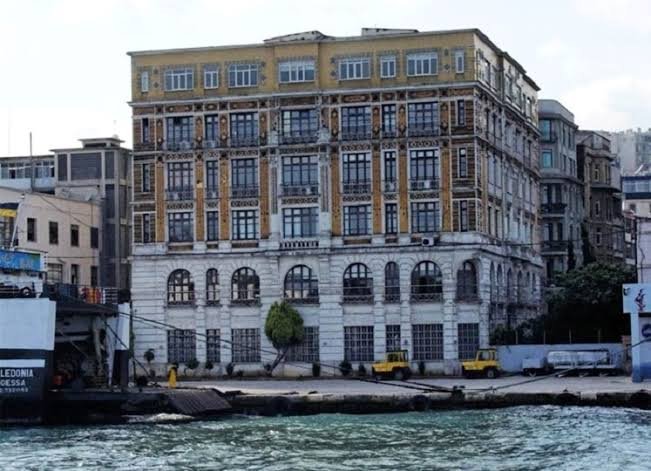
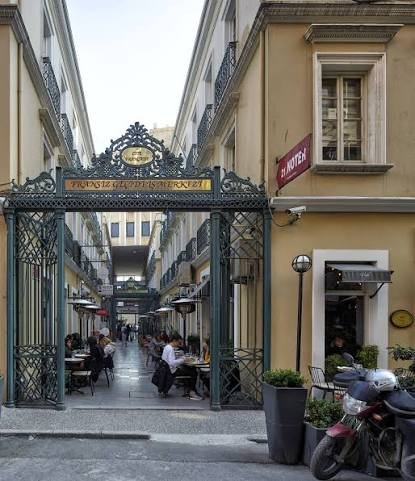
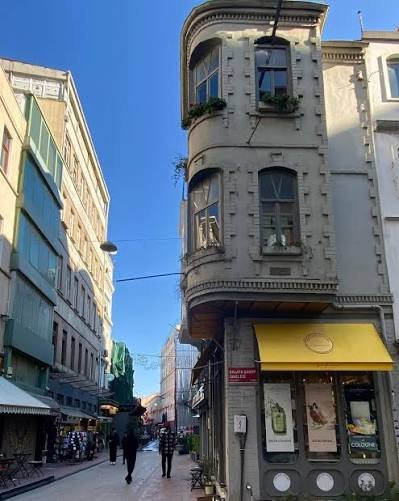
† Şarap İskelesi Sokağı is nevertheless one of the most impressive streets in Istanbul architecturally, even today. 6. Vakıf Han, Liman Ticaret Han and Muradiye Han at no. 10 are among the street’s elegant, attractive buildings. The lovely Liman Ticaret Han of 1897 in particular has, like so many buildings in Istanbul, been left to a desolate fate and to the care of car-park attendants.
† Another tavern-restaurant is Liman Lokantası, which also offers a view of the unique skyline of the historic peninsula. Those who come and sit in this restaurant at 52/3 Rıhtım Street shortly before sunset can enjoy a skyline much like the one seen 300–400 years ago by the regulars of the wharf taverns on Galata’s shore, as they turned their eyes to the tip of Istanbul’s historic peninsula. Galata, especially in the Ottoman period, was mostly perceived in an unfavourable light. As the Muslim community settled in the Tophane area after the Conquest grew in number, Galata increasingly became a district that more and more people described as “harabat” (a den of taverns). This negative perception, summed up in Tevfik Efendi’s description of it as “a bohemian house of scandal,” carried over into the Republican period as well. Ahmet Rasim recalls in his memoirs that, when he was a student at Darüşşafaka, the teachers would gather the pupils on the days they went home and warn them: “You will not cross over to Galata or Beyoğlu! Even those whose homes are in that district will not wander its streets!”
† The number of pupils at the Rüşdiye school in Galata, which had 120 pupils in 1874, also fell to 59 in 1877. The folk poet Vâsıf Hiç (1863-1946), also known as Destancı Vasıf, says that “the reason why pupils of the military schools and of Darüşşafaka were forbidden to walk about in Galata must be sought in the womanising, rowdy, ruffianly air of the district’s daily life.” For all this negative image, Galata, with its taverns, has always exerted a very strong pull. One of those who conveyed the attraction of Galata’s taverns most wittily is Kâşif, a 17th-century poet. His quatrain sums up, ironically, the Muslim view of Galata: “Kim ki İstanbul içre tövbe idüb / Dirse bir dahi içmezem asla / İtimad eylemen sözüne anın / Galat’a ihtimali var zira.” (Whoever repents in Istanbul and says, “I shall never drink again” – do not trust his word, for there is a chance he will cross to Galata.)
† Nor does the poet’s punning use, in the last line, of “galat” – a word meaning error or mistake in Ottoman Turkish – go unnoticed. Interestingly, there were also those so passionately attached to the district that they could say “may no evil eye fall upon it.” Âşık İbrahim of Erzurum, whose path led him to the taverns of Balıkpazarı towards the end of the 19th century, was one of them. Describing Balıkpazarı, the poet also lists the kinds of wine: “Edremit, Bülbülce, Mürefte, Fertek / Çakalım güzeller aşkına bir tek.” (Edremit, Bülbülce, Mürefte, Fertek – let us knock back one for the love of the beauties.) Zil İzzet – mostly known by the nickname “Zil” (tipsy), probably because he was seldom sober – was another who painted Galata pink with his pen: “Galata’ya geçelim / Bir köşecik seçelim / Sayd idüp bir dilberi / Bir iki tek içelim / Sokaklarda yatarak / Kendimizden geçelim…” (Let us cross to Galata, choose a little corner, catch ourselves a beauty, have a drink or two, and lie down in the streets until we lose ourselves…) Whether Galata in those days really offered such a welcome that one could sleep in its streets is hard to know. But as in many port cities of the world, Galata had taverns that offered a respectable atmosphere and service, and also squalid taverns that worked “without concern for decency or shame,” mixed up in all kinds of trouble from gambling to prostitution and fraud. These were frequented mostly by sailors, single migrant workers and knife-carrying adventurers. It is said that those who strayed into these taverns by mistake met with all sorts of misfortune, murder included. These taverns in the back streets of Galata, where fights and noise were seldom absent, were called “çakanoz meyhane.”
† They were probably given this name after the Tsakonians (Çakones), who came from the Tsakonia district under the kadılık of Benefşe in the Peloponnese and, known for their strong build, kept taverns in Galata.
† In his novel “Dürdane Hanım,” Ahmed Midhat Efendi portrays the Galata taverns as this kind of “çakanoz tavern,” where knives were drawn, pistols went off and people, maddened by the fury of drink, turned into beasts. Mehmet Tevfik (1843-1893), known in the Ottoman press by the nickname “Çaylak,” gives the names of three taverns in Galata Balıkpazarı known as old, licensed taverns of Istanbul: Kafesli Meyhane, Hançerli Meyhane and Yahudi Meyhanesi. It should not be assumed from this that the taverns of Balıkpazarı were limited to these; they were probably simply the most famous. Indeed, a folk poet named Âşık İbrahim of Sivas, thought to have lived in the reign of Abdülaziz, names 18 taverns in an epic poem he wrote on Balıkpazarı: Taş Merdiven, Topuklu, Altınoluk, Hançerli, Zindan, Cellad, Kafesli, Camekan, Yahudi, Folluk, Mecnun, Ferhad, Şadırvan, Çadır, Bağçeli, Nesim, Tandır, Dalyan.
† Of course, just as traditional Ottoman Istanbul – unlike Europe – was made up of neighbourhoods based on ethnic rather than class lines, each housing people of every social stratum, rich, middling and poor, so Galata, reflecting this Istanbul, had taverns for every class, rich, middling and poor, standing side by side, if not intermingled. In Galata, where many entrepreneurs made fortunes thanks to the financial market that developed especially in the second half of the 19th century, it is unthinkable that there were no select taverns in proportion to this wealth.
† Where Aynalı Sokak now stands, and where you will find at most a tradesmen’s kebab shop, there were two select taverns facing each other, Büyük Aynalı and Küçük Aynalı, frequented especially in the early 20th century by a respectable, “moneyed clientele.” The writer Sermet Muhtar Alus (1887-1952), known for his articles in the newspaper Akşam, noted in a piece written in 1938 that a small carafe of rakı, sold for one kuruş everywhere else, cost two kuruş there – not forgetting to add that this rakı was “genuine Mihyoti rakı.”
† Manol’s Tavern, which once stood just opposite Aynalı Sokak, was a place of the same kind. According to Ergun Hiçyılmaz, the swaggering toughs of Boğazkesen and Firuzağa would settle in at its counter in the evenings.
† Besides the taverns in Galata that only men could enter, there were also “balozes,” where hostesses worked and there were music and dance shows. “Baloz” was the name given to the European-style bars, most of them on Necatibey Street. The balozes, which became truly famous during the occupation of Istanbul, offered plenty of European drinks. Orhan Türker reports that in 1924 there were 24 bars in Galata alone.
† Near Aynalı Sokak there was also Şerbethane Sokağı. Since taverns – like “badehane” – were also called “şerbethane” in the Ottoman period, its name was later changed to Leblebici Sokağı. On this street there used to be the Şerbethane Balozu, a cross between a tavern with music and a bar. This baloz, where the band of Arap Yorgi – one of the well-known figures of the time – performed with lute, clarinet and zilli maşa (cymbal tongs), was famous both for its hostesses and for the fights that frequently broke out there.
† Sermet Muhtar Alus reports that opposite Şerbethane Sokağı, the Yüksek Baloz – a cut above it, and reached by 25-30 steps – and Hovarda’s Tavern beneath it were among the famous places of the day. Yannis Vlahos’s Universal, Christos Petropoulos’s Anatoli, Yannis Kairis’s Afrika, as well as Antilop and Moskova, were also among the balozes that enjoyed great success.
† In these places called balozes, it was said, “the sucker gets fleeced.” Probably because the meze sellers took the hostesses home towards dawn, these women too played along with the “fleecing”: if a customer asked the price before ordering meze, they would silence him by saying “how rude!” On Arkadi Sokağı – today Serçe Sokak – stood the Küplü Tavern. Küplü served 50 dirhams of rakı for the trifling sum of 20 para to the jobless, penniless alcoholics, the “küplü” crowd, as they were called at the time. The taverns nearby, annoyed by the advantage Küplü gained with rakı it gave away almost for free, used to complain to the Municipality, claiming that the rakı was adulterated. The municipal police raided the place three or four times and sent the rakı for analysis, but the samples proved to be pure, unbottled Marmara rakı. The favourite haunt of the fire-brigade crowd (tulumbacı) was Serope’s tavern on the same street. Perhaps because on Arkadi Sokak “hotel, dice, women and wine” made up the full set, Ergun Hiçyılmaz asked: “If this street isn’t lively, which one would be?”
† On Leblebici Sokak there was the tavern and hotel of Madam Bella, legendary for her beauty and formidable character. A young man named Stavros of Mytilene fell in love with Madam Bella, who was said to look no more than 25 even in her forties. When Stavros killed a customer in a fit of jealousy, the police closed the tavern and Bella was deported.
† In the last decades of the 19th century many taverns were on or near what is today Necatibey Street. Some were on Mumhane Street.
† There are two different views on the name of Mumhane Street. Eremya Çelebi Kömürciyan (1637-1695) writes that candles were made from tallow near the Mumhane Gate of the Galata walls, and many writers hold that the area’s name “Mumhane” (candle house) comes from this. But it is also possible that the name comes from hum rather than mum (candle). As for the meaning of the word hum… In the days before bottles, wine was kept not only in casks but also in earthenware jugs and large jars, and drinks were served from these jars with a dipper. Since the Persian for jar is hum, taverns were already called humhane in the 16th and 17th centuries. Even if we cannot be sure which of the two gave the area its name, we do at least know that Mumhane Street was once full of humhanes.
† Bahaî Efendi (1601-1653), one of the şeyhülislam poets, made a rather daring statement for his time with this easy-going couplet on humhanes, as if reacting against the bigoted circles of the day: “Eyler Bahâyî hâk-î harâbâtı secdegâh / Humhâne-i cihânda şu kim mey-perest ola.” This couplet, woven of words such as harabat, humhane and mey-perest that describe an imaginary universe, can be rendered as: in the wine cellar called the world, Bahaî, like one who dearly loves wine, makes the earth of the tavern his place of prostration. European travellers too witnessed the taverns of the district. The English poet Lord Byron, who came to Istanbul in 1811, went to the taverns here many times with his travelling companion John Cam Hobhouse. In his memoirs Hobhouse describes one of their tavern outings with the famous poet: that day he, Byron and a group went to a wine house in Galata, took narghiles, and saw two ugly old boys who threw back their hair, spread a carpet on the floor and, wrapped in shawls, performed an Alexandrian women’s dance – the same, except that they knelt on the ground and covered each other’s heads as if they were kissing. The Lavirentos Tavern, one of the taverns whose foundations are said to have been laid before the Turkish conquest of Galata, was also on Necatibey Street. Lavirentos was demolished in 1943 while it was still operating under that name near the Galata quay. Reşat Ekrem Koçu writes that one of the twin finance buildings on Necatibey Street in Galata was built in its place.
† According to one story, the tavern took its name from the labyrinth of tunnels said to exist beneath Galata. According to another, in the reign of Abdülhamid II a giant white spider, said to have lived for 300 years, dwelt inside an unused cask in the tavern’s cellar.
† The Galata taverns perhaps lived their last colourful days during the Crimean War. In this period, when Istanbul was full of foreign soldiers and sailors, above all British and French, both prostitution and crime rose in the district. After the war the local administrators even brought in 100 British policemen to clear the notorious places of crime and restore order. One of the last taverns of the district’s heyday was Hamdi Baba’s Bahriyeli Tavern, with one door opening onto Halil Paşa Sokağı and another onto Kemankeş Sokağı. From 1938 until its expropriation in 1959, Bahriyeli served mostly educated people and tradesmen. Ergun Hiçyılmaz stresses that the place of Hamdi Baba – who used to address the last Haydarpaşa ferry, which he took every night to his home on the Kadıköy side, as “my benefactor and my protector” – was a “school of good manners.”
† Today the streets near the old wharves of Galata are far from their former colour. According to Semavi Eyice, Galata lost its historic character through expropriations that began in 1857 but intensified mostly after 1955, and turned into an ordinary Istanbul district. In the early 1960s, in reaction to the events in Cyprus, the district also lost its name, and from then on came to be called “Karaköy,” after an ugly square opened up by the expropriations. The events that led non-Muslims to leave the city also played a considerable part in the district’s loss of its old character and in the decline in the number of taverns. Speaking of taverns, one cannot fail to mention wine, a drink that entered them long before rakı. The wines of the Ottoman lands were known and sought after by Europeans as early as the reign of Süleyman the Magnificent. Wines brought to Istanbul especially from Aegean islands such as Mytilene, Bozcaada, Crete, Chios and Santorini, and from places such as the island of Marmara, Euboea and Trabzon, were highly prized. According to Ogier Ghiselin de Busbecq, Austrian ambassador to the Ottomans in 1555-1562, these wines tasted better than wines such as Malvasia, Vipasha and Raffaldini produced in Europe at the time.
† That our wines today do not enjoy the reputation they had then is largely due to the collapse of viticulture in Anatolia with the emigration of the Greeks to Greece in the 1924 population exchange, and the subsequent disappearance of many wine grape varieties.
† Although Ottoman wines earned a good name, it should not be forgotten that in the Ottoman period Turks, or Muslims in general, could not easily go to taverns serving wine or arrack. It is known that for quite a long time Turks who went as customers to taverns run by Greeks, Jews and Armenians drank with some unease.
† For Muslims found by the police to have been drinking could, in some periods, be given hadd punishments of up to 100 strokes of the stick. Worst of all, the punishment was doubled with each new arrest.
† Yet wine was never something that punishments and bans could stop. A sentence by the Italian writer Edmondo de Amicis, in his travel book on Istanbul written in 1874 after his visit, sums up the picture – if somewhat exaggeratedly: if Istanbul were suddenly plunged into darkness one day and the sun rose again an hour later, fifty thousand Turks would be caught with a bottle to their lips.
† In the Ottoman period licensed (gedikli) taverns had to close at a set hour in the evening; staying open past it was forbidden. Of course bribery, one of the world’s oldest institutions, could solve this “problem” too, up to a point. Mehmet Tevfik, a 19th-century journalist, relates how it was overcome: “In a suitable place in such large taverns a big bell is hung. In the evenings one of the boys stands at the tavern door holding the bell rope. As soon as this boy sees an officer coming in the distance, he pulls the bell; the tavern doors are shut at once and silence reigns inside. When the officer has passed, the boy rings the bell again, the tavern opens and everyone returns to their revels. The officer, knowing this to be a mark of respect towards himself, makes no move against the tavern until its closing time comes.” In short, if the first rule for Muslims to avoid punishment was not to drink, the second – if they did drink – was to drink with decorum and not show it. A Muslim who easily showed this “colour” (!) and was caught would suffer humiliation and exclusion on top of the punishment, and since he might in this way get others into trouble too, such people were not much trusted. It should not be forgotten that this sense of decorum and measure, which also developed as a social necessity, plays its part in the fact that a young man known as an “akşamcı” (habitual evening drinker) did not easily get a girl’s hand in marriage, and that rakı is perceived even today as a “drink with character.”
† Like every ban, the bans on drink in time produced the opposite of the desired result. At times this led to the “measures” being tightened further. There were periods when drink was banned altogether. Yet the people of Istanbul always got on well with drink.
† In times when there were not many kinds of drink on the market, a ban on drink was understood as a “ban on wine.” A Bektashi anecdote sums up very nicely how some lovers of drink found a “way out” of this ban, especially in the 17th century: Murad IV, during an inspection he made while drink was banned, raided the cellar of a Bektashi lodge he suspected and found grape must in jars. Sultan Murad asked at once: “You heretics, why do you keep must in jars?” The Baba Erenler, of course, always had an answer ready: “My Sultan, we press the juice of the grapes and keep it in jars so that it turns into vinegar. But whether it becomes vinegar or wine, that is for God to know.” In later years rakı became as popular as wine. We have no way today of knowing or tasting what the first Turkish rakıs were like. But we know that the first new products that can be regarded as the ancestors of rakı were obtained by distilling the fresh grape distillate (suma) a second time in the alembic, and were known as “şarap rakısı” (wine rakı) or “arak.” In time the search for variety in rakı extended from certain fruits to spices such as cinnamon and mint, and in the end aniseed, more to the taste of Turks and Greeks, won wide acceptance.
† With the emigration of the Greeks to Greece in the exchange and the transfer of rakı to the state monopoly, this “drink with character” entered a period in which it would turn in on itself. For the Ottoman Empire had left the Republic not only taverns and “fish in the rakı bottle,” but also a mountain of debt. The Western powers that set up the Public Debt Administration (Düyûn-u Umumiye) so that the Ottomans could pay their debts had seized the country’s revenues through it. The Régie Administration, created for this purpose as early as the second half of the 19th century, gave way in the early Republican period to the Monopoly (İnhisar, later Tekel) Administrations. When rakı production too was taken into the monopoly (like tobacco, salt and so on), all the rakı producers in the country, large and small, were closed. Many rakıs – Lambiko, A’ Rakısı, Âlâ, Fevkalade, Aliyülâla, Hanım, Keyif, Baküs, Dem, Alem, Efe, Üzüm Kızı, Dimitrikopulo, Bahçe, Ankara, Memur, Stafilina, Bilecik, Olgun, Mürefte, Fertek, Çamlıca, Erdek, Elif, Ağa – passed into history. It was the end not only of the brands but also of the variety of products, for from now on only the state would produce rakı. Rakı thus became uniform. But rather than opening rakı to world markets and trying to match the fame of the wine once made from Anatolia’s renowned grapes, the state preferred to sell it easily, and at high tax rates, to a domestic market condemned to a single type of product.
† Meanwhile the Greeks diversified ouzo, rakı’s close relative, with a range of products, and the Bulgarians opened up to world markets with mastika. In Turkey, by contrast, different products made by different techniques – plain (anise-free) rakı, rakı with mastic, rakı with plums, different flavours – could not make an appearance. Rakı began to diversify little by little after the privatisation of 2004.
Part of these themes: Taverns, music and entertainment
Source: Akdoğan Özkan, A Traveler’s Guide to Galata (Nar Turizm, 2016), translated by Volkan Ersoy. Obvious misprints in the printed edition have been corrected. Paragraphs marked † appear only in the 2017 Turkish edition of the book (Galata Gezi Rehberi) and were translated for this site.
Last updated: · Last checked: (address and map position)
Spotted a mistake or something missing on this page? Suggest a correction