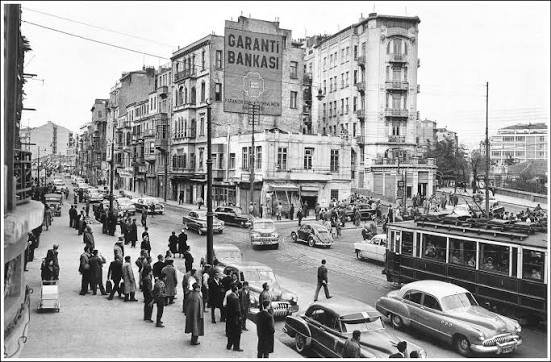
At the beginning of the 20th century, Bankalar Street (lit. “Banks Street”) was home to “the masters of money” who had the Ottoman government on a string. Today, you may still find here the offices of some banks and insurance companies, but it is mostly occupied by electronic parts stores and importers. To understand how it turned out to be like this, we have to go backwards and tell the story from the 19th century.
“Galata abounds with pickpockets in the south, drunkards in the west, murderers in the north, and chanteuses in the east,” says Hagop Baronyan, an Ottoman Armenian author from the 19th century. Then he adds: “There is no limit to spending and folly.”
Yes, these words were probably true for mid-19th century merchants and bankers in the region, but the Ottoman Empire had already arrived to the limits of spending, if not the folly. In order to finance the Crimean War, the state became forced in 1854 to borrow foreign money via Galatan bankers. It was followed by other foreign borrowings in 1855, 1858, and 1860.
“Galatan bankers” is a term which was used for non-Muslim businessmen who were engaged in usury in two commercial buildings (han in Turkish) - ‘Komisyon Han’ (Commision Han) and ‘Havyar Hanı” (Caviar Han) – and most of them were essentially goldsmiths. They played an important role in the history of the Ottoman economy until the establishment of the Public Debt Administration (Düyûn-u Umumîye), and especially until the foundation of the Ottoman Bank. The Galatan bankers also helped the Ottoman government in collecting taxes, providing short-term credits to clear the debts of the treasury, and exporting and circulating coins.
In time, the debt of the government to the Galatan goldsmiths has reached to more than 80 million gold liras. Some part of the promissory notes and jewelry pledged in return for this debt were seized by foreign merchants and bankers. Salivating at the prospect of big profits, foreign banks came to Istanbul to have their share in the finance market. In the 1860s, the Ottoman government begun to borrow not only from Galatan goldsmiths but also from the foreign banks. An era of banks had started.
“Bank-ı Osmanî-i Şahane,” one of the first banks operating in Istanbul was founded in 1863 and financed by British and French capital. The Bank acted as an intermediary for the borrowings of the Ottoman Empire, endowed with the prerogative of coining money when necessary. The Bank became the treasurer of the Empire with an agreement signed in 1875.
During this period, Abraham Behor Camondo and Nissim Camondo, the grandsons of the city’s influential Camondo family, partnered with Istanbul’s finance circles – mostly composed of Greek Orthodox businessmen – to found a bank under the name Societe Generale de L’Empire Ottoman. The purpose of the bank was to ensure that the Empire’s loan borrowing tenders are won by the Galatan bankers. With an edict of the Sultan, the bank was assigned as the “short term treasurer for internal and foreign loans.”
Between 1864 and 1868, the bank was unrivalled in winning internal loan borrowing tenders. From 1868, the bank had to compete with the İtibar-ı Umumiye Bank of the Societe General Group, which was owned by the Rothschilds, a family of German Jewish bankers.
The banks founded after 1864 in Galata were mostly based around the port, in the southern region of the city. Nine of ten hans of Camondos were in Galata.
In 1892, the Ottoman Bank had its twin office buildings designed by the renowned architect Alexandre Vallaury at 11 Voyvoda Street. It was to be used as the head office of a company founded with some foreign banks to administer the monopolies of the Public Debt Administration. One of the buildings was occupied by the head office of the Ottoman Bank, and the other became the administration building of the Régie Company (currently it is used by the Central Bank).
From then on, Voyvoda Street (later named as Bankalar Street) became Istanbul’s center of finance. Following the example of Ottoman Bank, many other banks and bankers moved their offices to this street. As of late 19th century some of the banks located here were: Banque de Salonique, Deutsche Bank, Banque Russe pour le Commerce Etranger, Banque d’Athénes, Commercial Bank of the Near East Ltd, Hollantse Bank-Uni, and Banco di Roma, Banca Commerciale Italiana. During the Republic, banks such as the Central Bank, Sümerbank and Garanti Bank were added.
Financier of the Sultans: Zarifi Family
Zarifis first engaged in commerce in the 18th century, by supplying Galata with wine, grape juice and grape molasses from their own vineyards on the island of Paşalimanı (former Aloni), Sea of Marmara. In the 1770s, they already owned a large company based in Istanbul. They lived first in Arnavutköy, and then in Fener districts of Istanbul.
Yorgo Zarifi, the grandson of the first Zarifi, was born in 1810 in Arnavutköy. As his father’s name was known to be on the list of financial backers of the Philiki Eteriae (a secret Greek organization whose purpose was to liberate Greece from Ottoman rule), the family left Istanbul for Odessa during the Greek uprising in the Peloponnese. Yorgo Zarifi was only 16 at the time. Tsar Alexander I gave him a free entry to the Lycée Richelieu. After eight years in Odessa, they went to now-independent Greece.
Missing his home country, however, Yorgo returned to Istanbul and started to work for Stefanos Zafiropoulos, the famous Greek banker of Galata. In 1836, he married to Eleni, the eldest daughter of the Zafiropoulos family. After some time, he became partners with Zafiropoulos family, entered into the banking sector and assumed important roles in the Ottoman finance system. His involvement in the Ottoman government’s debt raising started during early 1850s, just after Dersaadet Bank (Banque de Constantinople) was liquidated.
Yorgo Zarifi was now the president of a newly established bank: Societe Generale de L’Empire Ottoman (Osmanlı İmparatorluğu Şirket-i Umumiyesi). The bank was unrivalled in the Empire’s domestic debt raising. Zafiri served as the president of the bank between 1864-1864, and remained in the board until his death. His son Leonidas and his son-in-law Ulysse Negroponte (married to Sofia) were also in the bank’s board. His other son-in law Antoine Vlasto (married to Therese) was the bank’s chief inspector. Seven out of nine members of the bank’s board were Greeks.
The head office of the bank was in a han (on Kürekçiler Sokak) belonging to the Camondo family, who contributed to the urban development of Galata by building many hans and apartments between 1868 and 1909. This han became home to other important banks in the beginning of the 20th century, and it was sold to German-based Wiener Bank Verein in 1911.
The Ottoman government’s bankruptcy in 1876 was a turning point for Zarifi’s career because he became involved in certain political developments in the aftermath of it. He found new opportunities in this period of instability which started with the dethronement of Sultan Abdülaziz, and continued during the first years of Sultan Abdülhamid’s rule.
Zarifi’s close friendship with Abdülhamid had started when he was a prince. When Abdülhamid unexpectedly ascended to the throne, Zarifi undertook an important role in managing the financial affairs of the government and the court. He played an important role in financing the 1877-1878 Ottoman-Russian War by providing loans to the government, although the magnitude of the interest rates and the severity of the loan conditions were to that extent to distress the Sultan.
1880 was the beginning of a golden era for the Societe Generale de L’Empire Ottoman. Together with some other Galatan bankers, the bank was granted the tax-farming rights for the Empire’s many revenue sources – such as stamp duties, alcoholic beverages, and fishing. Yorgo Zarifi also played an important role in the foundation of the Ottoman Public Debt Administration.
During this last era of the Ottomans, the deficit between the Empire’s external revenues and external spending grew increasingly. As the country was reeling under a heavy foreign debt from the 1850s, it became more and more crucial to close the deficit. The Empire was relying upon transit trade as an effective revenue source to close the deficit. Like most other Galatan Bankers, Zarifi was one of the businessmen behind the transit trade between the Black Sea region and the Middle East.
When Yorgo Zarifi retired from business for health reasons, his son Leonidas Zarifi (1840-1923) took over the helm. Yorgo had a stroke in 1884 and died in Istanbul. His heart was removed and, with a separate ceremony, placed in a marble memorial in Agia Paraskevi Church in Tarabya.
In 1904 Deutsche Orient Bank has already been established in Istanbul and Leonidas Zarifi was representing the Ottoman interest in the board of the bank. So, it wouldn’t be so farfetched to refer to Zarifis as “the family who established the banking system in the Ottoman Empire.”
On the eve of Balkan Wars, Zarifis became partners with Baron Hirsch to finance Berlin-Baghdad railway, thereby increasing their wealth.
Zarifis continued to live in Istanbul until early 1920s, but then they left Istanbul for Marseilles when the Greek Army begun to invade the Asia Minor. The family had already one leg in Marseilles, as Leonidas’ brother Perikles Zarifi (1844-1927) had founded there a company in 1909, under the name P. Zarifi&Cie. This company became Zarifi&Cie in 1970, and it is currently managed by Perikles Zarifi’s 5th generation grandson Theodore Zarifi.
Yorgo Zarifi has always been known as a prominent benefactor of his time. The magnificent, castle-like building of the Greek Orthodox School in Fener, the Balıklı Greek Hospital, and the Agia Paraskevi Greek Orthodox Church in Tarabya were sponsored by him. In addition, he was one of the founders of the Greek Philological Association of Constantinople which earned a world-wide reputation with its library of thousands of books, as well as its publications and activities. His wife Eleni also sponsored the construction of the Central Greek Girls’ School in Pera (which closed doors in 1990 for the lack of students), as well as donating the building of the Greek Orphanage in Büyükada (Prinkipo Island) – the latter is known to be the world’s second largest wooden building and it remains unused since its closure in 1964.
† Yorgo L. Zarifi, the grandson of the elder Zarifi, even witnessed the inventor Edison presenting his great invention, the gramophone, at the Paris Exposition of 1889. He also watched in person the first modern Olympic Games, held in Athens in 1896.
† The family came to own mansions in Pera overlooking the British Embassy, a building on Çukurluçeşme Sokağı in Beyoğlu that serves today as a restaurant, houses in Maçka, summer houses on Büyükada and a villa on the shore at Tarabya.
† After the death of Yorgo Zarifi the villa in Tarabya passed to his heirs, who later sold it to a company. When the company could not pay its debts, the villa passed to the National Real Estate Directorate. The Istanbul Chamber of Commerce (İTO), which obtained the right to use it for 49 years, had a project drawn up for its restoration. When the Council for the Protection of Cultural and Natural Heritage withheld its approval, the İTO’s dream of the villa also came to nothing. Today the fate of the villa appears to rest with the European Court of Human Rights.
† In his memoirs Leonidas Zarifi, the son of Yorgo, also recounts some recollections of his closeness to Abdülhamid. In one of them he tells how, one morning, an orderly of Sultan Abdülhamid II rode up to his office in Galata to tell him that he was expected at the Palace. Leonidas Zarifi went to Yıldız at once. Abdülhamid said to him:
† “Two years ago your father rescued me from the clutches of my creditors, paid my debts and put my finances in order. Now my brother Reşad is in the same situation. I ask you to get him out of the impasse he is in.” Leonidas promised to do all he could and set about putting right Reşad’s badly damaged finances. Within a few years Reşad’s debts were paid, and a considerable sum was left over for the expenses of the heir apparent. The Zarifis opened a current account for Reşad, just as they kept one for Abdülhamid.
† In time, however, Reşad’s spending again began to exceed his income. One day a cheque of Reşad’s without funds to cover it even reached the Zarifis. At this Leonidas left the Palace and went straight to the heir apparent to give him the necessary warnings. But Abdülhamid, who in recent years had begun to suspect everyone, had turned the palace in which Reşad lived into a prison as well, and had posted mounted sentries around it. When Abdülhamid’s informers brought news of the meeting to the Palace, the Sultan was displeased.
† What business did Zarifi have with the heir apparent? The next day another mounted messenger arrived in Galata to say that he was once again expected at the Palace. Leonidas went straight to Yıldız Palace.
† The Sultan he found before him was not the smiling Abdülhamid of old. The Sultan came straight to the point: “I took you for a loyal friend. But you have joined my enemies and begun to plot against me.”
† When Zarifi, not understanding, asked him to explain, he said: “Do not pretend not to understand. Why did you go to him yesterday and come to an arrangement with him?” Leonidas then understood the reason for the Sultan’s suspicions and replied: “Your Majesty, you will find no one more loyal to your throne than I am. Who told me to look after his interests? Who charged me with the management of his financial affairs? You did, Your Majesty! But when your brother issues a cheque without funds, what would you have me do? Let the cheque go unpaid and bring trouble on his head, or go and explain to him how matters stand?”
† Convinced of Zarifi’s honesty by this explanation, Sultan Abdülhamid said: “Very well. But I do not want my brother to have accounts with third parties. I want you to close his current account. Tomorrow I shall send someone to Galata to pay what he still owes. But you will hand over to him all his accounts and all his securities, and from now on you will never go near him again.”
† The next day everything happened as the Sultan wished. And Reşad was condemned to a great solitude that was to last 28 years – until the troika of the Young Turks, Enver, Cemal and Talat Pashas, came to free the heir apparent from surveillance and place him on the throne! Thinking it his duty to pay his respects to the new sovereign, Leonidas requested an audience with Sultan Mehmed V Reşad. When it was granted, he went to the palace. The Sultan said to Zarifi: “I am sorry to have been the cause of my elder brother’s troubling you. I wish to express my gratitude for everything you once did for me. Out of the respect I have for you, I shall instruct my minister of finance to consult you.”
† But Leonidas never again had the chance to speak with Reşad, nor was he given the opportunity to concern himself with financial matters.
Part of these themes: Banks and hans
Source: Akdoğan Özkan, A Traveler’s Guide to Galata (Nar Turizm, 2016), translated by Volkan Ersoy. Obvious misprints in the printed edition have been corrected. Paragraphs marked † appear only in the 2017 Turkish edition of the book (Galata Gezi Rehberi) and were translated for this site.
Last updated:
Spotted a mistake or something missing on this page? Suggest a correction