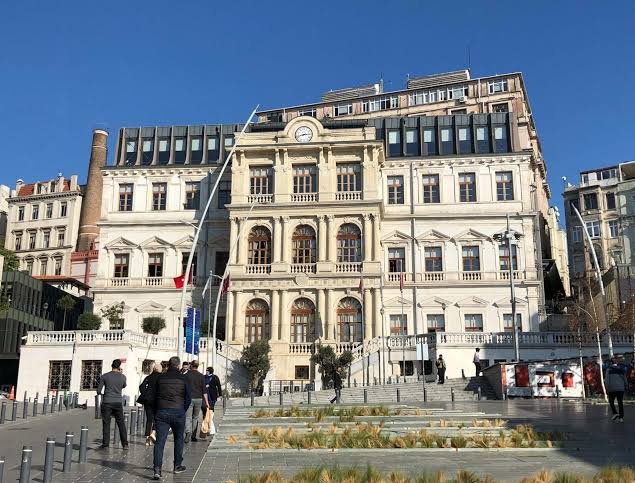
6th Municipal Department (“Altıncı Daire-i Belediye” in Ottoman Turkish) was the first western-style municipality of Istanbul. It was formed to serve the 6th of the 14 districts of Istanbul – namely, Galata and Pera. During the first term of Edouard Blacque Bey – who was the head of the 6th Department from 1876 to 1890, and from 1893 to 1895 – it was decided to build a modern municipality building. It is this white building, which was designed by Italian architect Giovanni Barborini and opened doors in 1890. Until the formation of Beyoğlu Municipality in 1924, it was called as 6th Municipal Department.
The building, with its neoclassical style façade, overlooks the Golden Horn and the historic peninsula.
After the Crimean War (1853-56), a need appeared for the establishment of a new, modern local administrative authority in order to bring order into the city’s disrupted public services. A commission formed for the purpose reviewed municipal practices in the European capitals and drafted a regulation. As a result, Istanbul was divided into 14 municipal districts – following the examples of Imperial Rome and the Byzantine Constantinople. Although Beyoğlu would be the first district to implement the new practices, it was called “6th Department” after the 6th Arrondissement of Paris, the most developed district of Paris. As the commerce and finance center of Istanbul, and as a district with valuable properties and affluent foreigner and non-Muslim Ottoman residents, the 6th District was in need of development.
The mission of the 6th Department was to introduce European-style public services and urban development arrangements in the region. As a division that operated directly under the Grand Vizier’s office, the 6th Department was endowed with the powers of a Ministry of Development.The Department started putting plans into motion from 1857 onwards.
One of the first acts of the 6th Department was to produce cadastral maps and parcelation plans of Beyoğlu and Galata. Accordingly, street signs and building numbers were placed. A tender was held in 1859 for the cleaning of the streets. The streets were divided into 3 classes: First class streets were to be swept every day while the third class streets once a week. Of course, westernized elite neighborhoods of Beyoğlu received the best treatment. Public parks for recreational use were created at Taksim and Tepebaşı; and the İstiklal Street was paved. Following the draft of a city plan, the roads were enlarged, old buildings were demolished, the streets were paved, and the sewage network was completed.
During the 1870s, Cadde-i Kebir – today’s İstiklal Street – became the first street to be lined with street lamps, powered by gas from the Dolmabahçe Gasworks. Then, the gas-powered street lights spread to other regions such as Galata, Pera, Yüksek Kaldırım, Pangaltı, Fındıklı, Tophane-i Amire, Talimhane, and Saraçhane.
In 1869, a permit was granted to Konstantin Karapano Efendi to operate horse-drawn trams. The first tram line was opened in 1871 between Azapkapı-Beşiktaş; and the Karaköy-Şişli line followed in 1883.
During the Republic era, the historic and symbolic building was used as the district governorate until 1960s; then, it was re-assigned as the regional directorate of the Istanbul Municipality. In 1984, Beyoğlu region, covering 45 neighborhoods, was reincorporated as a district municipality, and the building was assigned to the newly established Beyoğlu Municipality. When “modern additions” were made on both sides and at the top floor of the building during a controversial restoration in 2014, criticism came from academic circles that the building had lost its original character.
“Go Tell It To Marko Pasha!”
The old Turkish adage of “Go tell it to Marko Pasha” takes its source from Dr. Markos Apostolidis Pitsiotis, the private doctor of Sultan Abdülaziz and Sultan Abdülhamid. His house was on Kabristan Sokak in Şişhane. Markos Apostolidis Pitsiotis (1824 -1888) was also the commander of Mekteb-î Tıbbiye-î Şâhâne (the Imperial Medical School at Gülhane), and he was the first physician to rise to the rank of mirliva (brigadier general) in the Ottoman Army. For this reason, he was referred to with the title “Paşa” (Pasha). In 1877, he co-founded the Red Crescent (Hilâl-i Ahmer Cemiyeti, or today’s Kızılay) with Aziz Bey of Crimea, and became the first chairman of this institution. For his time, Marko Pasha was very knowledgeable and experienced in surgery and medicinal plants He had three children (Arjeta, Yorgo, and Marika).
As for the roots of the famous adage “Go tell it to Marko Pasha…” Being a mild-mannered, patient doctor, administrator, and a member of the Senate (elected in 1877), Marko Pasha had to accept many visitors every day and listen to their problems. He would listen, or at least pretend to listen, the complaints and demands of the teachers, students, and even of those who had no connection with him but merely encouraged by his fatherly look. Once a visitor finished telling his problem, Marko Pasha would pause a moment and ask with his typical Greek accent: “Yes I see, but what (about it)?” The visitor would tell his problem once more, in greater detail, only to get the same, calmly expressed response: “Yes I see, but what?” The visitor, exhausted from telling his story, would helplessly leave, seeing that the Pasha wouldn’t provide him with a solution. If a visitor turns out to be more stubborn than Marko Pasha, then he would call his right hand and first secretary Muhtar Efendi and whisper into his ear: “Dear Efendi, please invent something to write and send him away.” And sometimes he would pretend not understanding, and ask in Greek to a person next to him: “Ti lei?”
According to Despina Anats, his granddaughter, Marko Pasha would even use his famous “Yes I see, but what?” to stall off the Ottoman Greeks who came to him with complaints about Young Turks.
Once the Pasha’s notorious behavior was heard amongst the people, “go tell it to Marko Pasha” came to be used as an expression to avert somebody, as if to say “that’s all I can do.” According to writer Said Duhani, the adage meant, “Tell your complaints – or expectations – to the walls.” A more dramatic example of Marko Pasha’s refusal to answer the demands of those who appeal to him had presented itself during the reign of Sultan Abdülaziz, when he was the imperial head physician. Marko Pasha, an unmatched physician with uncompromised work ethic, was summoned to the palace by Grand Vizier Hüseyin Avni Pasha in the aftermath of Abdülaziz’s dethronement and execution. The late emperor was murdered by cutting both of his wrists, and Marko Pasha was asked to write and sign a forensic report to attest a suicide, without even touching Abdülaziz’s corpse. Marko Pasha was in fact a friend of the Grand Vizier, but he refused writing such a report. The putschists then went to find another doctor who could be persuaded to arrange a suicide report for the murder. After the accession of Abdülhamid to the throne, Marko Pasha became the private doctor of the new Sultan too. Marko Pasha died at the age of 64, and his grave is in Kuzguncuk Greek Cemetery. In a time when ideas of freedom was spreading amongst the students, the Medical School students gathered at an evening roll-call and shout at once “Padişahım alaşağı” (“Down with the Sultan”), instead of the customary triple “Padişahım çok yaşa” (“Long live the Sultan”). Hearing this, the alarmed class supervisors appeared before Marko Pasha the next day in order to inform him. But had he ever really listened to someone’s problem? He summoned the students, and a group of student representatives came to his presence. The students defended themselves: “Dear Pasha, you studied physics. As you know, the sound echoes between four walls, which distort the words. We shouted ‘long live,’ but the class supervisors were standing afar, and in accordance with the rules of physics, our shout must have reached to their ears as ‘down with’.”
Satisfied with this explanation, Marko Pasha turned to the supervisors and said: “The students are right; this is what the rules of physics and science dictate.” But the Pasha was nobody’s fool: after the supervisors left, he turned this time to the students and said: “Yes I see, the sound echoes. But what?”(*)
Furniture Was Their Business: Psalty Family
As the number of new apartments in Galata was rapidly expanding during the second half of the 19th century, the demand for furniture has also increased. Many stores selling imported European furniture were opened to meet the demand of Istanbuliots. With them, the production and consumption of contemporary furniture in Istanbul started and became widespread. One of the most well-known among them was Maison Psalty, a furniture and accessories store which was founded in 1867 by an Ottoman Greek named Georges Jean (Yanni) Psalty.
Psalty, adapting the fashionable designs of European furniture to the taste of Ottoman clientele – or, sometimes directly imitating them – gained considerable reputation among Pera’s wealthy families, as well as in court circles. The main store of Psaltys was located opposite the 6th Municipal Department, on Müellif Sokak (at no.8 on former Kabristan Street). In this store, Psaltys (or Ipsalties, as pronounced by Turks) were selling European brands as their agent, as well as making furniture themselves to order. Especially the “Thonet” chairs, imported from Austria, were very popular. Again imported from Austria, Psalty’s bedroom, dining room and living room sets, secretaries, and cupboards aroused much interest among the wealthy and the court circles.
In the following years, Psaltys opened a branch at 146, Grande Rue de Pera (İstiklal Street), followed by other branches in the region. The company had 30 employees.
Psalty family also gave their name to the lovely passage which connects Küçük Hendek Street to Şahkulu Street. A block in the passage was probably housing one of Psalty’s manufacturing facilities in Istanbul. (Consisting of three blocks and a courtyard, this structure was renovated in 2010, staying as close as possible to its original).
Psaltys also had a building – again, probably used for manufacturing purposes – at 866, Amber Sokak (today Tutsak Sokak) in Galata. In 1932, aging father Psalty handed the business to his son Georgiades (Psalty) Micropoulos, who studied in Paris, specializing in furnishing and interior decoration. After the foundation of the Republic, the company submitted proposals for government tenders. In 1941, they won the contract for the furnishing of the State Airlines Administration’s head office.
“Psalty Furniture and Decoration Co.” ended furniture production in 1952. During the 50s, however, the second-hand furniture of Maison Psalty gained antique status and were sold at a store named “Dekorasyon” at 353, İstiklal Street. Even today, it is possible to come across well-maintained Psalty furniture at antique shops and auctioneers.
Psaltys had also produced furniture for Dolmabahçe Palace, and some examples of both import and own production furniture of Psalties (the latter bearing the label “Maison Psalty-Constantinople”) can be seen by visitors in Room No. 51 of the Palace.
Poet İlhan Berk says that Georgiades (Psalty) Micropoulos had ruled over Müellif Sokak like a feudal lord ruling over his lands, and he gives the following description about him:
“In a photograph of him, Psalty is tall, with thin eyebrows on an oblong, slender face. He is dressed as a European (otherwise is unimaginable) – ruffs starched, holding a cane. He has a dark beard, a small chin, and a small mouth. As reported by somebody who had talked with him, he was skipping ‘r’s altogether. His left eye was continuously twitching. And like all carefree Levantines, he was daydreaming a lot.”
Part of these themes: Architects and apartment buildings
Source: Akdoğan Özkan, A Traveler’s Guide to Galata (Nar Turizm, 2016), translated by Volkan Ersoy. Obvious misprints in the printed edition have been corrected.
Last updated: · Last checked: (address and map position)
Spotted a mistake or something missing on this page? Suggest a correction