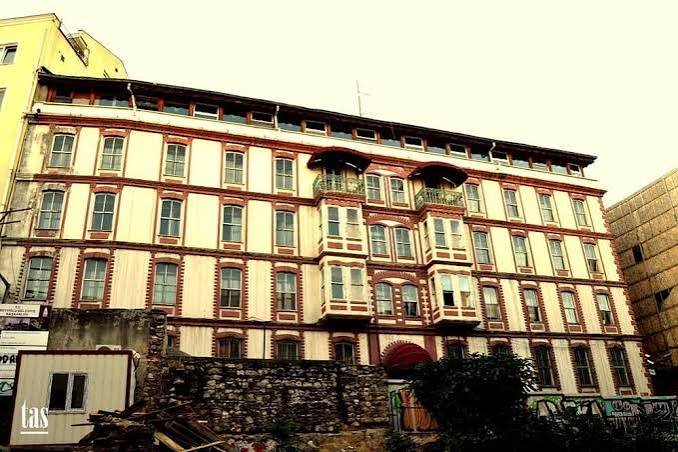
Barnathan Apartments were once one of the most elite residence buildings in the Galata region. Stretching along the left hand side of the Tımarcı Sokak (former Cerrahpaşa Sokağı), it was one of the first examples of apartment-type residences constructed in Galata during late 19th century. The architect is Charles Maruletto, whose title was shown on the plan drawings as “ingénieur.” The construction started in the 1880s and continued until 1893. Unlike Doğan Apartments, it didn’t have a large courtyard with a view of the Marmara Sea, and hence, it didn’t become as popular.
By the left side of the first entrance door is written “5652” in Hebrew calendar, and “1892” in Gregorian calendar on the right side. Similarly, the door to the second block bears the dates “5654” and “1894” on its left and right sides, respectively. The third block turns towards the Şahkulu Çıkmazı (cul-de-sac) and it was constructed after 1896.
As the name suggests, these residence blocks belonged to the Barnathan family for long years. As they were constructed for the purpose of renting, the family didn’t live here and continued their life mostly in Kadıköy and Moda.
As told by Cesar Alfredo Barnathan, a member of the family who was forced to leave Istanbul years ago and who is living in Buenos Aires now, “Barnathan” means “Daughter of the Prophet Natan” in Hebrew.
The origins of the family can be traced back to the Sephardic Jews who left Spain for the Ottoman Empire in 1492. The family members in Istanbul were mostly occupied in commerce, and they had strong international connections. Nissim Barnathan (1827-1907), who was considered to be the elder of the family, was a banker and the owner of the Barnathan Han in Eminönü. Some family members were in the cigarette rolling paper business. Again from the same family, Albert, Samuel and Fanny lost their lives in the Auschwitz Nazi concentration camps in 1944. According to the surviving family members, a large part of the Barnathan family immigrated just before the World War I to Brazil or to the USA, while some members settled in France. Some others left Turkey during the late 1920s. By this time the apartments should have changed hands, because they are referred to as “Appartements Vlahioti Antoine” in the trade directories of 1921.
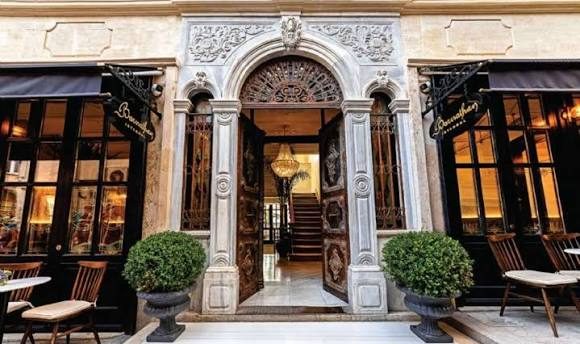
On an inheritance document from 1968, the name of the apartments was shown as “Hamit Bey Apartmanı,” while an earthquake insurance policy from 2003 names it as “Halil Hamit Apartmanı.” The second block was named as “Demir Apartmanı” during a later time period. From the Barnathans, only the inscription “Barnathan Han” remained above the second entrance.
At the time of construction, Galip Dede Street was a part of Rue de Pera (today’s İstiklal Street), which means, the façade of the building was overlooking one of the most important streets of Istanbul. For this reason, the façade is more elaborate in design compared to other wings. The balconies are in classic “French balcony” style, and unlike other apartments, they are not supported by concrete corbels.
In 1892, when there was only the first block, only 8 people were living in the apartment. The first tenants were rather from the new middle class of the time: Levantine bank clerks and tradesmen, non-Muslim bankers, doctors, employees of the Ottoman Bank, goldsmiths, glass merchants, and professionals who work for the newly founded “Chemins de fer Orientaux” (i.e. the railway company operating between Vienna and Istanbul).
At the time, living in an apartment had some passing resemblance to the Western life-style. The locals would continue to live in their own wooden frame mansions for a long time.
Today
The building was bought and restored by Nar Yatırım in 2011. Today it houses Meroddi Barnathan Hotel. Barnathan Garden is in the garden on the ground floor and Barnathan Roof on the terrace floor: the Garden serves a buffet breakfast in the mornings and has live music every evening except Monday; from the Roof the Galata Tower, the Golden Horn and the Bosphorus can be seen together.
Articles on Barnathan
From Çiğdem Oğuz’s study “Barnathan Apartments”:
- Where Does the Barnathan Name Come From?
- The Architectural Characteristics of the Barnathan Apartments
- The Barnathan Apartments: From the First Residents to the Present
- Apartments in Galata
Part of these themes: Architects and apartment buildings
Source: Akdoğan Özkan, A Traveler’s Guide to Galata (Nar Turizm, 2016), translated by Volkan Ersoy. Obvious misprints in the printed edition have been corrected. The “Today” and “Articles on Barnathan” sections were written for this site.
Last updated:
Spotted a mistake or something missing on this page? Suggest a correction