Camondo family was one of the wealthiest Sephardic Jew families of Istanbul, and they made considerable contribution to the modernization of the city. They had many properties around Galata. Although they were being listed amongst the leading Jewish banker families of the 19th century Europe, they owed most of their influence to building a real estate empire around Galata. In 1881, there were more than 170-180 shops, banks and offices paying rent to Camondos – and, of course, depositing the rent to Camondos’ own bank.
The real estate registers from 1874 and 1881 lists the hans (commercial buildings) owned by the Camondos in Istanbul: Saatçi Han (Perşembe Pazarı Sokak), Lacivert Han (Zülfaris Sokak), İbret Han (Söğüt Sokak), Latif Han (Söğüt Sokak), Dilber Han (Karaköy Square), Kamondo Han (1 Yorgancılar Sokak), Yakut Han (Mertebani Sokak), Kuyumcular Han (87 Yorgancılar Sokak), Lüleci Han (Sirkeci), and Gül Han (Billur Sokak).
Apart from these hans, Camondos had the following residential properties: an apartment at 2-4-6 Felek Sokak, an apartment at 3-5 Polonya Sokak, 10 houses at 17 to 35 Hoca Ali Sokak, a house at 5 Mertebani Sokak, houses at 2-4-6-8 Mertebani Sokak, a house at 5 Kamondo Sokak, an apartment at 16 Hacı Ali Sokak, an apartment at 42 Yazıcı Sokak, a large residence at Yemenici and Kabristan Sokak, a house at 13 Glavani Sokak, an apartment at 6 Nane Sokak, a house at 9 Keklik Sokak, a house at 41 Köybaşı Sokak in Yeniköy, and a house at 5 Söğütlü Sokak in Büyükdere.
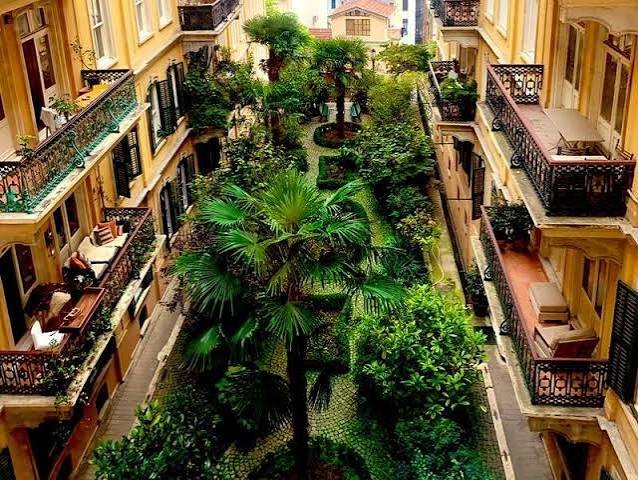
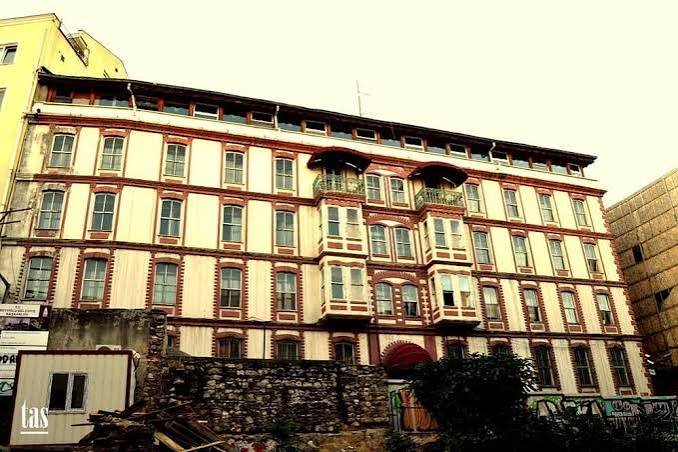
Camondo Han is probably the most famous one amongst the still-standing ones. The rear wing of the building overlooks Tatar Beyi Sokak.
Camondo Han was built between 1861 and 1868 in neoclassic style and it has a symmetrical plan. An introductory guide at Nissim Camondo Museum in Paris describes the location of the building: “It is adjacent to the Braunstein Apartment, the Doctor Castro Apartment, and the Camondo Residence on three sides, and the fourth side overlooks the Yazıcı Street.” (On the other hand, this building on Serdar-ı Ekrem Street – formerly, Yazıcı Street – should not be confused with the Camondo Han on Galata Yorgancılar Street, which was home to various banks and bankers between 1868 and 1909.)
† The han on Galata Yorgancılar Street, where the Société Générale de l’Empire Ottoman also had its premises between 1881 and 1893, should not be confused with the Camondo Han described here.
The architect of the Camondo Han on Serdar-ı Ekrem Street is unknown, but we know that the offices in it were converted to apartment flats between 1870 and 1876 by Stampa, the trusted architect of Camondos. However, no one from the Camondo family had ever lived in these flats. The Camondos chose Galata only for their real estate and other investments. In fact, they had one foot in France, and some of the important members of the family – especially, Abraham Camondo, who had lost his only son Raphael – had immigrated to Paris during the first half of 1870s.
According to the administrative registers of the building from 1881, ten of the tenants were either European or Levantine, which is not surprising because the population census of 1882 shows that almost half of the inhabitants in Galata were “foreigners.”
Camondos were one of the first among the real estate investors to understand that apartment flats were easier to rent, and generating more rental income, than detached houses. During the late 19th and early 20th century, they converted several office buildings and detached houses to apartment flats in the vicinity. Famous names who lived in these flats included Hantz von der Heyde, the dentist of Sultan Abdülhamit, and Abidin Dino, the well-known Turkish painter. Dino’s large flat/studio was identified with the Camondo Han, and it became a gathering place for many famous writers, poets and artists of the era.
† The architect Gabriel Tedeschi, who lived in Camondo Han from 1889 to 1921, converted the houses at nos. 23, 25, 27 and 29 – two blocks standing in front of the façade of the han that faces Tatarbeyi Sokağı – into apartment flats in 1892-93. Tedeschi also completed the house at 16 Hacı Ali Sokağı so that it contained 16 apartment flats.
† İlhan Berk (1918-2008), one of the great names of Turkish poetry, said of this studio – with its large interconnecting rooms and salons and its long, wide balcony from which the Bosphorus could be seen – that “this was a headquarters of the new writing and the new painting,” and went on: “Of writing above all. The whole of the new Turkish literature ate, drank, slept and woke here. So as not to leave anyone unremembered, we shall content ourselves with naming Abidin Dino, Ahmet Hamdi, Mina Urgan, Halet Çambel, Asaf Halet Çelebi, Sait Faik, Yaşar Kemal, Güzin Dino, Nail V., Bedri Rahmi, Arif Kaptan, Fikret Adil, Yusuf Ahıskalı, Orhan Veli, Oktay Rıfat, Melih Cevdet and Cahit Irgat.”
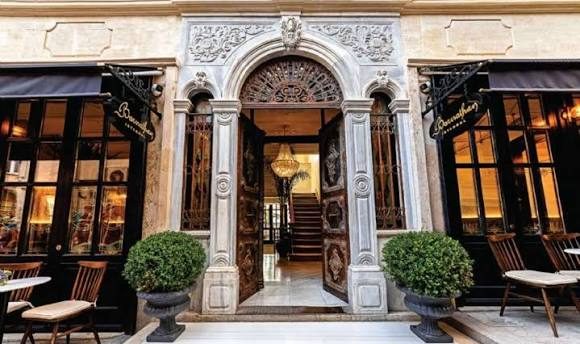
From 2000s, a new, bourgeois character was breathed into the already architecturally pleasant buildings on Serdar-ı Ekrem Street (formerly, Yazıcı Sokak). The investors were chasing after the spirit of the old times. The value created by this transformation made the street one of the trendiest locations in the city. Once home to bankers, insurance brokers and lawyers, the street is now lined with the stores and studios of the famous Turkish fashion designers, boutique hotels with historical pasts, and colorful café-restaurants.
† Today the street is home to the shops and studios of fashion designers such as Bahar Korçan, Arzu Kaprol and Çiğdem Akın, and to boutique hotels in historic buildings such as Meroddi Galata Mansion and Georges Hotel.
Part of these themes: Banks and hans · Architects and apartment buildings
Source: Akdoğan Özkan, A Traveler’s Guide to Galata (Nar Turizm, 2016), translated by Volkan Ersoy. Obvious misprints in the printed edition have been corrected. Paragraphs marked † appear only in the 2017 Turkish edition of the book (Galata Gezi Rehberi) and were translated for this site.
Last updated: · Last checked: (address and map position)
Spotted a mistake or something missing on this page? Suggest a correction