As mentioned before, the first property bought by the Prussian embassy in the Galata/Pera region was a lot with an old Turkish mansion on it, near the Galata Dervish Lodge. However, the Prussians later decided to build their embassy building in Ayazpaşa. After the fire of 1870, the old mansion was used for a while as a German nursery school (or crèche), and then it was demolished, except for one of its annexes. The Prussian ambassador wanted to sell the lot but the Ottoman Empire was in economic crisis, and nobody showed interest.
Then, Sultan Abdülhamit II gave a lot in Tarabya as a gift to the Prussian Emperor Wilhelm I, and the Prussians wanted to build a summer residence there. The construction was commissioned in 1885 to a British contractor, “Constantinople Land & Building Company Ltd.” The contractor agreed to build the summer residence in return for the old lot in Galata, in addition to a payment of 60,750 Mark.
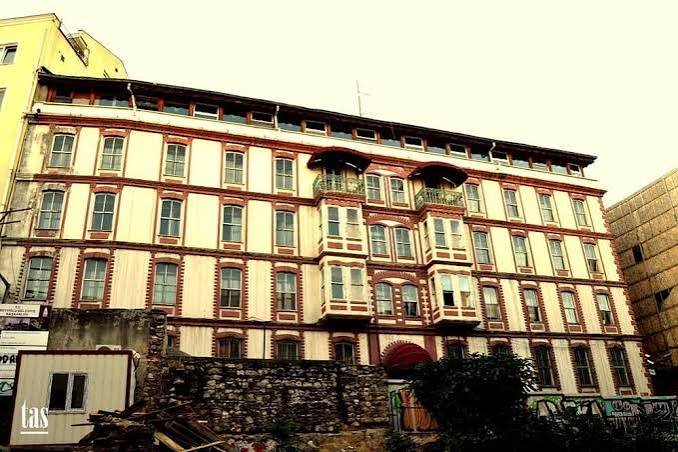
Due to the lack of evidence, it is unknown on whose name the purchasing was made, but after years of remaining empty, a spectacular apartment was built on the lot between 1892 and 1894 by Albert Helbig, a Belgian banker. The architect of the building – which would be known as Doğan Apartments years later – is unknown. However, Helbig at the time was living in Rue Misk (a side street of Grand Rue de Pera, or today’s İstiklal Street), and the architect Serkis Balyan (1835-1899) was his neighbor. For this reason, it would not be unlikely that the building was designed by Balyan.
Comprised of 45 flats, the building was designed as a rental residence for the elites, foreigners, Levantines, and wealthy Jews and Greeks. As the building belonged to the Helbig family until 1919, it was referred to as Helbig Apartments or Nahid Bey Apartments in real estate registers. A 1910-dated postcard shows the address as “Rue Yazidji Apartments, Helbig.”
Following the Ottoman Empire’s defeat in the World War I and the occupation of Istanbul in 1918, many citizens of German origin were forced to leave the city. As the owner died in the mean time, the building and its lot was auctioned off in 1919 by the Istanbul Execution Office to Mair de Botton, a businessman of Ottoman origin. Its name was now changed to Botton Han. During the time, mostly Greeks and Jews of Germany origin were living in this neighborhood. It continued to be an elite neighborhood until the beginning of 1930s.
The flats of the apartment were rented by many small shops and businesses. However, the building was mortgaged, and when Buttons could not pay their debt, it was sold again in 1929 to the Berlin-based Victoria Insurance Company. Now, its name was Victoria Han.
In 1942, the building was sold to Doğan Insurance Company, which was owned by Kazım Taşkent, the founder of Yapı Kredi Bank. Taşkent names the building after his son, who had died in an accident in the Alps at the beginning of 1940s. The building was now called as “Doğan Apartments.” Between 1950s and 70s, the flats in the apartment were sold one by one and made private residences. In 1985, there were 45 property owners in Doğan Apartments.
† What Taşkent had actually wanted was to turn the building into a hospital, but this wish was never fulfilled.
Doğan Apartments represent the beginning of the transition from detached houses to apartment flats in Beyoğlu. From early 2000s, the flats attracted the attention of middle-high classes, and begun to be occupied by younger generations with high living standards.
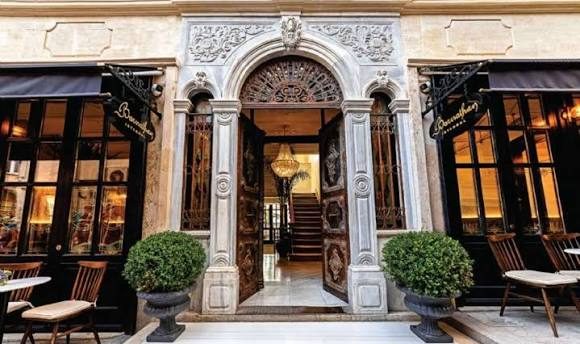
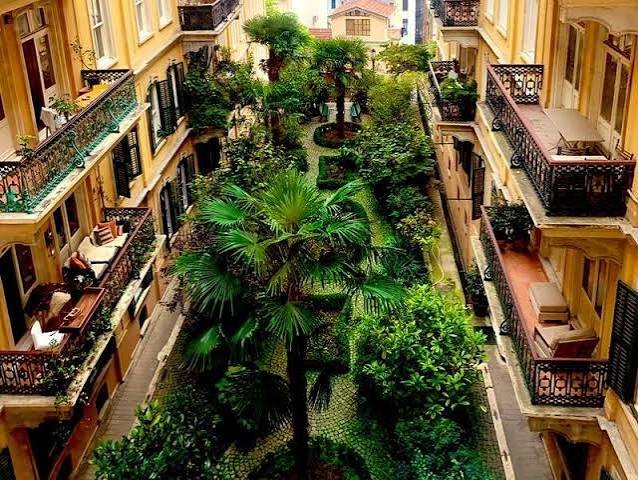
In 2003, the façade underwent a comprehensive renovation. The entrance of the building opens to a 330 sqm inner courtyard. The building, composed of four blocks, surrounds the courtyard from three sides, and the long northern wing protects the courtyard against the dominant northeast winds of Istanbul. The courtyard has an unparalleled view of the Marmara Sea and Sarayburnu (Seraglio Point). Doğan Apartments is composed of 49 European style flats in sizes between 91 to 196 sqm. Considering its date of construction, they are very comfortable residences. The electricity was connected before the World War I. Each flat has a WC, kitchen, gas and water installations. Each room in the flats has a separate chimney outlet, totaling to 302 outlets.
Part of these themes: Architects and apartment buildings
Source: Akdoğan Özkan, A Traveler’s Guide to Galata (Nar Turizm, 2016), translated by Volkan Ersoy. Paragraphs marked † appear only in the 2017 Turkish edition of the book (Galata Gezi Rehberi) and were translated for this site.
Last updated: · Last checked: (address and map position)
Spotted a mistake or something missing on this page? Suggest a correction