An excerpt from Çiğdem Oğuz’s study “Barnathan Apartments”. The study was prepared in 2014; “today” in the text refers to that date.
The First Residents and Neighbors of Barnathan Apartments
Who were the first residents of the Barnathan Apartments? The two blocks were constructed respectively; therefore the first residents of the apartment were only eight people. The apartments, as mentioned before, were built to provide an income for the owners. All the residents were tenants who were working around Galata. While the local people already had their own estates, living in an apartment reflects a more temporary settlement and more modern way of life. Therefore the first residents were those who work in the new financial centers of Galata or Levantines who deal with commerce, the bankers, and the employees of the contemporary Chemins de fer Orientaux. In 1892, the date when the first block was completed, we see only eight residents were registered.
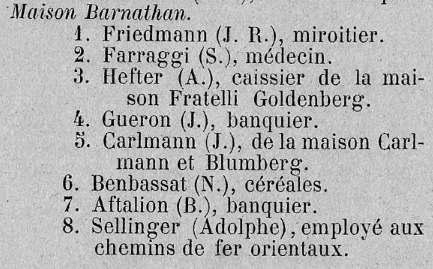
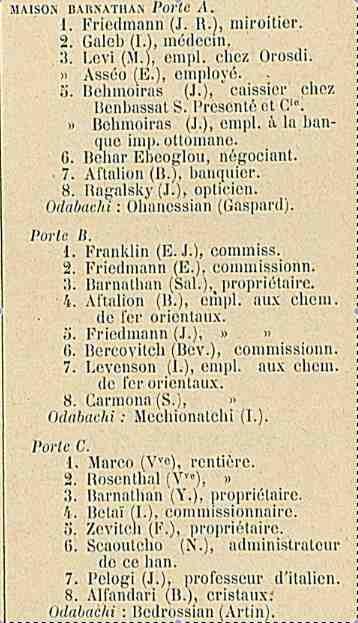
It is possible to argue that these employees from different institutions constituted the new middle class of the Ottoman Empire. The employees of the Ottoman Bank, doctors, moneychangers and merchants were among the first residents. All these residents were either Levantines or non-Muslim Ottomans. Although they were tenants in the building, they lived there for quite long. Also there were housekeepers in each block. On the records it is possible to see two Barnathans registered as property owners starting from 1898. In that year, the construction of all the blocks was completed.
Back at the time in Cerrahpaşa Alley there were cafes, wine houses along with shoe shops and tailors. In the opposite of this alley, there were traditional carpenter’s shops, which gave the name to the alley. As indicated on the map, there was a coal store in the part where Pera Street went along. The entrance floors of the apartments were designed as stores and shops. According to this map of 1906, there were a woodshed and a wine house on the Cerrahpaşa (Tımarcı Sokak) part.
The map indicates small row houses going through all along the Pera street.
The neighbor apartments in the area were built relatively later than the Barnathan. For instance there were the Apartments of Mehmed Bey and Apartments Robert in the same alley. The one in the opposite of Barnathan building was constructed in 1907, in the map of 1906 shows this place as a burned house.
Barnathan from Past to Present
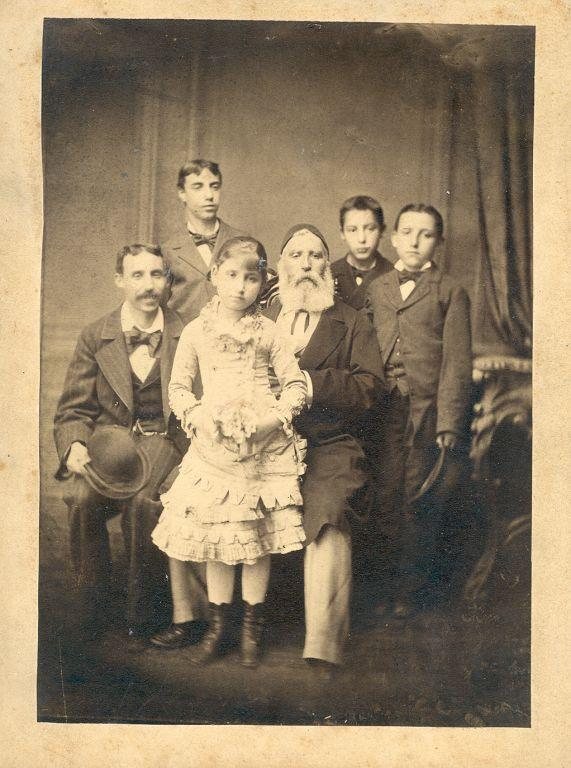
The changing ethnic structure of Beyoğlu was reflected to the Barnathan Apartments as well. The apartment, which was originally a property of a Jewish family, had different owners in time. The non-Muslim residents of the apartment moved away consequently. Some lines of the big Barnathan family left the country in the beginning of the First World War. The other ones stayed until 1920s. We assume that the shares of the Barnathan Apartments were divided between different holders during the war years. These holders were either Jewish or Greek. According to the annual commerce records of the year 1921, the apartments were recorded as “Appartements Vlahioti Antoine”. The former record of the annuals was published in 1913 and the name of the apartments was still Barnathan in that year. Therefore, in these seven years, it is possible that the property was transferred into someone else. Once we assemble the evidences, the name Vlahioti Antoine and the last known heir of the apartment, Eleni the daughter of Diyonis, might be related. Cumhuriyet newspaper on March 26, 1935 mentioned a factory owner, Diyonis A. Vilahioti who ran away from Turkey due to his debts.
According to the land registers of the Barnathan property, two lawyers, Halil Arda and Hamit Karaorman, started to buy the shares of the apartment in 1930s from various people. The first sale dates back to 1932. There were 24 shares when they started to invest in here. The existence of multiple shares might be a consequence of various marriage and inheritance reasons. In the land registers we see that Konstantinos Siskidi owned many of the shares. Apparently he was a founder member of the Ship Agency Organization. Another name on the registers was Dimitri Voridis. Since the sales of the shares were done before the presence of these two names, we can assume that they were related from the previous family ties. The remaining shares were sold through auction and court action. The ones who testified for these sales were the Turkish tenants lived in the apartment.
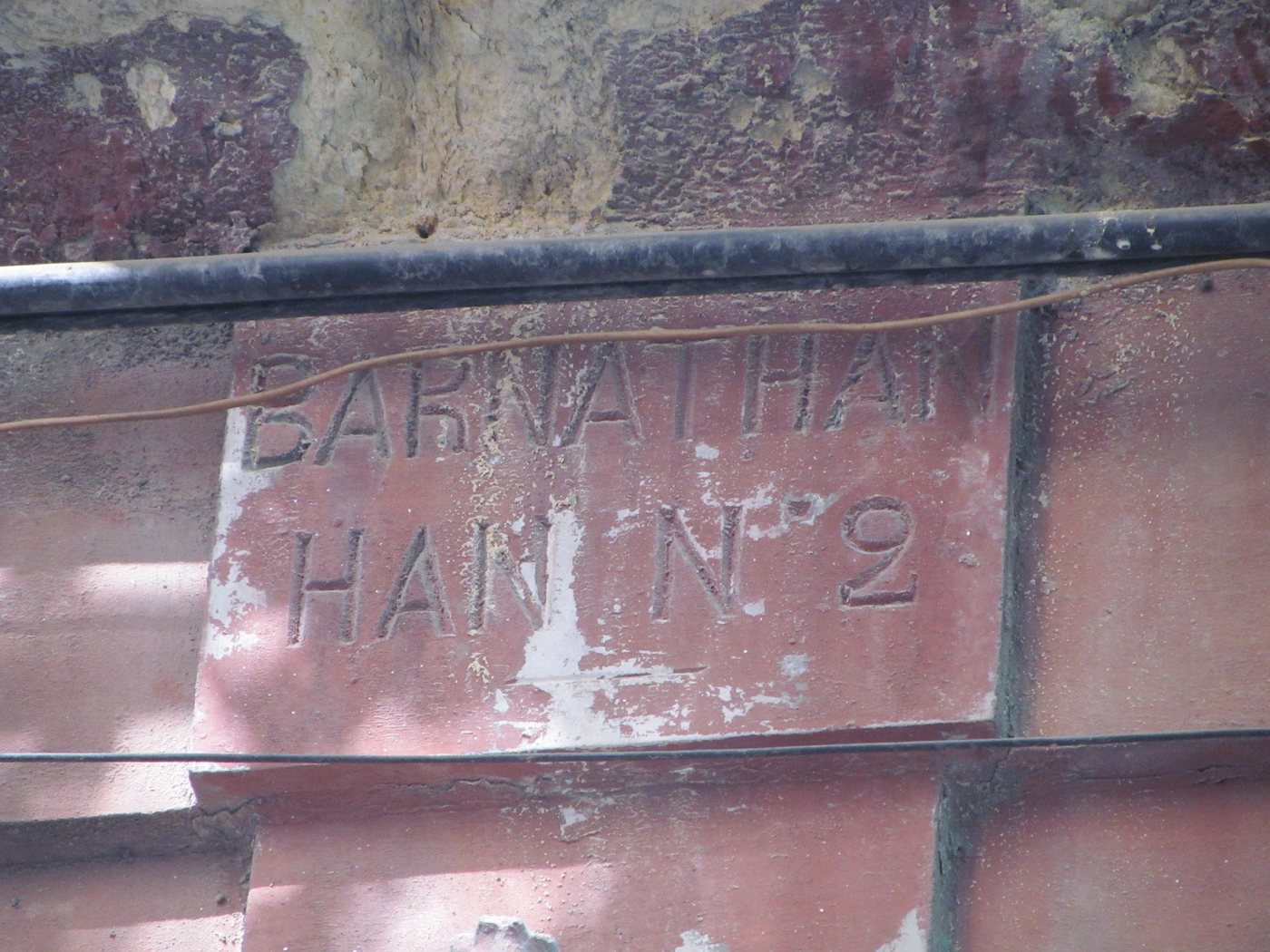
Hamit and Halil Bey bought some other shares through endowments and court action until 1960s. In the end there were 30 shares, which 15 belonged to Hamit Karaorman, and 14 to Halil Ethem Arda. Only one share remained unsold, the share of Eleni the daughter of T. Diyonis. As a consequence of this, beginning from the 60s the apartment was known as Halil Hamit Apartments. While an inheritance document in 1968 the property was referred only as Hamit Apartments, according to 2003 Earthquake Insurance it was “Halil Hamit Apartmanı”. The second block, relatively in a later period, was known as Demir Apartment. The only sign left from the name Barnathan is the engraved “Barnathan Han” inscription on the second gate.
The tenants of the apartments were from different ethnic origins until 1960s. We made an interview with Günel Hanım, who lived in the apartment for 65 years as a tenant. Günel Hanım’s parents got married in 1940s and rented a flat in Barnathan Apartments. She heard that the property originally belonged to Greek people however she recalled Hamit and Halil Bey more than the previous owners. She told that the old tenants were more permanent while the owners were not living in the apartment. The tenants were handing the amount of the rent to the housekeepers who were residing in the entrance flat. Fifty years ago the tenants were mainly from Jewish and Greek origins. Günel Hanım witnessed to the Events of 6-7 September 1955 when a group of looters attacked to non-Muslims and their properties in Beyoğlu with nationalist motives. Günel Hanım remembers those moments when they were plundering the goods of non-Muslim’s shops on the streets. She added that there was the Greek owner of the grocery shop in the opposite who sheltered in their flat. The Events of 6-7 September 1955 constituted a reason for non-Muslims to immigrate other countries. However, especially the year 1964 marked the turning point for immigration from Galata and Beyoğlu. In 1930s there was an agreement between Greece and Turkey called “Trade and Sea Transportation Agreement” signed in the atmosphere of Turkish-Greek friendship, allowing Greeks to live in Turkey with their Greek passports. They were almost 12 thousand people who already established connections with the Turkish citizens of Greek origin. Turkey revised the agreement during the Cyprus crisis and deported them. Many Greeks who were Turkish citizens left the country together with them, in a total amount of 30 thousand people, since they had relatives and family members among the deported. Günel Hanım told that all of her Greek neighbors left the apartment during this period.
After the death of Halil Bey in 1966 and Hamit Bey in 1967 the apartments were divided between seven heirs. The tenants continued to reside in the apartment. Some of the flats were used as offices while the ground floors were used as shops by carpenters, smiths, chipboard workshops and stationers. In 1930s there was a cinema next to the apartments.
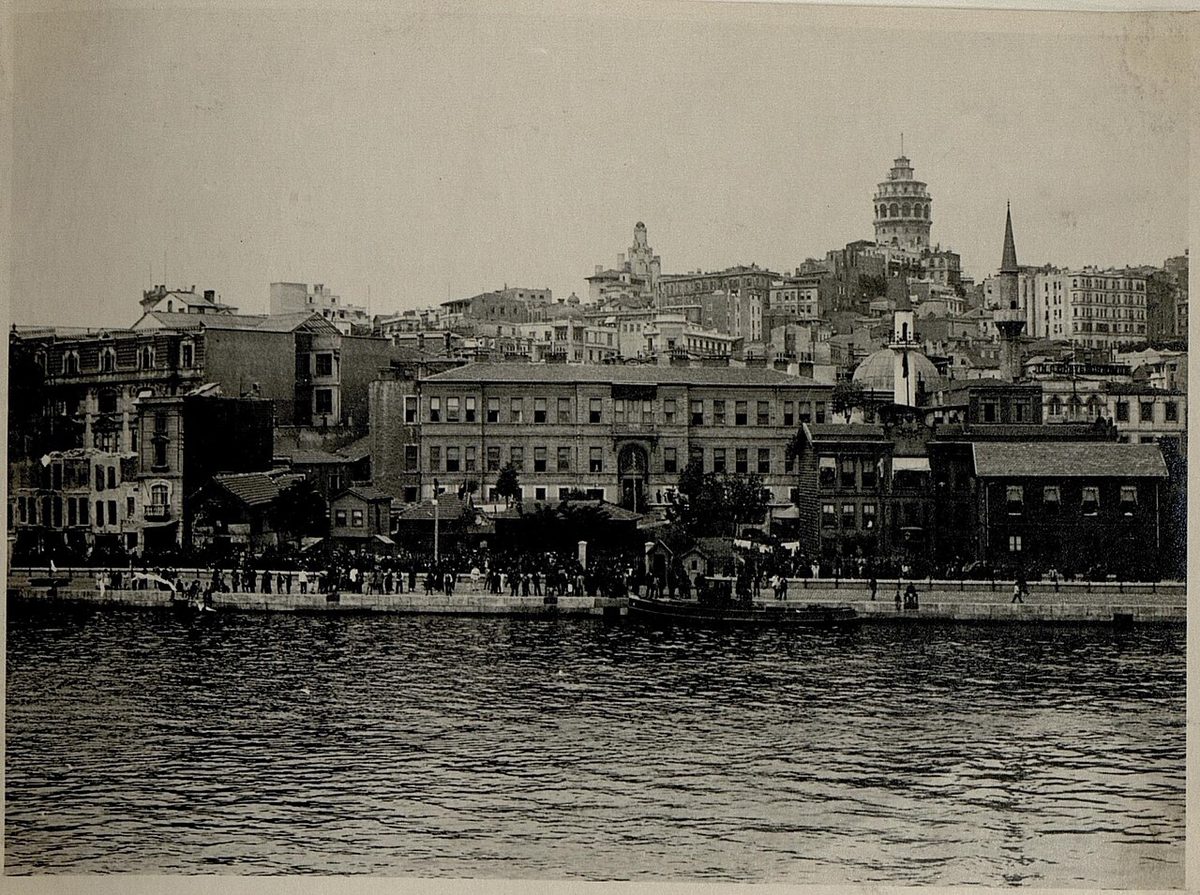
The Barnathan Apartments is a monumental building which have witnessed 120 years history of Galata and Beyoğlu. Through the stories of owners, residents and neighbors, one can follow the transformation of Beyoğlu with regard to property, life styles and architecture.
Sources
- Annuaire Oriental du Commerce 1921, SALT Arşiv, AAO014.
- Cumhuriyet, 30 May 1933.
Related pages
- Where Does the Barnathan Name Come From?
- The Architectural Characteristics of the Barnathan Apartments
- Apartments in Galata
- Barnathan Apartments
- Meroddi Barnathan Hotel
- Barnathan Garden
- Barnathan Roof
Source: Çiğdem Oğuz, “Barnathan Apartments”. Published with the author’s permission.
Last updated:
Spotted a mistake or something missing on this page? Suggest a correction