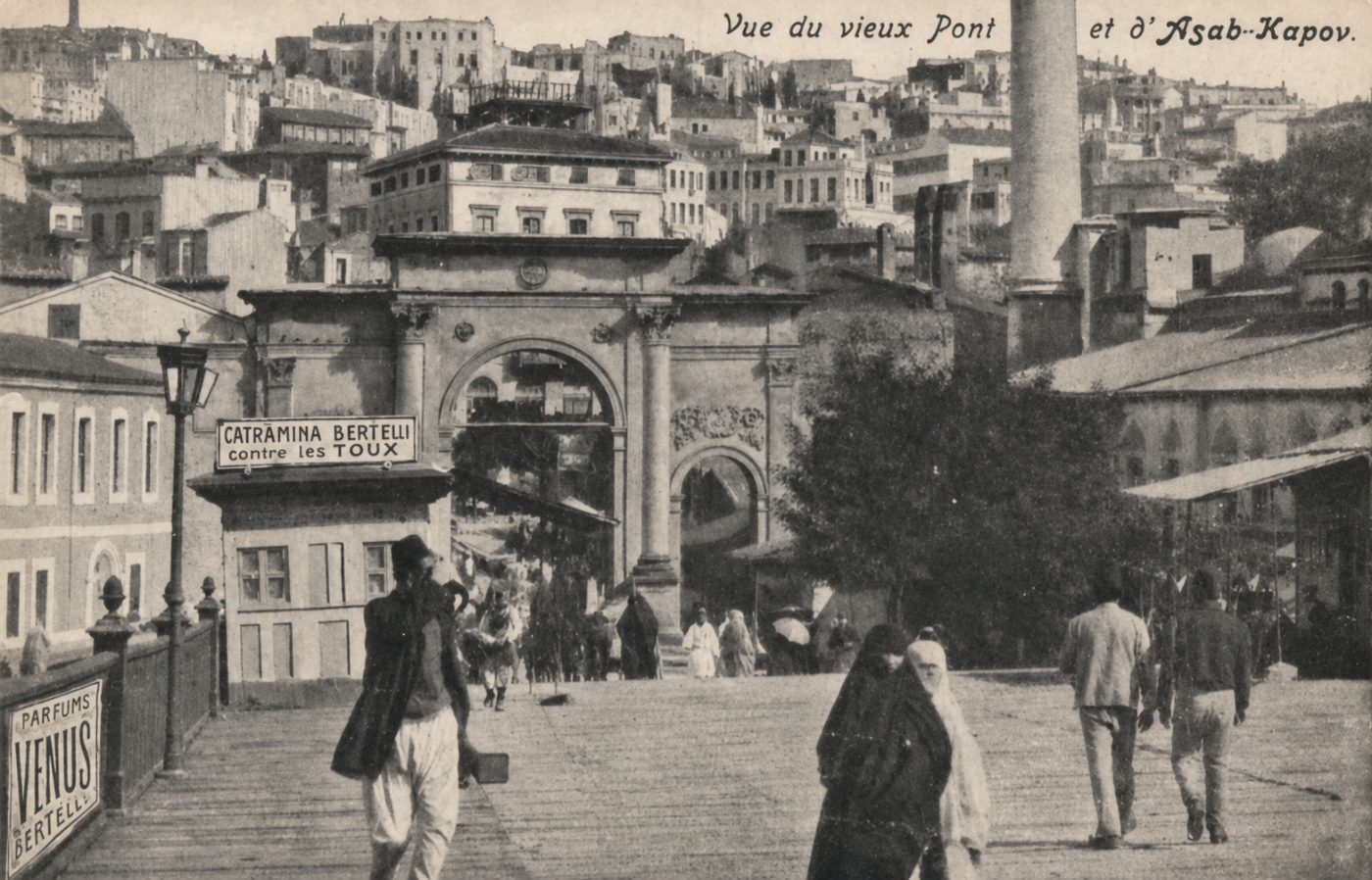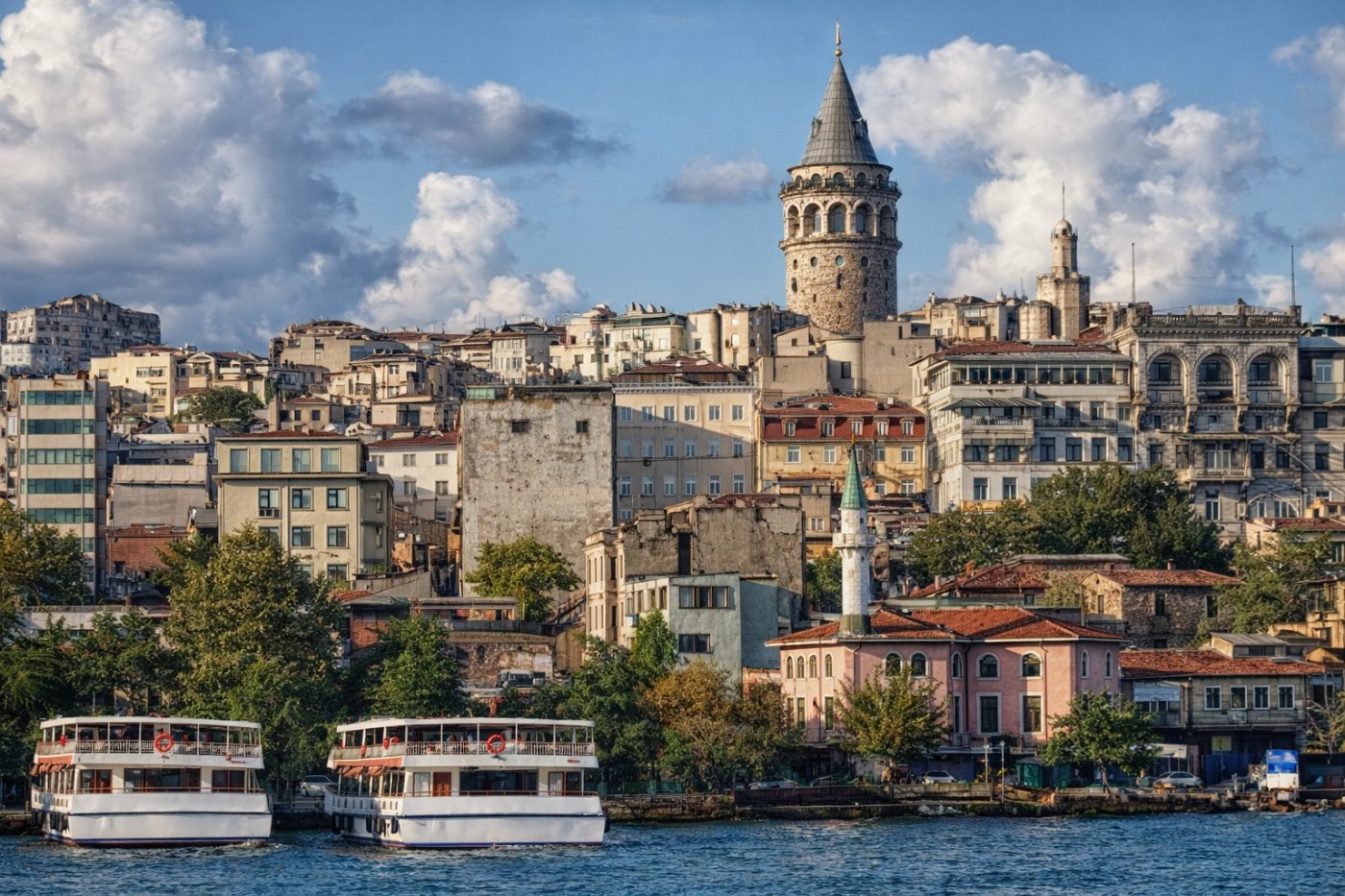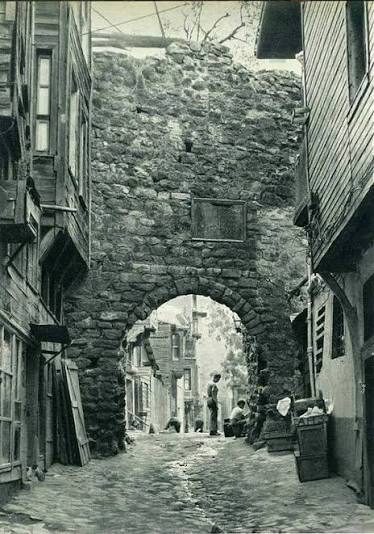
As mentioned before, most of Galata’s walls were demolished during the development project of 1864, and only a few sections have survived until today. One of them is Harup/Harip Gate, which was previously on outer walls but later became an inner gate because of the expansion of Genoese settlements during the era. Once located about 80m northeast of the Inner Azap Gate on the same inner wall line, Harup Gate is somewhat still standing today. To see the 14th century inscription, walk down Emekyemez Sokak until it intersects with Mürver Sokak. Walk through the Gate towards the Haliç–Şişhane subway route, that is passing as close as 10m to this gate. Above the gate is an inscription, believed to be of the Doria and De Merude (or Merodi) families, which once ruled Galata. For protection, the Chamber of Architects installed a steel grid on the inscription after it was damaged by a work machine in 2005.
† About 190 m southeast of the Harup Gate, where Yanık Kapı Sokak meets Bankalar Street today, there was once another gate called Yanık Kapı (the Burnt Gate). It is said to have taken its name from having been opened to fight a fire that broke out in 1335 – which would make it older even than Galata Tower. Unfortunately, Yanık Kapı has not survived.
† Because the two are often confused, you may find the gate that still stands today with its inscription referred to as Yanık Kapı in various sources.
† Readers of İhsan Oktay Anar’s superb novel “Puslu Kıtalar Atlası” (The Atlas of Misty Continents) will remember Kubelik, the character who secretly gathers the bodies of men strangled around the palace at night and performs autopsies on them. In the novel his house is described as adjoining Yanık Kapı; the gate meant here may in fact be the Harup Gate.
† The etymology of the name Harup or Harip is uncertain. The first question that comes to my mind is whether it could be a corruption of the word “Mağrip” (Maghreb). As is well known, some of the Andalusian Muslims known as Moriscos – most of whom went to northwest Africa after being expelled from the Iberian Peninsula in 1609 – came and settled in Istanbul. These Muslim Arabs had begun migrating to Istanbul after the War of al-Busharrat (the Alpujarras, 1568–1571) that followed the great uprising in Granada, and they settled in Galata. In the Islamic world, and of course in Istanbul, the Moriscos’ homeland was called “Mağrip.” Could the Harip (Harup) Gate have taken its name from these “Maghrebis” living nearby, and the name then evolved into its present form? Perhaps!
Part of these themes: Genoese Galata
Source: Akdoğan Özkan, A Traveler’s Guide to Galata (Nar Turizm, 2016), translated by Volkan Ersoy. Paragraphs marked † appear only in the 2017 Turkish edition of the book (Galata Gezi Rehberi) and were translated for this site.
Last updated: · Last checked: (address and map position)
Spotted a mistake or something missing on this page? Suggest a correction