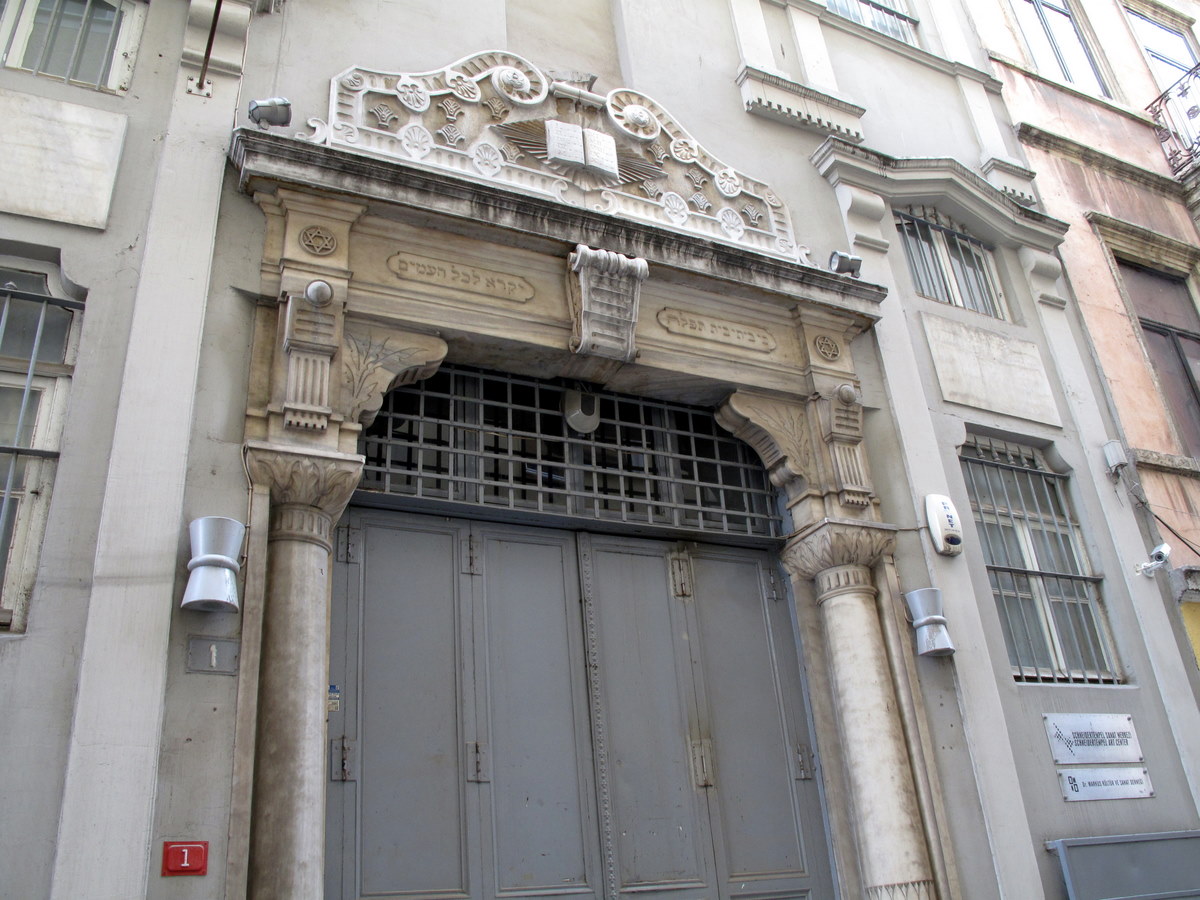
In 1856, the City Planning Council (“İntizam-i Şehir Komisyonu”) was established under Şehremaneti, the first local governing body of Istanbul. This council made many proposals for the development of Galata-Pera region, which was chosen as the pilot project site. From the second half of the 19th century, the region begun to acquire a European look with renewed and gas-lit streets, and new hans and buildings. Abraham-Salamon Camondo, one of the influential members of the council, made a personal contribution to such efforts by having a two-way stairs (in the form of number 8) built up from the Voyvoda (Bankalar) Street.
It is believed that the Camondo Stairs (Eskaleras de Kamondo) were built sometime between 1870 and 1880.
Art nouveau style stairs connect Bankalar Street to Kart Çınar Sokak, and it is one of a kind in the city – and it is even difficult to find a similar one around the world. Maybe a resemblance can be found to the 1910-built Strudlhofstiege stairs in the Alsergrund district of Vienna.
During the mid-1980s, the stairs were renovated, as noted on a plate on one of the landings midway. While the plate gives the names of the contributors to the renovation, it is saddening; to say the least, that there is no mention about Abraham-Salamon Camondo, who was probably the biggest philanthropist of 19th century Istanbul.
† In the 1960s there was a post box belonging to the PTT above the entrance to the stairs on Bankalar Street. It was ideally placed for bank employees who did not want to walk as far as the Karaköy post office with their letters. The plaque, set close to the middle of these historic stairs, is dated 30 September 1985 and reads, in Turkish and in German: “These stairs were repaired by the Municipality of Beyoğlu with the contributions of Demirbank T.A.Ş. and the Austrian High Schools.”
From a Vast Fortune to Extinction: Camondo Family
In the 19th century Ottoman Empire, the major role in the institutionalization and urbanization of finance capital was probably played by Camondos, a Sephardic Jewish family of Portugal origin. Although their name (Ca’mondo/Casa del mondo) means “the house of the world,” they were forced to seek shelter at the four corners of the earth. Fleeing from the Inquisition, the family first settled in Venice, and then in Istanbul. In the 1840s, they became the most prominent bankers of Galata after the Baltacı (Baltazzi) family. Through two generations, Camondo Family left its mark on many fields in Galata, from banks to companies, from educational institutions to public works. They also established a small-scale real estate empire in Istanbul. As social entrepreneurs and philanthropists, Camondos played an important role in the society. In 1869, the grandchildren of the family settled in Paris while their bank was still active in Istanbul.
The family’s most famous personality in the Ottoman realm was Ortaköy-born “grandfather” Abraham Salamon Camondo (1781-1873). Reportedly his father was a common crier, and a leader of the Ortaköy Synagogue.
According to some sources, the Camondos’ branching into finance started in 1802 – or in 1815 to some others – when Isaac Camondo and his bigger brother Abraham Camondo founded their own bank, “Isaac Camondo & Cie.” On Isaac’s death from plague in 1832, his brother Abraham Salomon inherited the bank. He prospered greatly without leaving the helm for thirty years. At the time, bankers of foreign origin were not permitted to directly foreclose the mortgaged real estate properties on the debtor’s failure to repay his debt. However, Camondos overcame this difficulty by having a special permit issued by the Sultan, who was in need of loans because of the burden of the past wars. He granted Abraham Salomon Camondo the right to own real estate “on condition that he will not set an example to others.” He was granted with this right because he was the financier banker to the Ottoman state before the establishment of the Ottoman Bank. Almost throughout the entire Crimean War, his bank financed the Ottoman government.
Camondo Family constructed numerous buildings that left their mark in the modernization of the Ottomans. The most famous of such constructions is the Camondo Steps on Bankalar Street. Other notable buildings constructed by the family include the Headquarters of the Northern Sea Area Command in Kasımpaşa, Galata Residence, Camondo Han on Serdar-ı Ekrem Street, Büyükada Han on Meşrutiyet Street, Saatçi Han in Karaköy, Latif Han, Lacivert Han, Yakut Han, Kuyumcular Han, Lüleci Han, and Gül Han.
The real estate properties of Camondos in Istanbul included 10 hans, 50 shops (some of which were inside these hans), 27 apartments in Galata and Pera (five of which were private residences), and a theater.
During the municipal development projects carried out from 1855 to 1865, the area between Felek and Kürekçiler Streets in Galata was defined as the commercial district of the city. This area - in which Camondos’ 10 commercial buildings (mostly hans) were located - was inhabited by prominent banks.
During that period, all of the six new banks of Istanbul chose Galata for their head office, and four of them were the tenants of Camondos – Credit Lyonnais, Societe Generale de Change et de Valeur, Banque de Constantinople, and Societe Generale de L’Empire Ottoman.
In the second half of the 19th century, the Ottoman government was receiving loans not only from Galatan goldsmiths but also from the foreign banks. In this period, Abraham Behor (1829-1889) and Nissim (1830-1889) – the grandsons of Abraham Salamon Camondo – partnered with the finance circles (mostly from the Greek Orthodox community) to found the Societe Generale de L’Empire Ottoman in 1864.
The Camondos also contributed to the renovation of Istanbul by taking place in the Municipal Commission of 1856. As part of this responsibility, they provided project design support and loans for activities such as street illumination, street and sidewalk pavement, and constructing new commercial buildings within the jurisdiction of the 6th Municipal Department. Also, they participated in the foundation of Şirket-i Hayriye (Istanbul Ferry Company), and founded the first tram company of Istanbul (La Société des Tramways de Constantinople) in 1870 with their Greek Orthodox banking partners such as Zografos and Zarifi.
When they left for Paris in 1869, Abraham Behor was 40, and Nissim was 39 years old. From Paris, they continued to run the bilingual (Turkish and French) school they had built in Hasköy district of Istanbul. Both brothers died in 1889. Their respective sons Isaac (1851-1911) and Moise (1860-1935) would immediately and entirely stop the family’s support for education and philanthropic mission. Instead, the two cousins rose amongst the leading patrons of arts in Paris. As expressed by Nora Şeni, who is known with her comprehensive research on Camondos, Abraham Salamon and Nesim had now “given up on the Orient.”
Abraham Salomon died in Paris at the age of 92, and was buried in the mausoleum built for him in the Hasköy Jewish cemetery, as per his will. The Ottoman government organized a commemorative ceremony on his name. Since their arrival in the Ottoman territory, no other Jew had garnered so much respect.
After the 1970s, his neglected mausoleum has deteriorated into a state of heavy disrepair and received damage due to vandalism, but recently it was restored with the financial support of Istanbul 2010 European Capital of Culture Agency and the efforts of Architect Hayim Beraha.
For Moise Camondo, the family business and properties in Istanbul were “endless trouble.” Instead of dealing with them, he allowed himself to be drawn into the social life in Paris, his trips to St. Moritz and Monte Carlo, and his passion for luxury automobiles. Although he was the wealthiest French real estate baron in Turkey, he wouldn’t mind it at all. In 1908, he took his 16-year old son Nissim for a trip to Istanbul, like a tourist visiting an exotic country. His purpose was to make Nissim familiar with the family properties in Istanbul but their stay in Moise’s summer residence in Tarabya remained their only visit to Turkey. In 1914, with the outbreak of WWI, Nessim enlisted into the French Army. He was killed in an aerial combat in September 1917.
Following the tragic loss of his only son, Moise Camondo largely withdrew from society. In 1935, he donated his home at 63 Rue Manceau, its 18th century furniture and a rich art collection to Paris’s Decorative Arts Society as a museum in honor of the loss of his son. He died the same year.
After the German occupation of France during World War II, his daughter, Béatrice (1894-1943), his son-in-law Léon Reinach and their children, Fanny and Bertrand, deported by the French, died in the Auschwitz concentration camp.
As the Camondo family died out without leaving heirs, their 176 properties in Istanbul were escheated by the National Real Estate Directorate.
† Because the Camondos died without leaving heirs, the lure of the hundreds of properties they had owned in Istanbul was to keep the Istanbul courts busy after 1918 as well. At one point two young Jewish men, claiming to be the illegitimate children of Abraham Camondo, laid claim to the inheritance. Unable to find any other way of verifying the claim, the courts turned to the chief rabbi in Istanbul. The chief rabbi of the day declared: “I knew Abraham Camondo and his family closely; he had no illegitimate children.” In the end the one hundred and seventy-six properties of the Camondo family passed to the National Real Estate Directorate.
† Abraham Camondo was very close to Grand Vizier (Koca) Mustafa Reşit Pasha, one of the leading statesmen of the Tanzimat period. In his book “Galata Bankerleri,” Haydar Kazgan conveys the degree of this closeness by relating an episode that ended with the Pasha’s death. European banks and bankers had made it a condition, if the Ottoman state was to obtain the credit it needed in 1858 by borrowing on the international markets, that the paper money (kaime) in circulation be withdrawn. Camondo, who acted as an intermediary for the state in this loan agreement, handed over to the Treasury for destruction his own kaimes, worth 375 thousand kuruş, in order to set an example to his colleagues – just as Zarifi did. With the credit to be obtained, the short-term claims on the government of the Galata bankers, Camondo among them, were to be settled. Because Grand Vizier Mustafa Reşit Pasha wished to follow the matter closely, he was meeting Abraham Camondo frequently.
† One evening the Pasha returned the visit of the French ambassador, who had called on him to wish him well during his illness the year before. For this purpose he went to the French Embassy in Tarabya. On his way back that evening he called on his concubine, who lived in a waterside mansion in Emirgan. Later, on reaching his own waterside mansion – used today as the Baltalimanı Bone Hospital – he felt the need to go straight to the hamam. When Camondo called at the mansion that evening too, to bring news of the loan negotiations, he was told that the Pasha was in the hamam. Camondo went to the door of the hamam and, while waiting for the Pasha to come out, was suddenly startled by screams. Mustafa Reşit Pasha had suffered a heart attack, collapsed in the hamam and died. Bewildered by the cries of “The Pasha is dead” and worried about the fate of the agreement, Camondo at first cried out “Alas!” But then he began to shout: “He is dead, but he has gone to heaven.”
Then and now
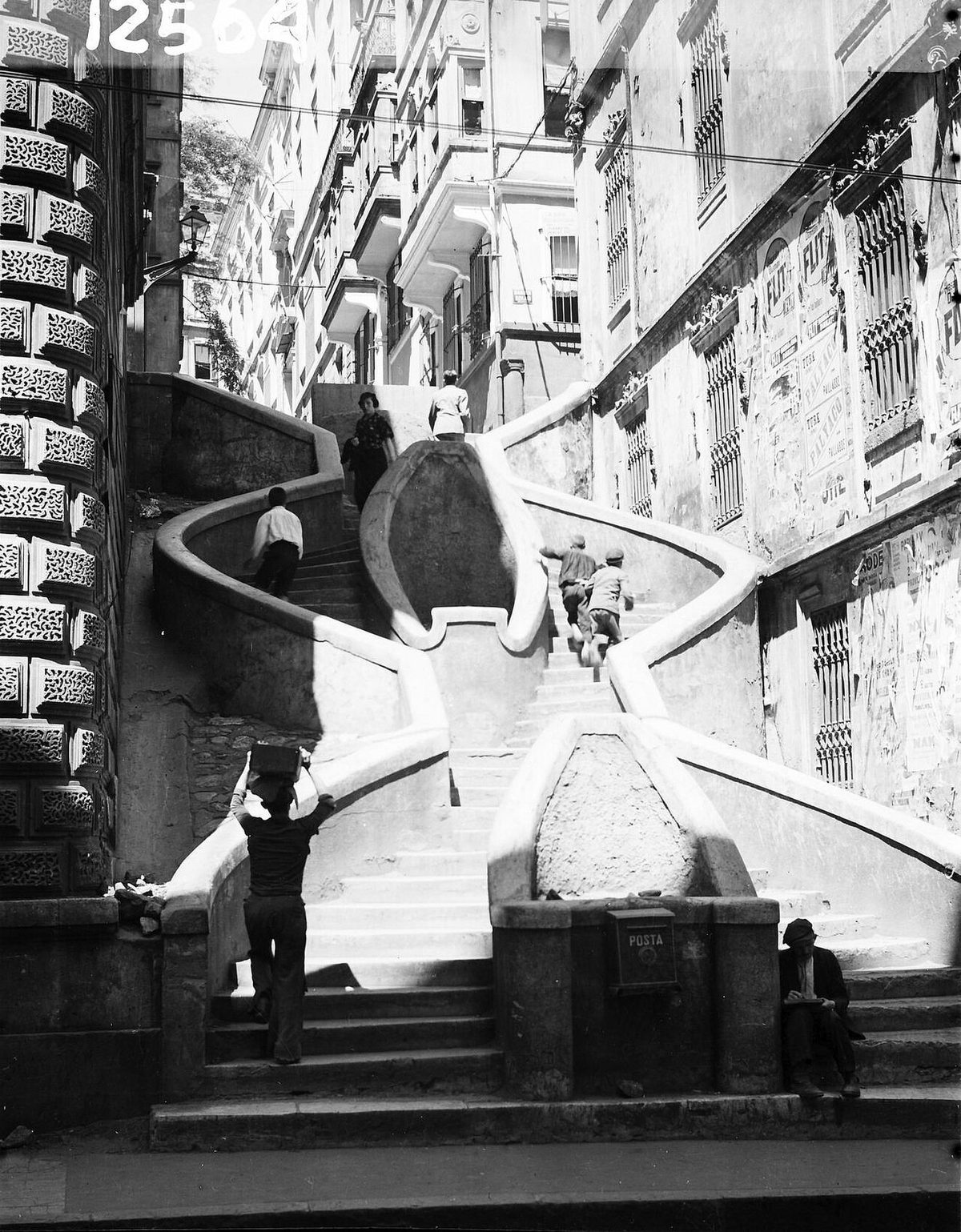
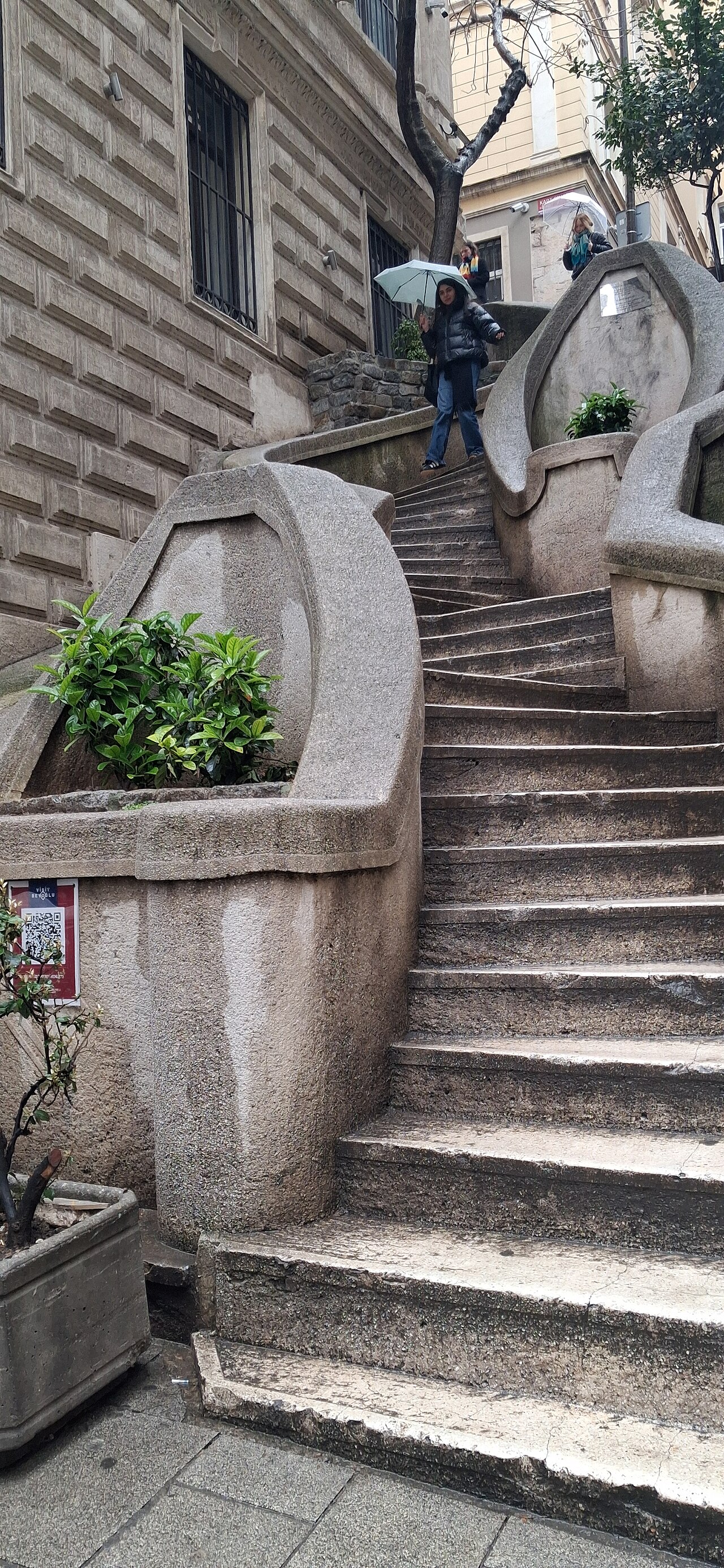
The stairs in 1937, with the same two curving flights and landings as today. Historic photo: Willy Pragher / Landesarchiv Baden-Württemberg, 7 June 1937 (CC BY 4.0), Wikimedia Commons
Part of these themes: Banks and hans
Source: Akdoğan Özkan, A Traveler’s Guide to Galata (Nar Turizm, 2016), translated by Volkan Ersoy. Obvious misprints in the printed edition have been corrected. Paragraphs marked † appear only in the 2017 Turkish edition of the book (Galata Gezi Rehberi) and were translated for this site.
Last updated: · Last checked: (map position)
Spotted a mistake or something missing on this page? Suggest a correction