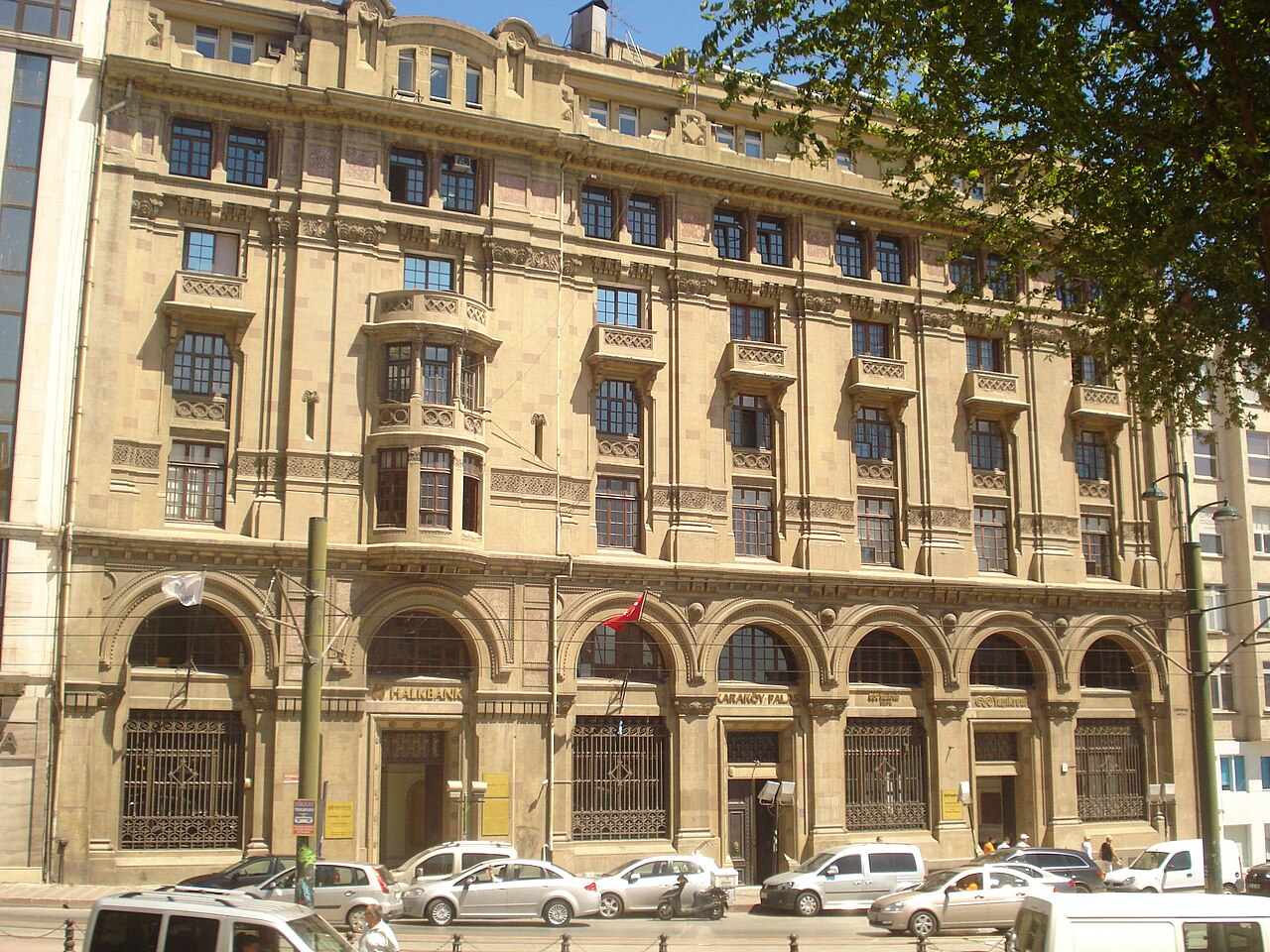
Karaköy Palas is the most flamboyant and glorious building on the square of the same name. Not a namesake square, however: Karaköy Square did not exist at the time. Karaköy Palas was the last example of the group of prestigious buildings mostly clustered around the Karaköy side of the Voyvoda Street.
During the demolitions of 1956 to 1958, the buildings on the opposite side were taken down in order to open a square, and Karaköy Palas came into view with all its glamour. The square (!) is ugly, but the building is impressive.
† Although it was initially planned with four floors, the requirement that it be shared by three separate institutions made necessary the asymmetrical design we see on the façade.
The building has three entrances on its façade. The entrance in the middle is for the office block. Left and right entrances are for the branch offices of two unrelated banks. On the side of one of the arched windows is the signature of Mongeri, its architect.
† These are perhaps the nicest bank branches in Istanbul in which to wait while your business is done. It is said that hotel chains are queuing for Karaköy Palas, which investors have had their eye on for quite some time.
The building was designed during late 1910s by the Istanbul-born Levantine architect Giulio Mongeri (1873-1953), and during the 20th century, it has been home to many foreign companies.
† Among them was Banca Commerciale Italiana, which played an important role in exporting Italian products to international markets. Six German banks owned 75 per cent of the founding capital of the bank, founded in Milan in 1894. Banca Commerciale Italiana opened branches in some Eastern European countries and in Istanbul in 1918; this branch operated in Karaköy Palas between 1933 and 1944, then moved to Agopyan Han, where it remained until 1976.
Giulio Mongeri was one of the most important architects of the era. He was also a lecturer at the Academy of Fine Arts (named as Istanbul Sanayi-i Nefise Mektebi at the time), and he is considered to be one of the names, together with Vallaury and Jasmund, behind the most noteworthy Istanbul buildings in the “Western Historicism” style. He is also the architect of the St. Antoine Church. He left Istanbul during the World War I, but returned back to the Academy after the war, and contributed to the training of the first generation architects of the Republic until 1930. The headquarters of the Ottoman Bank, Ziraat Bank, and İş Bank in Ankara are also among his works.
Part of these themes: Architects and apartment buildings
Source: Akdoğan Özkan, A Traveler’s Guide to Galata (Nar Turizm, 2016), translated by Volkan Ersoy. Obvious misprints in the printed edition have been corrected. Paragraphs marked † appear only in the 2017 Turkish edition of the book (Galata Gezi Rehberi) and were translated for this site.
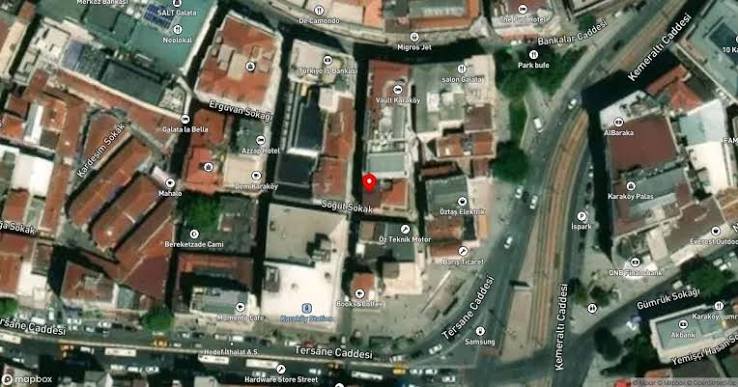
Last updated: · Last checked: (address and map position)
Spotted a mistake or something missing on this page? Suggest a correction