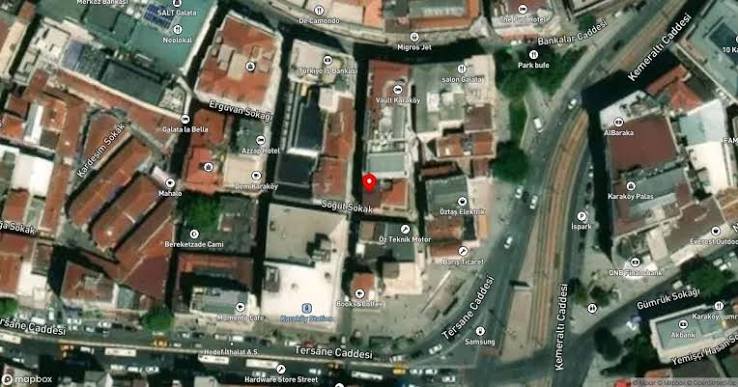
Çituri Han is at the intersection of Teğmen Hüseyin Sofu Sokağı (former Mertebani Sokak) and Söğüt Sokak. At the beginning of 20th century, the printing house of Alexandros (Aleko) and Dimitris Tsitouris (Çituri) brothers, named as “Çituri Biraderler Basımevi” (Printworks of Çituri Brothers), used to be located in this han.
Still known as Çituri Han, it is one of the 19th century hans in Galata that retained its original character. It was built in 1861, and the first owner was Vasil Hacıyanopulos. During that period it was called as “İbret Han,” and was hosting stock brokers, merchants and insurance agencies. Çituri Brothers were said to have bought this building in 1918, and added two more floors to the two existing ones. The entrance on 5 Teğmen Hüseyin Sofu Sokak is of neo-classical style. The stone masonry building has a simple façade, but a curved arch under a triangular pediment, and two fluted pilasters with Ionic capitals on both sides adorn the entrance. Çituri Brothers’ printhouse had served many local and foreign publications, but they also had a stationery shop on the ground floor. They sold the han when they left Turkey but the building retained its outlook until today. Also during the 90s, the ground floor had a stationery shop as if a reminiscent of Çituri Brothers. Today it is occupied by a hardware shop. The upper floors of the pink painted building are mostly used as depot.
Famous Printers: Çituri Brothers
At the beginning of the 20th century, the Çituri Brothers’ Printhouse of Alexandre (Aleko) and Dimitris Çituri (Tsitouri) had served many local and foreign publications. They were also operating a stationery shop at the same location. The Çituri Family was the owner of a building at the corner of Meşrutiyet Street and Kıblelizade Sokak. At the time, the building was called as Çituri Apartment, and it is now situated just opposite to Galata Antik Hotel (formerly, Decugis House). The Çituris had made a name for themselves with their printhouse, where they had printed many foreign language publications, including “The Tourists’ Istanbul” (1953), one of the first comprehensive tourist guides on Istanbul. In the 1950s, “Yeryüzü” magazine, published by the period’s young litterateurs and writers such as Fethi Naci, Metin Özek, Arif Damar, and Şükran Kurdakul, was also amongst the publications printed by the Çituris. This biweekly continued only for 11 issues between 1 November 1951 and 15 March 1952. During those hard times, Çituris were under pressure by the police, and they didn’t want to print the magazine after a few issues. Metin Özek, one of the managing editors, would visit the Çituri Han before every issue and beg Çituri brothers to print it. Each time Çituris would say, “It’s for the last time, you know.” To persuade them, the editors would appeal to the help of famous Turkish poet Can Yücel, as the Çituris couldn’t refuse him. When the conditions became more difficult to handle, however, they had to stop publishing the magazine after eleven issues. While the editors of the magazine continued their path, albeit under different publications and in different ways, the future didn’t get any better for these two Greek printer brothers, especially in the aftermath of the Istanbul pogrom of 6-7 September 1955. Following a ridiculous accusation of “provoking the church priests against Turkey,” the Çituri brothers were deported in November 1957 with a decision of the Cabinet. Aleko Çituri lost his life in Athens in August 1961, four years after his departure from Turkey. In Istanbul, the Çituris had also wanted to take advantage of the commercial activity in Pera by opening a stationery shop there. For this purpose, they took over a pharmacy (belonging to one Isak Sevy) at 337 İstiklal Street (at the corner of Eski Çiçekçi Sokak) and converted it to a stationery shop. Today, this shop is at no 185, just opposite to Odakule Business Center, and it is operated by Panter Kırtasiye, which sells stationery as well as souvenirs.
Part of these themes: Banks and hans
Source: Akdoğan Özkan, A Traveler’s Guide to Galata (Nar Turizm, 2016), translated by Volkan Ersoy. Obvious misprints in the printed edition have been corrected.
Last updated: · Last checked: (address and map position)
Spotted a mistake or something missing on this page? Suggest a correction