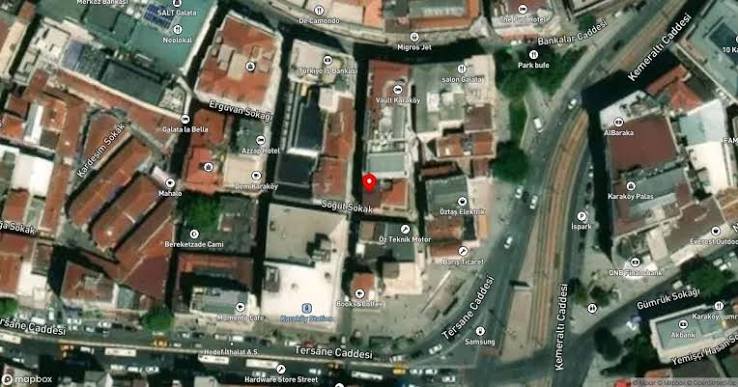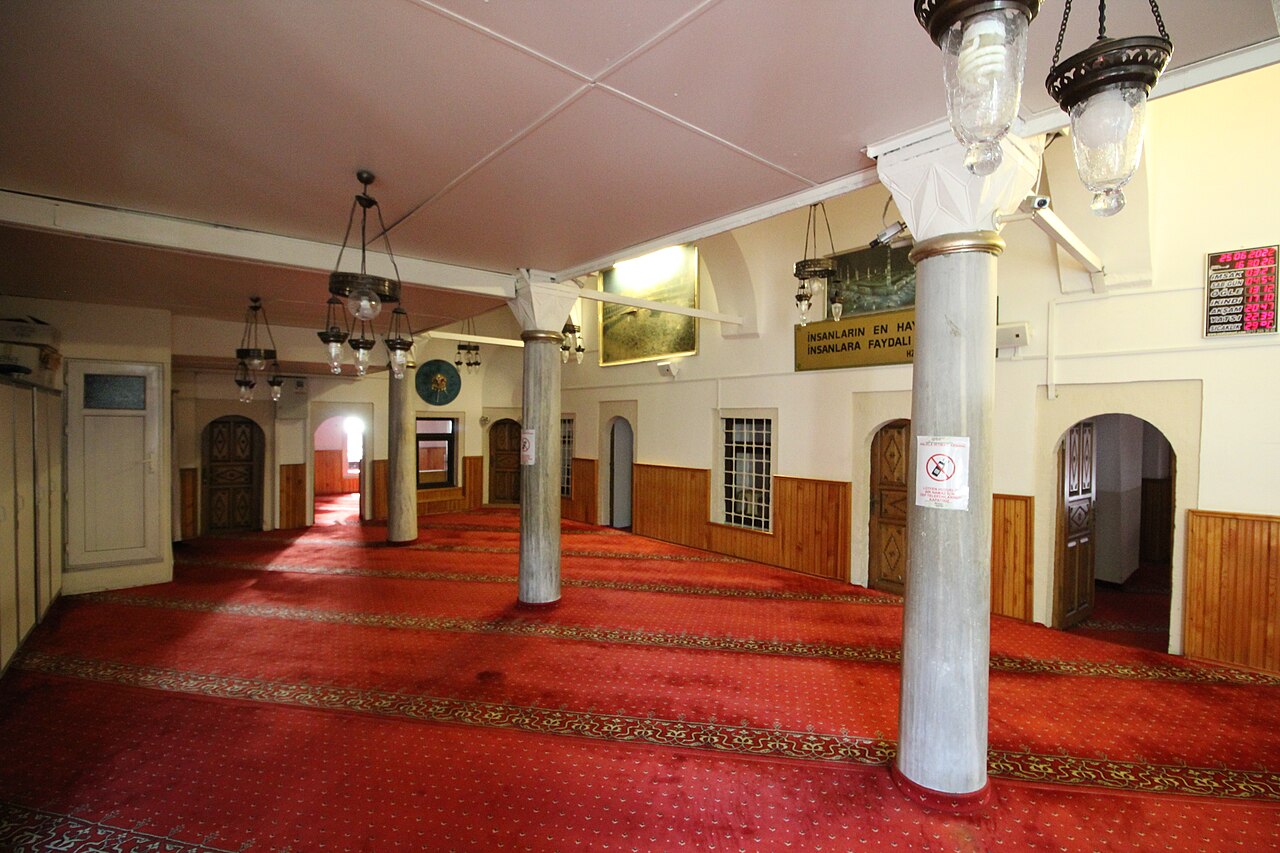
On this street was once Bereketzâde Külliyesi (külliye = Islamic social complex). The original mosque of the külliye does not exist anymore. However, the medrese building that survived is used partly as a mosque today. The building has a dome that sits on a hexagonal frame, but the niche and the pulpit are not aligned to the axis of the building, which tells us that it was not originally constructed as a mosque. Serious restoration in 1977 and 1986 took away from its architectural originality. Some of the rooms of the medrese are today used for Qur’an courses.
The founder of the building, Hacı Mehmet Pasha, was a chamberlain to the mother of Sultan Mustafa II and Sultan Ahmet III. The inscription above the entrance informs us that it was constructed in 1705. The building’s brick and stone walls were constructed using the drywall technique. The façade on Bereketzâde Medresesi Sokak has a birdhouse in the form of rectangular pavilion.
† Further up the hill from the Bereketzâde Medresesi there once stood the Bereketzâde Mescid and the Bereketzâde Fountain, which had no connection with the medrese.
† The mescid, at the junction of Bereketzâde Medresesi Sokağı, Camekan Sokağı, Hacı Ali Sokağı and Bereketzâde Cami Sokağı, had been endowed by Bereketzâde Hacı Ali b. Hasan, one of the first wardens (dizdar) of Galata Tower. According to the old inscription above its door, this small classical-style place of worship with a tiled roof was repaired in 1241 AH (1825–26). According to what Şevket Sevencan, a former headman of the Bereketzâde quarter, told Hakkı Göktürk in the 1960s, the mescid was demolished in 1947–1948.
† After the mescid was demolished, the original Bereketzâde Fountain of 1732 at its corner was moved to the square of Galata Tower. The century-old trees and graves of its burial ground were cleared in 1952–1953 to make a car park for the neighbouring hospital. The mescid was recently rebuilt by local residents to its old plan, and reopened for worship in 2007.
From recent research
The plot of Bereketzâde Medresesi on a sketch of 1653
Using an annotated sketch dated 1653, Hasan Sercan Sağlam matches the site of the church of San Sebastiano with the plot of today’s Bereketzâde Medresesi Mosque. He also discusses, as a possibility, that the older name San Fabiano may have belonged to the same building.
Source: Hasan Sercan Sağlam (2020), Transformation and Continuity of Sacred Places: The Case of Galata (Istanbul), pp. 1846–1848, fig. 7.
Part of these themes: Ottoman Galata: Tophane and Azapkapı
Source: Akdoğan Özkan, A Traveler’s Guide to Galata (Nar Turizm, 2016), translated by Volkan Ersoy. Paragraphs marked † appear only in the 2017 Turkish edition of the book (Galata Gezi Rehberi) and were translated for this site.
Last updated: · Last checked: (address and map position)
Spotted a mistake or something missing on this page? Suggest a correction