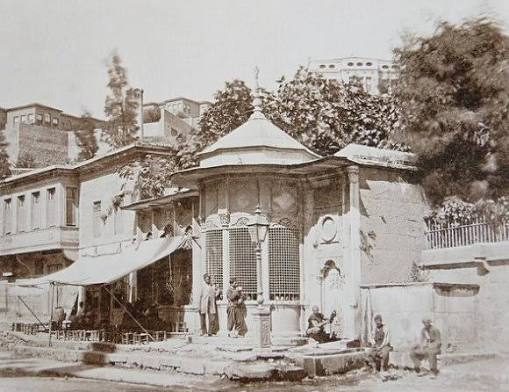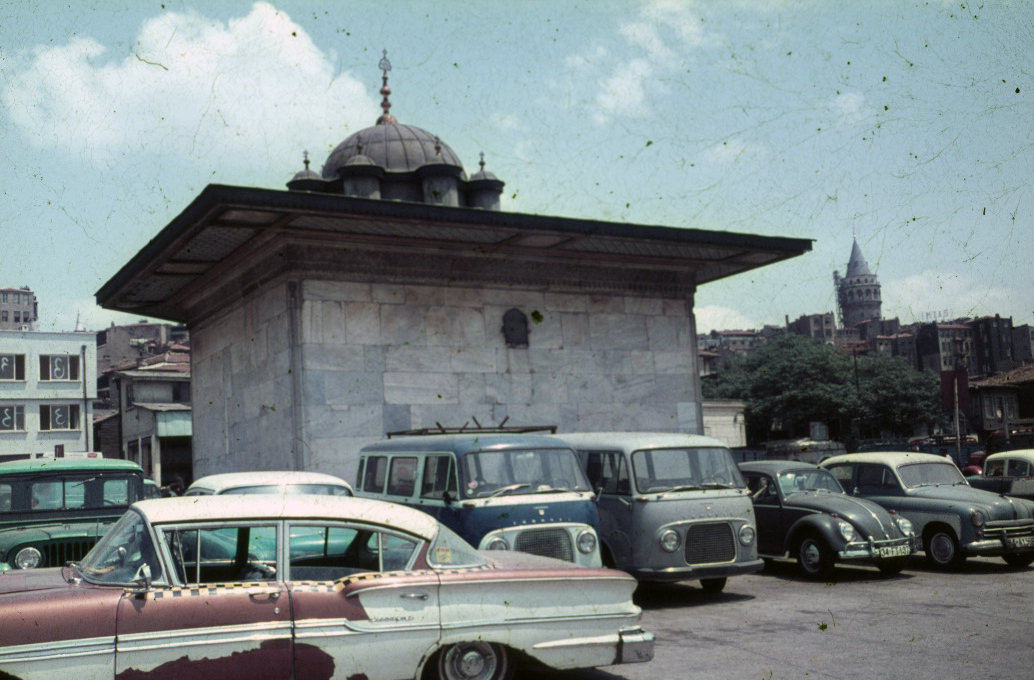
Featuring a drinking water kiosk in the middle and two taps on both sides, this monumental fountain was one of the most beautiful freestanding meydan fountains (lit. “Square fountain”) of old Istanbul. Today the square does not exist but Saliha Sultan Fountain continues to be arguably the most remarkable of the monuments built by benefactors. It is at the northern end of the Atatürk Bridge, to the south of a complicated road junction. It can be seen from the westernmost end of the Tersane Street.
Lacking abundant water resources, Galata was supplying water from old Istanbul, even during the Genoese era. The growing population in the 18th century made the need for water even more pressing. In such cases, beneficent dynasty members, rather than the state treasury, would take the situation at hand. Following the custom, Saliha Sultan, mother of Sultan Mahmut I, came to Galatans’ help (she was rumored to have spent her childhood in the region). Thanks to the efforts of her son, aqueducts had been built to convey water from Istanbul’s Northern Forests to the Taksim reservoir. She had her namesake fountain built near the shipyard in Galata, taking its water from this reservoir.
† Her son Mahmut I, who also had dams built in the Belgrade Forest, wrote poetry under the pen name Sebkati; for this reason the Queen Mother is also known as Saliha Sebkati Valide Sultan.
Although it was built during the time of head architect Mehmet Ağa of Kayseri, the architect of the fountain is uncertain. With its kiosk, it was designed as a block of asymmetrical polygon shape. The calligrapher was Mehmet Rasih Efendi of Eğrikapı. According to the calligraphic inscription, written by Seyyit Vehbi, a famous Ottoman poet of the 18th century, it was built in 1732-33.
Saliha Sultan had the fountain built concurrently with an infants’ school. It was to the north of the fountain, close to the sea. Reportedly, the fountain, Saliha Sultan Sıbyan Mektebi (infants school), Sokollu Mosque, and Yeşildirek Hammam were together forming a külliye (Ottoman social complex). The infants’ school was demolished in 1957 for the road works of Atatürk Bridge, stripping the Fountain Square off one of its monumental buildings. Today, the only way to see the fountain in its historic environment is to check the 1838 dated engraving of William Henry Bartlett.
† In the past there was also a bakery and shops just below the school.
Still, you wouldn’t regret if you pay a visit. It’s one of the best examples of Ottoman art with its ornamented roof with wide eaves, its metal festoons, hand-drawn motifs, muqarnas niches, and beautiful decorations.
† The inscription itself invites passers-by to come to the Valide Sultan’s sebil and drink the water of Kawthar, the river of paradise. The marble front is carved in a naturalistic style with flowers, fruits, curling branches, vases of flowers, rumi and palmette motifs and muqarnas, while the rear and side faces are plain, decorated only with tap niches.
The fountain had its first major restoration in 1953 with the help from drawings created by Italian architect Montani Efendi in 1873. The last restoration was carried out in 2005. Brass taps were manufactured with inspiration from historical images, and fitted into their place. But soon they were stolen away, and today the fountain cannot even perform its basic function.
Part of these themes: Ottoman Galata: Tophane and Azapkapı
Source: Akdoğan Özkan, A Traveler’s Guide to Galata (Nar Turizm, 2016), translated by Volkan Ersoy. Obvious misprints in the printed edition have been corrected. Paragraphs marked † appear only in the 2017 Turkish edition of the book (Galata Gezi Rehberi) and were translated for this site.
Last updated: · Last checked: (address and map position)
Spotted a mistake or something missing on this page? Suggest a correction