Named as Metopon (forehead) during the Byzantine era, Tophane (lit. “cannon foundry”) gained a new character after the Conquest with the establishment of iron foundries and artillery barracks. During the period, the eastern end of Galata was crawling with artillerymen and cannon foundry workers. With the arrival of others from different segments of the society, Tophane became a large settlement. Evliya Çelebi wrote in the 17th century that there were 70 Muslim, 20 Greek, 7 Armenian neighborhoods, and several Jewish houses in Tophane. The cannon production in the region reached its climax during the reign of Süleyman the Magnificent.
Jérôme Maurand, a French priest of Antibes who visited Istanbul in 1544, reported about the Tophane of the Suleyman the Magnificent era:
“We saw here cannons of every kind, including a basilisk of 24 palms length, as well as seven mortars which were used against Rhodes. On the barrel of one mortar, you could see the trace of a cannonball shot from the Rhodes castle. A man could fit inside its barrel. We also saw a 22-palm long culverin in the form of a Corinthian column, and a 15-palm long mortar. Brought by İbrahim Pasha from Hungary, this mortar had beautiful reliefs on it. About 40-50 Germans work in the cannon foundry.”
Tophane took this look and image also to the 17th century. It was like a scene from “a gun exhibition,” with all cannons lined side by side.
French botanist Joseph Pitton de Tournefort (1656-1708) visits the region in the 17th century. He reports that the foundry was located about a hundred steps back from the shore, and the Turks were casting very good cannons there.
The scene changed dramatically during the reign of Selim III: The cannons were gone, the plane trees which adorned the square were cut down, and the enlarged square was turned into an exercise ground for Nizam-ı Cedid (lit. “New Order”) Army.
During mid-18th century, Tophane had a beautiful square with a wooden wharf on the coast. Monuments such as Tophane Fountain and Kılıç Ali Pasha Külliye were adorning the square.
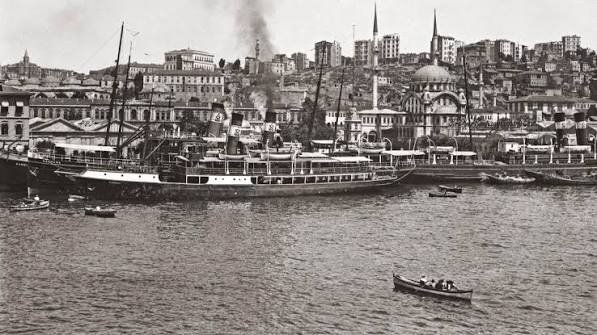
Although having a wharf, Tophane was lacking in a modern dock for ships. This requirement reached its peak during the 19th century, because the ships had to moor to the buoys just off the Galata cost, and the passengers had to take barges or rowboats to the wharf. In 1892, a French company undertook the construction and operation of a dock, but the boatmen and bargemen, who were employed at the wharf, objected. For this and other reasons, the construction was held back, and finally a dock that stretched 785m from Galata Bridge to Tophane was completed in 1895. Memphis, a French passenger ship, became the first ship to moor in the Galata dock in September 1895. A part of the dock, however, collapsed in 1898, and the repair work continued until 1900. In 1940, a passenger lounge on piles was constructed for the dock.
† Unloading cargo was difficult as well. During the Crimean War (1853-1856), the British and French who came to the aid of the Ottomans had great trouble landing their supplies at Galata because there was no dock, and the French raised their complaints at the Peace Conference of 1856, putting pressure on the Ottoman government.
† The passenger lounge was opened on 1 July 1940. The land it needed was obtained by demolishing Küçük Rıhtım Han, Panorama Han, Orta Han and Maritime Han, which stood between Galata Çinili Rıhtım Han and Merkez Rıhtım Han. Because the plot was on the shore and on reclaimed land, bored piles were driven in at set points and the lounge was built on them.
Although having the most needed dock by the 20th century, glamorous times were over for Tophane region and the square. Istanbul’s economy was already beaten by the lost wars, and later, the exchange of population cost the city many investors, skilled workforce, and craftsmen. Istanbul’s share from the world trade had plunged significantly.
† With Ankara made the capital, Istanbul’s share of world trade fell considerably. Between 1911 and 1927 the number of ships entering the port of Istanbul fell from 21,331 to 15,074, and the total tonnage entering the port from 20,169,000 to 11,531,000 tons. In short, the port’s entire trade almost halved.
One of the solutions found by the government to the decline was to create the first “free trade zone” of the Republic in an area that stretches today from the water-pipe cafés by the side of Nusretiye Mosque onwards, to the north of it. Thus, the first automotive assembly plant of the Turkish Republic was founded in 1929 by Ford Motor Company. The company’s assembly lines for automobiles, trucks and tractors used to be situated in the car park lot that you have to cross today to enter Istanbul Modern Art Museum.
† The single-storey workshops producing cannons, gun carriages and other military equipment – built on the site of the shoreside barracks that burned down in the fire of 1863 – and the warehouses were cleared out. The cannons were gone, and a car factory had taken their place. Ford’s aim was to ease the load on Trieste, at that time an important shipping point in the Mediterranean.
† Of the workers to be employed in the assembly of motor vehicles in the free zone, 60 per cent in the first two years, and 75 per cent by the end of the sixth year, were to be Turkish nationals. In this way Istanbul hoped first to increase employment and then, if possible, to become a regional centre.
Galata Dock had a special significance for 20th century Istanbul that it became the scene for 3 large-scale migrations:
- Tens of thousands of refugees who escaped from Russia after October 1917 Revolution came to Istanbul.
- After the departure of the occupation forces from Istanbul, thousands of Greeks, Armenians and Levantines left the city for fear that the new Turkish government would call non-Muslims to account for their support to the foreign occupants.
- With the foundation of the Israeli state in 1948 in Palestine, tens of thousands of Jews of Istanbul left for their new country.
Also, Mustafa Kemal Atatürk, the founder of the modern Turkish state, departed from Galata docks to Samsun for his assignment as the Inspector of the 3rd Army. With his 21 companions, he took a motorboat from the docks on 16 May 1919, and went on board SS Bandırma, which lay anchored off the Maiden Tower (Kız Kulesi).
Part of these themes: Ottoman Galata: Tophane and Azapkapı
Source: Akdoğan Özkan, A Traveler’s Guide to Galata (Nar Turizm, 2016), translated by Volkan Ersoy. Obvious misprints in the printed edition have been corrected. Paragraphs marked † appear only in the 2017 Turkish edition of the book (Galata Gezi Rehberi) and were translated for this site.
Last updated: · Last checked: (address and map position)
Spotted a mistake or something missing on this page? Suggest a correction