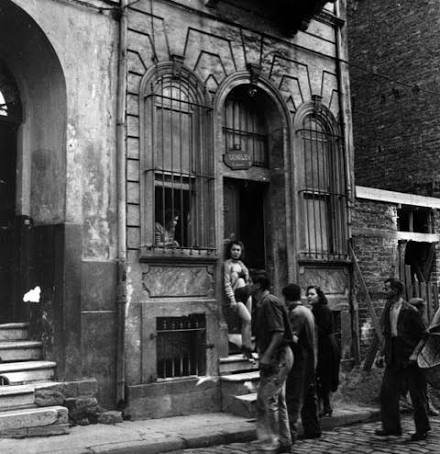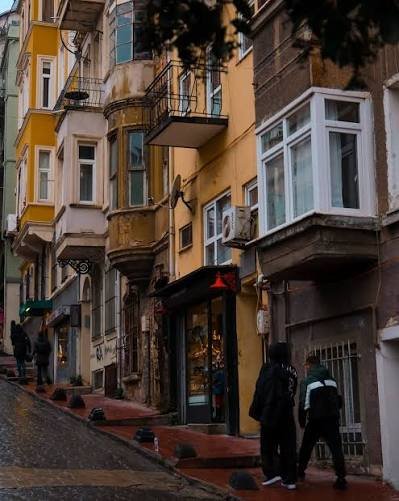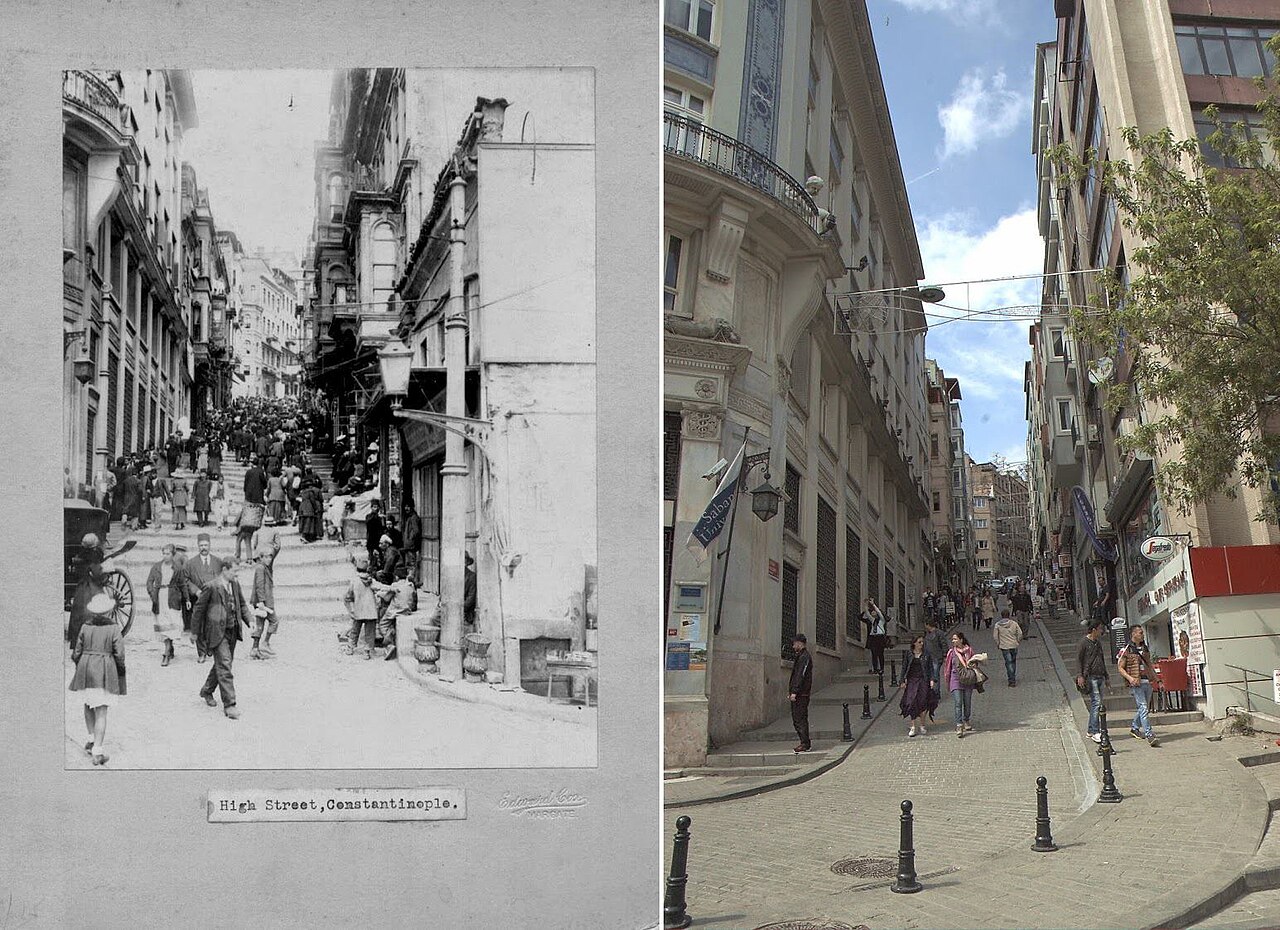
Once, this street was a part of İstiklal Street. This 270 m long slope connects Galip Dede Street to Karaköy and the wharf; in other words, it connects Pera to the Galata coastline.
During the past times, travelers who land on one of the wharfs – or in the 19th century, on the dock – of Galata would probably use this main axis of the city in order to reach their hotels or embassies in Pera. Or should we say, it is where the famous Turkish poet Orhan Veli “kissed Eleni in broad daylight,” as he told us in one of his poems.
† The street begins at Minerva Han, at the end nearer the sea, and runs north as far as the point where Galip Dede Street and Lüleci Hendek Street meet.
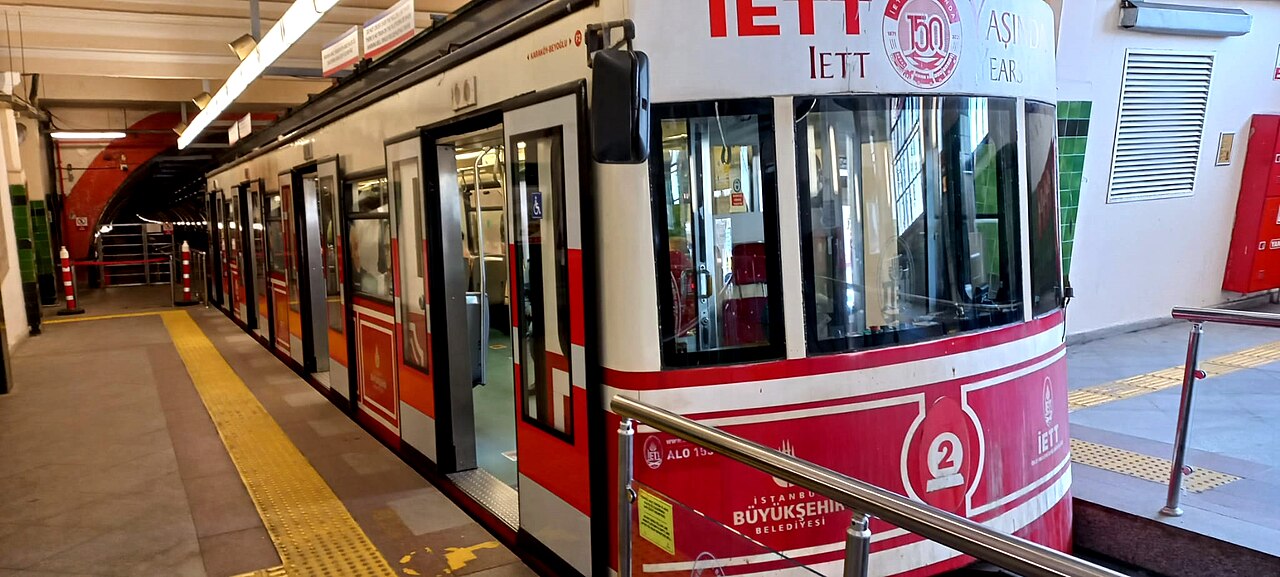
This steep slope was a very busy street during 1860s and 70s. It didn’t escape from the French engineer Eugene Henri Gavand’s notice that every day about 40 thousands of people were walking up or down this slope. In order to connect Galata, the city’s finance center, to Pera, the city’s popular entertainment center, Gavand envisioned an underground funicular project. These two centers were finally connected in 1874 with a 570 m tunnel. During its first months, the people were referring to it as “mouse hole,” even wondering “why someone might wish to go underground before their death.” On the other hand, it was now possible to climb up to Pera in just a few minutes - and by paying 20 para (1/200th of a gold lira).
Previously, one had no choice but walk to be able to reach Pera from the Galata wharfs. If you were with baggage, as British publisher John Murray noted in his 1854-dated book, you had to hire a porter and pay him 5 para. We also learn from Murray’s notes that on Yüksek Kaldırım the best shop for travelers was the Stampa’s, the best hotel was Hotel d’Angleterre – followed by Hotel de Byzance with its beautiful view, and by Hotel d’Europe – and the daily rate for the less comfortable Hotel de Pera was 1.5 dollars.
The British author Albert Richard Smith (1816-1860) also visited Istanbul in 1849, and stayed in Hotel d’Europe. He describes Stampa as the “embodiment of Pera and Galata”:
“His shop is a marvelous depot of everything you want. He supplies you, with equal readiness, with a pot of Atkinson’s bear’s grease, or a bottle of Tennant’s pale ale, a packet of Gillotts’ pens, a dozen of Day and Martin’s blacking, or a box of Holloway’s Pills. If you want some Harvey’s sauce – you find it at Stampa’s; you do not know the address of some merchant in Galata – Stampa will tell you directly; you are uncertain about the different departures of the steamers – Stampa has all the information at his finger’s ends, or if he by chance has not, his clever son is a walking Bradshaw. For good razors (of which I hold Heiffor’s Sheffield ones, at a shilling, to be the best, and accordingly recommended him to lay in a stock for future demands), solar lamps, cutlery, London ink, pasteboard, pins and needles, Stilton cheeses, gutta percha, otto of roses, sponge, Windsor soap, and Howqua’s mixture, there is no shop like Stampa’s.”
Of course it was not only the Stampa’s Shop that attracted the interest of the Levantines and tourists. According to the 1889-1890 Oriental Trade Directories, on Galipdede Street – from the Tunnel Square to the Lüleci Hendek Street – there were 15 shoe stores, 12 fashion designers, tailors and hat shops, 7 furniture stores (of which two stores belonging to Psaltys), 6 jewelers, 4 engravers, 4 groceries, 3 watch sellers, 3 pharmacies, 2 physician’s offices, 2 haberdashers, 2 gun shops, 2 tobacco depots, 2 stove shops, and 2 tinsmiths.
Today Yüksek Kaldırım is an end-to-end asphalt paved street, but in the past it had wide cascading steps as seen on old photos. In the early 1940s, during the office of Governor Lütfi Kırdar (1938-1949), the street was renewed and paved with cobblestones. This beautiful street has lost its character when it was asphalt paved during the second half of the 20th century.
† This “thorough repair and rearrangement” of the early 1940s required an area of 3,027 square metres to be laid out and paved, and cost 41,156 lira.
† In the 19th century Galata had become a place where goods of every kind were landed, stored and sold by Western – French, British and Italian – industrialists and merchants. For this reason the banks and all the institutions connected with international trade were concentrated in lower Galata, by the shore. The higher ground that we call Beyoğlu or Pera, on the other hand, had been settled from as early as the 17th century by various embassies, the British and French first among them – at first as a summer retreat, and later in order to keep away from plague epidemics and fires. The density of settlement in Pera, and the spread of apartment buildings there, was accelerated by the building of the dam systems in the early 17th century and by the construction of the largest water distribution chamber (maksem) at Taksim. In short, Yüksek Kaldırım was in the past an axis linking the commercial districts of Galata with the residential and entertainment centre in Pera.
They Rocked the World With Cymbals: Zilciyan Family
Galip Dede Street is also known as a frequent visiting place for professional musicians. Leading towards Yüksek Kaldırım, the street is lined with many instrument stores. Attentive passers-by would not miss the brass cymbals in most of the shops’ windows, and some of them bear the logo “Zilciyan” or “İstanbul Zilciler.”
Although it’s not a well-known fact, the cymbal as the indispensable instrument of rock and jazz music, was first developed, and introduced to the world, in the 17th century by Zilciyans (or, Zildjians), an Ottoman family. Therefore, the cymbals in the windows of the instrument stores on and around Galip Dede Street represent the last generation products of a tradition that started in the 17th century Istanbul – a tradition which played an important role in the success of numerous bands and musicians, including the familiar names such as Beatles, Rolling Stones, Deep Purple, and Pink Floyd.
The story of Zilciyans, the first known inventor of cymbals, began in Istanbul’s Samatya district, where they settled coming from Black Sea region. The first known member of the family was Kerope, who grew up in the orphanage of the Surp Kevork Church. In the following years, he earned his life by making church bells. According to the Armenian sources, Kerope’s first brass foundry was on today’s Ağahamam Müşir Süleyman Pasha Street in Samatya (in the place of a shop at no. 45).
After Kerope’s death, the foundry passed to his son Avedis I, who was born in 1596. 17th century was offering new opportunities for craftsmen who work with brass (copper/tin) alloys. During this period, an instrument called zil (hand bell, or cymbal) was introduced to the Ottoman Mehteran band, one of the most deeply rooted army bands in the world. With an edict dated 1618, Sultan Mustafa I commissioned Avedis to make cymbals for the Janissary Army within the premises of Topkapı Palace. The Sultan also granted him with the title Zilciyan (Zilcioğlu). The cymbals casted by Avedis were played by band members in the last row, and accompanied the other instruments of the Mehteran band such as drums, kös and nakkare (types of kettledrum), and zurna (clarion). In 1623, Sultan Murat IV gave Avedis permission to leave the palace and establish his own foundry in Samatya. Avedis improved the sound of the cymbal by developing new brass production techniques and adding different metals to the alloy. Avedis was the first keeper of this secret alloy formula that would pass from father to son for generations. Thus, Avedis’ son Ahkam learned the secret of bell making from his father and took over the foundry in 1651.
By the end of 17th century, cymbals were introduced to Europe. The first European composer to utilize cymbals was Nikolaus Strungk, in the 1680 opera Esther. When prominent composers like Mozart and Haydn started to regularly feature cymbals in their compositions, the cymbals of Zilciyan Family gained popularity among musicians all over Europe.
In the 19th century, Sultan Mahmud II (1808-1839) abolished the Guild of Janissaries, and hence, the Mehteran Band as its integral part, and established a western style military band in its place. This development brought cymbal production almost to a halt. Still, three members of the Zilciyan Family - Hoca Artin, Kerope II, and Karabet – were believed to have continued cymbal production during this period. Avedis II Zilciyan, who is believed to be the son of Hoca Artin, participated to the 1851 World Trade Fair in London, as well as receiving quality and craftsmanship awards with his cymbals in London and Paris. Avadis II was visiting Europe frequently, and he returned from London with another award in 1862.
When he died in 1865, his brother Kerope II took over the business, as the two sons of Avadis II were very young at the time. The cymbals produced by Kerope II gained reputation with their rich tones and robustness – now they were bearing the brand name “K. Zildjian.” Kerope II participated in fairs in the USA (Chicago 1873, 1893) and Europe (Vienna and Bologna, 1888) to expand the market share of “K. Zildjian” cymbals.
Kerope died in 1910, and the family business was passed on to Harutyan, his eldest son. When Harutyan chose a career as a statesman, Aram Zilciyan – who spent long years as an apprentice to his uncle Kerope – took over the company. However, the claims that Aram Zilciyan took part in the assassination attempt against Sultan Abdülhamit II in 1905 forced him to leave the country for Romania. In Budapest, Aram made cymbals under the Zildjian name (A. Zildjian & Cie), while still maintaining contact with the Istanbul factory (K.Zildjian & Cie), which had been supervised by Kerope’s eldest daughter Victoria. When Victoria died, her nephew Mikael Dülgeryan helped run the foundry. In the meantime, Aram returned to Istanbul in 1926, but kept the factory in Bucharest open. In 1926, he also sold the rights to American distribution of his A. Zildjian & Cie cymbals to the Fred Gretsch Company.
Facing health problems and without an offspring, Aram wrote in 1908 to his nephew Avedis (III) who was living in Boston, USA, and asked him to come to Istanbul to take over the business. When Avedis III insisted in staying, however, Aram decided to migrate to USA. Avedis III was in clothing business, but encouraged by the arrival of Aram, he founded a cymbal company in 1928. It was a time to capitalize on the jazz boom. In the big band era, working with drummers like Gene Krupa, Chick Webb, Papa Jo Jones and Buddy Rich, he developed the modern range of cymbals that came to define the modern drumming and percussion sound.
When Avedis’ son Robert Zilciyan (1923-2013) was at the age of 14, it was time for him to learn the secret manufacturing process of his ancestors. But the outbreak of the World War II had a dramatic impact on the business. Copper and tin, essential to cymbal production, were also the principal components of the war industry. Robert enlisted in the army and served as an infantryman in Europe.
Returning to the family factory after the war, Robert developed export sales, concentrating on European markets. The rock’n’roll and pop crazes fuelled demand for the company’s cymbals, and in 1967 Zildjian established a subsidiary operation called Azco. In 1968, Robert bought the K. Zildjian Co. and all European trademarks on behalf of the Avedis Zildjian Co. After a while, he also closed down the Istanbul factory.
After the death of Avedis in 1979, Robert’s big brother Armand was appointed as the president of the company. After a while, the two Zildjian brothers quarrelled, and it took two years of litigation in the courts to reach a settlement under which Armand kept the original Zildjian company and Robert received the Azco subsidiary. Having taken the secret manufacturing formula with him as part of the deal, in 1981 Robert Zildjian opened a new cymbal company called Sabian – an acronym formed from the first two letters of the names of his children Sally, Bill and Andy – pitting it against his own brother’s 350-year-old family business.
Within a few years Sabian was selling some 200,000 handmade cymbals a year, claiming a third of the global market and by 2010 was shipping more than 900,000 cymbals around the world annually. Robert Zildjian lost his life in 2013, and his business was passed on to his youngest child Andy.
On the other hand, Armand’s K. Zildjian successfully competes against Sabian. With 2006 revenues of $52 million, the Zildjian Company is now run by 14th-generation descendents Craigie and Debbie Zildjian. Craigie and Debbie Zildjian weren’t trusted with the secret until they were in their mid-30s and deemed sufficiently committed to the company - and they, too, have decided to keep the secret from their daughters, the 15th generation, for a few more years.
When Aram migrated to the USA, Mikael Zilciyan took over the foundry on Samatya Ağahamamı Street and continued with the cymbal production using the formula perfected by his ancestors. In 1965 he moved the foundry to Bayrampaşa, Sağmalcılar and run it until 1977. His cymbals, branded “K. Zilciyan” were being sold all over the world by the USA branch of the family.
However, in 1977 Mikael received a letter from his American relatives. It says Mikael’s cymbals were not admired as before in the USA, and informs him that they will stop importing his cymbals. In fact, the leading drummers of the world have begun to call pre-1977 cymbals as “Old K,” and complain that the new cymbals were not up to the quality of old ones. With exports coming to a halt, Mikael was forced to close the foundry, and he died after some years.
On the other hand, Mehmet Tamdeğer and Agop and Oksan Tomurcuk brothers, who have been apprentices to Mikael Zilciyan since their young ages, did not want to give up the pursuit of cymbals. They founded a partnership called “İstanbul Zilciler,” in order to put the secrets they learned into practice. In 1984, they imported their first hand-made cymbals to USA. When Agop Tomurcuk lost his life to an accident in 1996, the partnership ended. Mehmet Tamdeğer’s company took the name “İstanbul Mehmet,” while the company founded by Agop Tomurcuk’s sons Arman and Sarkis was registered as “İstanbul Agop.” In the meantime, three Turkish cymbal craftsmen who learned the job from Agop have founded another company, the “Turkish Zil.”
In summary, the cymbal making tradition, which started in Istanbul in the 17th century, has now went beyond the Zilciyan Family, and proliferated into the 21th century. The cymbals you will see in the shops on Galip Dede Street today whisper their long history.
Part of these themes: Taverns, music and entertainment
Source: Akdoğan Özkan, A Traveler’s Guide to Galata (Nar Turizm, 2016), translated by Volkan Ersoy. Obvious misprints in the printed edition have been corrected. Paragraphs marked † appear only in the 2017 Turkish edition of the book (Galata Gezi Rehberi) and were translated for this site.
Last updated: · Last checked: (address and map position)
Spotted a mistake or something missing on this page? Suggest a correction