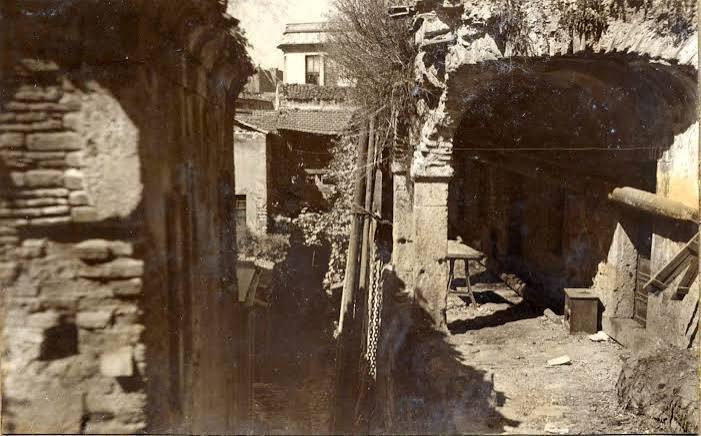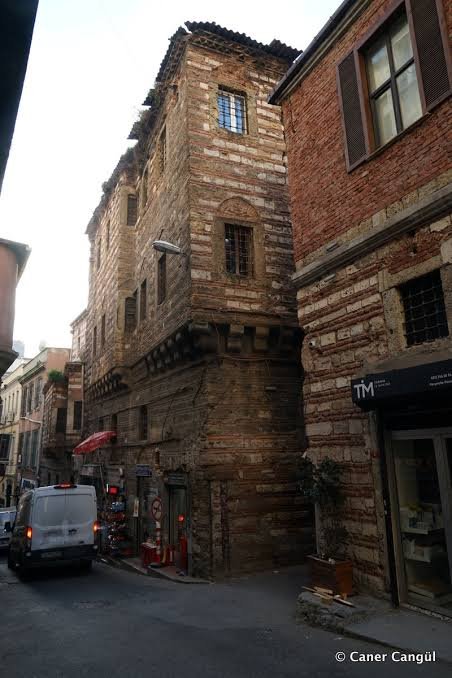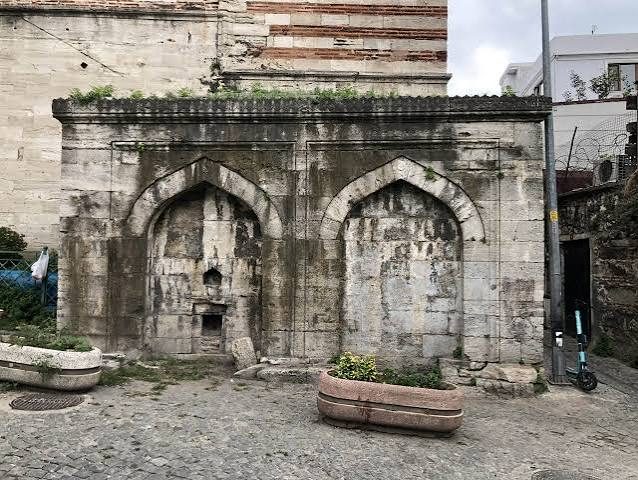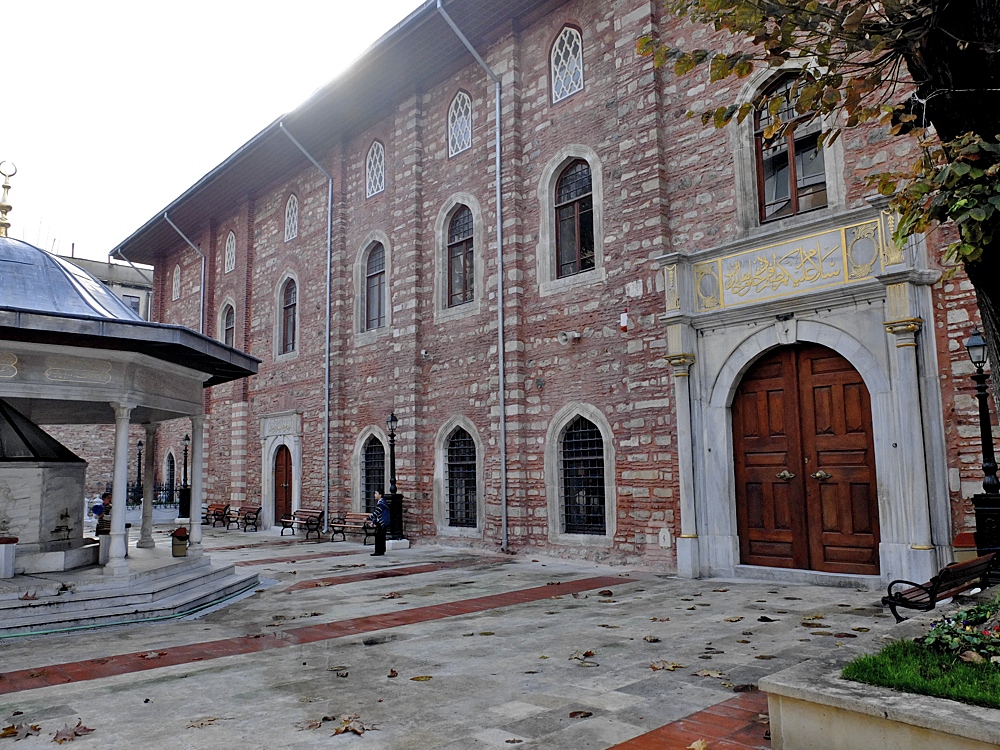
It is one of the most interesting architectural feats of the city, one of a kind in Galata and the whole Istanbul. In the courtyard, first the şadırvan (a type of fountain that provides water for drinking or ritual ablutions) greets the eye. At the end of the yard is a grave adjacent to the building. It is claimed to belong to Mesleme bin Abdülmelik, an Umayyad general who is known with his expedition against Byzantium in 717-718. Based on this claim, the building is said to be constructed originally as a mosque. However, it’s baseless thinking that a mosque could be constructed in the city during the Arab sieges of 7th and 8th centuries.
In fact, it is known from detailed studies that it was constructed as a Dominican church at the beginning of the 14th century. It is believed, however, that even this church was built on the ruins of the Orthodox church of Agia Irini. After the conquest, the church has lost most of its community, and converted to a mosque under the name Arab Mosque. It fell victim to almost all great fires through its history in Galata, and was renovated numerous times. As none of the renovations were keeping with the architectural character of the building, it reached the present day with serious transformations.
Today the building has a rectangular plan, 49 m in length and 21 m in width. Its square bell tower has a pyramidal roof, and functions today as a minaret. On its east side, it is possible to see the traces from the old church of 14th century.
To the right of the courtyard, the ribbed vaults of the arch reflect the early gothic style of the building. Also in the mihrab (high altar) section, there are several gothic windows with pointed arches.
At the end of the courtyard, to the right of the passage that opens to Galata Mahkemesi Sokak, a marble door case with engravings can be seen. According to Celal Esad Arseven, it belongs to the original door which was once located under the tower, but then moved to its current place for protection.
The most comprehensive work on Arab Mosque was penned by Fr. Benedetto Palazzo, the prior of Saint Peter’s Church in Galata (between 1933 and 1938), after a study of 10 years. The book, named “L’Arap Djami ou Eglise Saint Paul a Galata,” was published in 1946, and it tackles with the claims about the mysterious past of the Arab Mosque.
Benedetto Palazzo concludes that it was built in the 14th century by the Dominican Order who wanted to introduce the Catholic faith in Byzantium, the center of Orthodoxy. According to him, the church’s founder was probably Guillaume Bernard de Gaillac, a Dominican prior who arrived to Constantinople with his entourage in 1299 from Toulouse in France. According to Byzantine historian Pachymeres, in 1307 the Byzantine Emperor expelled them from the city with all other Latin-rite clergymen for fear that the Catholic faith may spread among Orthodox priests. Subsequently, Gaillac and his entourage took refuge in Pera. Gaillac wanted to construct a convent in Pera for Catholics in the region. To this end, he first had a temporary, small church constructed and dedicated it to Saint Paul. In the mean time, the Genoese in the region donated the lot of the Agia Irini (St. Irene) Church which then was in ruins.
Agia Irini was reportedly constructed in late antiquity by Pertinax, the Bishop of Byzantium, and renovated by the Emperor Justinian in 532. Today, the marble plinth in a glass covered pit at the arched entrance of the mosque is believed to be of Agia Irini Church, from the Justinian era.
As time went by, Agia Irini went to ruins, and on its lot, Gaillac started to build a large convent and a church, dedicated to St. Dominic, the founder of the Dominican Order. The construction, however, was to be completed by the next generations. As the small church built by Gaillac was dedicated to St. Paul, the next church also came to be known as such, although it was officially dedicated to St. Dominic.
† In fact, the Byzantines were right to fear that people might abandon the Orthodox faith for Catholicism. Among the renowned theologians of St. Paul’s Church were men of Byzantine birth who later joined the Dominican Order, such as Fr. Simon of Constantinople and Demetrius Cydones. According to Palazzo, Simon must have been expelled from the city with his fellow believers after the end of the Latin occupation (1261). After the Society of Pilgrim Friars was founded, he was appointed to the Convent of Pera because of his Constantinopolitan origins, in the hope that he would help build good relations with Byzantium. Some of his works explaining the doctrine of the Holy Spirit to Byzantine political and religious figures survive today.
† Demetrius Cydones was one of the most notable writers of 14th-century Byzantium. While serving as private secretary to Emperor John Kantakouzenos, he translated – with the emperor’s permission, and in order to know the Latins better – books on the faith of the Latin world, such as the Summa contra Gentiles. Influenced by the works of St. Thomas Aquinas that he had translated into Greek, Demetrius became a Catholic and then donated a large sum for the repair of the Convent of Pera. The works he wrote after embracing Catholicism made their mark on the Byzantine intellectual world, and many converted to the Catholic faith.
It can be said that the St. Paul Church has survived to the present day – even if as a mosque through various transformations – but the convent has gone without a trace. It was referred to as Galata Dominican Convent, or Convent of Pera, or as Conventus Saint Dominici. It used to be located parallel to the church, in the northern part of the courtyard of today’s Arab Mosque. The entrance was through the door under the bell tower, and along its apses.
Wolfgang Müller-Wiener says that the northeastern niche of the church at the time might have had small chapels serving as burial places for Genoese families. In fact, two Latin headstones were found – on the main entrance under the bell tower, and above the arch of the southern-side entrance, from 1323 and 1337, respectively. Based on this, Palazzo concludes that the construction started before 1323, and ended around 1337.
† In short, the paintings of saints that once adorned its walls and were moved to the Istanbul Archaeological Museums during restorations, the Latin headstones found here, the shape of the building and its bell tower all confirm that the Arab Mosque was a Latin Catholic church before it became a Muslim place of worship.
† Don Ruy González de Clavijo, who travelled to the land of the Mongol ruler Timur as envoy of the King of Spain, wrote that he stopped in Pera in 1403 and visited the Convent of St. Paul. Let us not forget, too, that Ibn Battuta, one of the greatest travellers of the Middle Ages, crossed to the far shore of the Golden Horn and visited Galata when he came to Constantinople in 1334. The Arab traveller makes no mention of so important a mosque in Galata; he only remarks that there is no good in the churches of the Galatans, which are without splendour and silent. That he mentions no convent either suggests that the Dominican convent may not yet have been completed at the time.
† When the building was converted into a mosque after the conquest of Istanbul, the Dominican friars moved in 1476 to a smaller building a few hundred metres away, dedicated to St. Peter (Saint Pierre). A 1478 endowment deed of Mehmed II mentions “Mesa Domenico” in Galata as having recently been converted into a mosque – confirming that this was a Dominican church turned into a mosque after the conquest.
The mosque probably took its name from the Arabs who fled Spain at the end of the 15th century, took refuge in the Ottoman Empire, and settled in this region.
During the reign of Sultan Mehmet III (1595-1603), when the mosque was renovated, the structures around it were demolished against potential damages to the mosque. The great fire in 1731 resulted in significant architectural transformations in 1734-35, when Saliha Sultan, mother of Sultan Mahmut I, embarked upon a large scale renovation campaign. At this time, the mosque’s many gothic features were replaced by components of Ottoman architecture. The fountain in the courtyard was also built during the same time.
The great fires, which were not uncommon around Galata, have frequently affected the Arab Mosque. After one of such fires, it was renovated in 1807-1808 by Adile Sultan, daughter of Mahmud II, followed by another renovation in 1854-1855. A comprehensive renovation under the supervision of Giritli Hasan Bey took place between 1913 and 1919, during which above mentioned medieval headstones and Byzantine parapet slabs were found under the ground.
From recent research
Gravestones of 1475 that shed light on the history of the Arap Mosque
Halûk Çetinkaya reads the gravestones of 1475 in the floor together with the Dominicans’ move in June 1476 to the nearby San Pietro, and so dates the last period of the building’s use as a church.
Source: Halûk Çetinkaya (2010), Arap Camii in Istanbul: Its Architecture and Frescoes, p. 171, “History of the building”.
The case of sixteen houses in Galata
A record of 1710 had called for the residents of sixteen houses to be removed. After the ruling, the French ambassador submitted a petition so that those living around the Arap Mosque could return. The accusations and counter-claims of the two sides can be followed one by one in the text.
Source: Kenan Yıldız (2020), Bitmeyen Bir İskân Tartışması: Galata’da Yeni Valide ve Arap Camileri Etrafında Katolik - Müslüman Çekişmesi (1693-1713), pp. 105–106 and appendix 2.
Part of these themes: Genoese Galata
Source: Akdoğan Özkan, A Traveler’s Guide to Galata (Nar Turizm, 2016), translated by Volkan Ersoy. Obvious misprints in the printed edition have been corrected. Paragraphs marked † appear only in the 2017 Turkish edition of the book (Galata Gezi Rehberi) and were translated for this site.
Last updated: · Last checked: (map position)
Spotted a mistake or something missing on this page? Suggest a correction