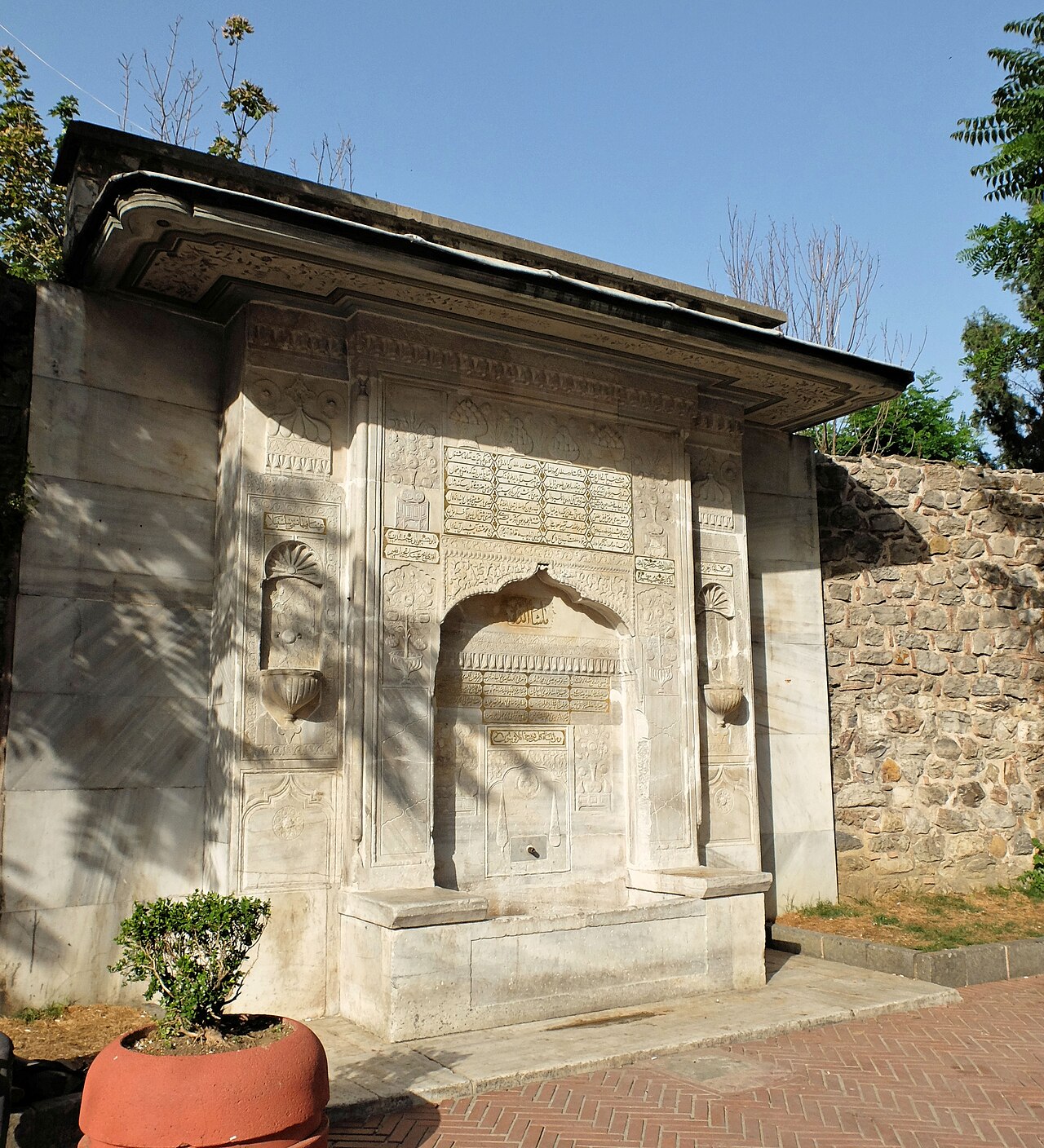
Galata Tower was located on the highest point of the Galata walls, commanding a magnificent view of the Golden Horn and the southern end of the Bosphorus. It was built during the mid-14th century in an area which, according to historian Scarlatos Byzantios, used to be a burial ground during the time of Justinian (527-565).
During early 14th century, the Genoese, equipped with the privileges gained from the Byzantine Empire, begun to build fortifications around Galata. They were increasing their influence by taking advantage of the authority gap caused by the throne fights between Ioannes VI Kantakuzenos and the young co-emperor Ioannes V Palaiologos. Although the Genoese were not permitted to build towers, they used an opportunity which presented itself when Kantakuzenos fell ill in Demotica, and built the Galata Tower in 1348 at the most commanding point of Galata. In 1349, they connected the city walls to the tower. In 1444, the height of the Tower was raised – close to its current height.
The Byzantine sources refer to it as “Megalos Pyrgos” (meaning “Great Tower”), while Latins were calling it “Christea Turris” (Tower of Christ). A 1422-dated Istanbul map by the Florentine cartographer Cristofore Buondelmonte shows the tower with a conical cap with a cross on top. A letter by San Savino of Chiot to Pope Nicolas V also confirms that the tower used to have a big cross on the top.
† Because the tower that once stood on the site of the Kurşunlu Mahzen Mosque, on the side nearer the sea, was also called the Tower of the Cross, old books sometimes confuse that tower with the Galata Tower.
Again according to San Savino of Chiot, Sultan Mehmed II shortened the tower by having it cut 10 arşın (about 7 m) from the top, as a display of power.
Galata Tower took serious damage during the 1509 Constantinople earthquake, referred to as “The Lesser Judgment Day” by contemporaries. Reportedly, most parts of the tower had collapsed. The restoration work by Architect Murat bin Hayreddin was completed in 1511.
The look of the tower in the 16th century can be seen on an Istanbul miniature created between 1533 and 1535 by Matrakçı Nasuh, an Ottoman cartographer and miniaturist. The miniature is in the Irak Seferi Menzilnâmesi (Iraq Expedition Journal), and it is kept in the Library of Istanbul University. On this miniature, the Galata Tower is depicted as a massive round tower with a conical cap.
In his Book of Travels, Evliya Çelebi says that from nowhere can one see the entire circuit of the walls of Istanbul, and its triangular shape, except from Galata Tower, and he adds:
“In clear weather, the Mountain of Monks (Cebel-i Ruhban, today Uludağ) which looms over Bursa is visible, and even the buildings of Bursa can be seen through a spyglass. This tower, cylindrical in shape, is visible from three parasangs’ distance. The tower interior was a dungeon in ten layers; it is now a storage for Ottoman naval equipment.”
Clearly, it was an exaggeration that the buildings of Bursa can be seen through a spyglass. For these lines, the famous Turkish poet and essayist Salah Birsel (1919-1999) pokes fun at him: “If you use a spyglass, you can even see Bursa’s marketplace from the Tower, but our Evliya didn’t mention it because it would hardly be convincing.”
† It is also said that Takiyüddin (1520-1585), the Arab astronomer and mathematician who made his name with the astronomical observations he carried out while serving as a kadı, made observations at the Galata Tower in 1574. Tayyarzade Ata’s book “Tarih-i Atâ” likewise relates that, with the support of Hoca Sadeddin and Sokollu Mehmet Pasha and by decree of Sultan Murat III, the tower on the heights of Tophane was repaired and an observatory was set up there under Takiyüddin’s direction. According to this account, because the tower soon fell into ruin, the observatory survived here only until 1580. That the observatory was in the Galata Tower has not, however, been scientifically proven. Semavi Eyice writes that Takiyüddin may have made use of the Galata Tower for some temporary observations, but that the observatory proper was near the Gritti Mansion on the heights of Tophane.
In the 16th century, the Tower was used for a while as a dungeon for Christian prisoners of war who were put to work at Kasımpaşa Shipyard. French traveler Pierre Lescalopier, who visited Istanbul in 1573-74, confirms that the Tower was being used as a dungeon. Also, Michael Haberer of Bretten, who was a captive in Istanbul between 1582 and 1588, mentions that about 1,500 prisoners were being held in a tower in Galata. The Ottoman Galata was notorious for frequent fires because most of the buildings were of wooden frame construction. For this reason, the Galata Tower was used as a fire observatory post from 1717.
Istanbuliot geographical author P. Ğ. İnciciyan mentions that in the 18th century the midnight hour was being announced by beating drums at the top of the Galata Tower. Based on a petition from 1780 for the repair of some musical instruments, Semavi Eyice, a well known Turkish art historian suggests that there may also have been a janissary band camp in the Tower during the 18th century.
† According to Eyice, in the course of the 18th century the Galata Tower was assigned to the fire-watchers and to a mehter band. Vahidi, one of the poets of the period, also mentions in a kaside dated 1797/1798 that the nevbet was sounded in the tower. The tower, then, had also taken on the character of a kind of “town tower” where kettledrums were beaten, much like the bell towers of the West – which the French call “beffroi” and the English “belfry.”
The conical roof of the Galata Tower, made of lead and wood, was burnt down in a fire in 1794, during the reign of Sultan Selim III. After the fire, the walls of the Tower were shortened by about 2 meters, then a floor was added with oriel windows on four sides, and it was covered again with a conical cap.
† Ayıntaplı Avnî, one of the poets of the period, speaks in one of his kasides of this repair, which left the Galata Tower finer than before. The poem ends with the line “Yenilendi Galata Kullesi pek oldu güzel” (“The Galata Tower has been renewed and has become most beautiful”), 1209 (1794–1795).
In 1831, the Tower caught fire again, destroying the top floor and the conical cap. During the ensuing restoration work, a high-ceilinged level with 14 windows, another 14-windowed observation level on top, and an all-around balcony were added. Also, the roof was covered with a steeper conical cap. (The inscription above the entrance of the Galata Tower, an epigraph by poet Pertev, tells about the restoration work and that it was carried out upon the order of Sultan Mahmud II.) After a strong storm in 1875, the framework of the roof was heavily damaged and replaced by an octagonal wooden frame cupola. Italian author Edmondo de Amicis, who visited Istanbul during the second half of the 19th century, says: “The city of Galata is shaped like an open fan, of which the tower, placed on the crest of the hill, represents the pivot.”
The Tower remained in this shape until its final restoration in 1964. In its current form, according to Semavi Eyice, the first three floors of the Tower are entirely of Genoese work, while the rest was made by Turks. Indeed, the technique used for stairs between the third and fourth floors is different from the stairs between other floors. Today the stairs from the main entrance to the fourth floor is of stone, and lead up in a tunnel embedded into the wall. From the fourth floor up, the stairs are of wooden construction. The fifth floor has seven cannon ports. Semavi Eyice notes that the pointed brick arches of these ports leave no room for doubt that they were made by Turks.
Then and now
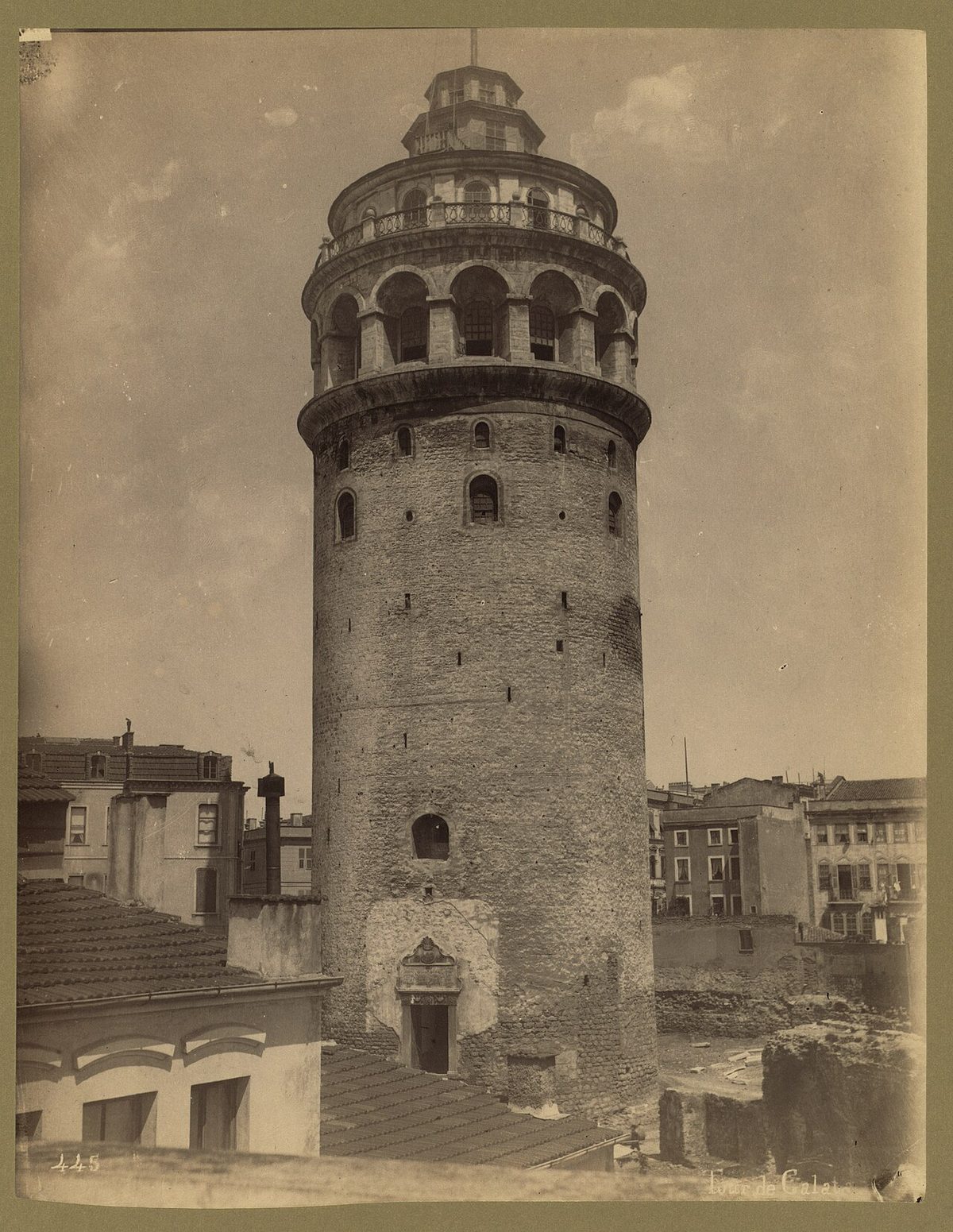
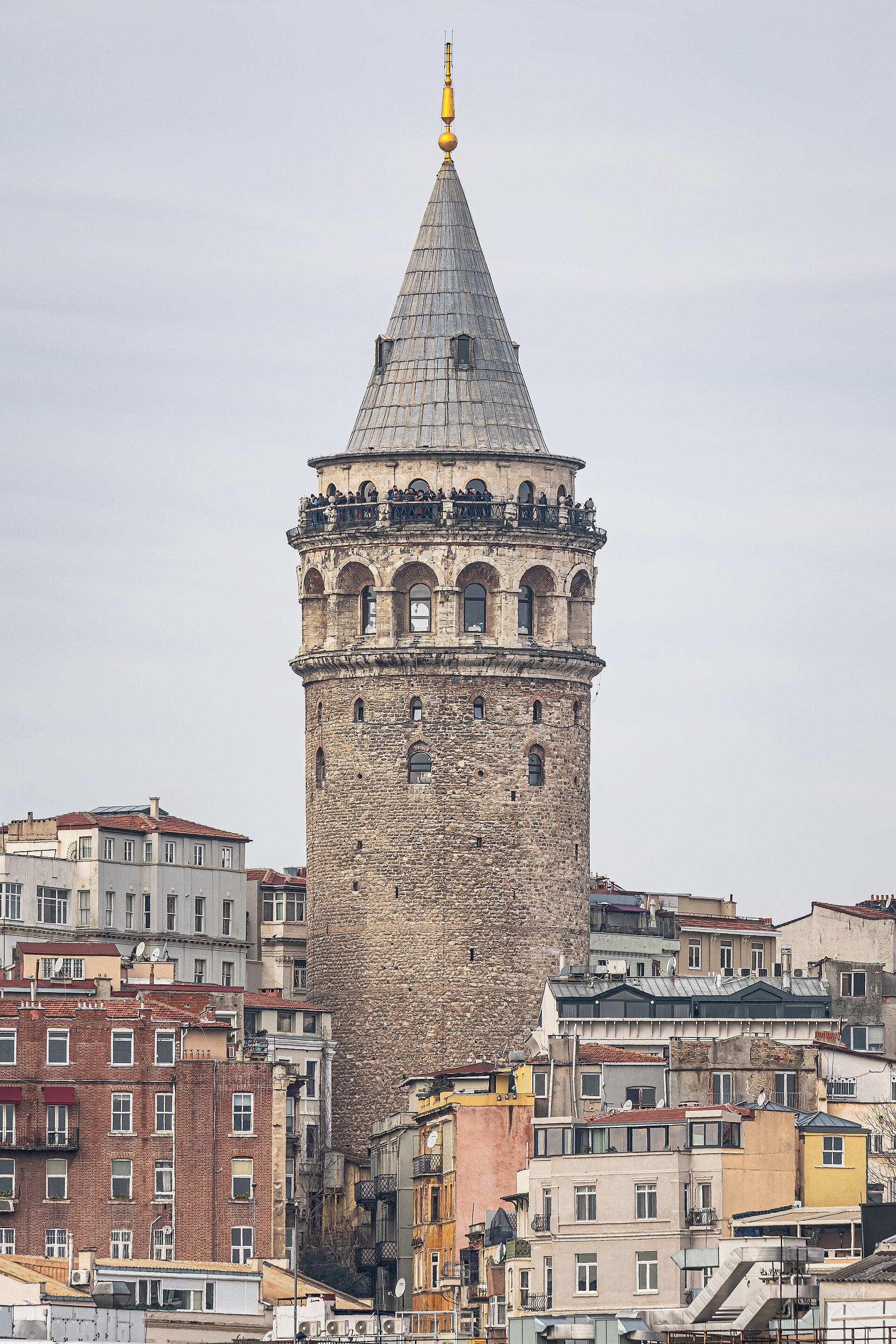
The tower with its upper floors as they were before the 1964 restoration. Historic photo: Abdullah Frères, 1880 (Public domain), Wikimedia Commons
Part of these themes: Genoese Galata
Source: Akdoğan Özkan, A Traveler’s Guide to Galata (Nar Turizm, 2016), translated by Volkan Ersoy. Obvious misprints in the printed edition have been corrected. Paragraphs marked † appear only in the 2017 Turkish edition of the book (Galata Gezi Rehberi) and were translated for this site.
Last updated: · Last checked: (admission)
Spotted a mistake or something missing on this page? Suggest a correction