Galata Mevlevîhânesi, or Galata Dervish Lodge, is probably the oldest of the still-standing dervish lodges and cloisters in Istanbul – once, there were more than 300. It was built in 1491, on the foundations of the Agios Theodoros Monastery (from the Byzantium era) in an uninhabited area just outside the Galata walls. When the city’s first plague outbreak claimed many lives in the 6th century, men were hired on St. Theodoros’ order to dig graves on this hill (which would later be named after him). As the body count was growing, the historical sources report, St. Theodoros commanded the hired men to jump on the bodies to squeeze them into the graves.
† In a sense, then, this hill became Galata’s City of the Dead.
Evliya Çelebi, famous Ottoman traveler and author of the 17th century, wrote the following about Galata Mevlevîhânesi:
“In Galata, on top of the mountain outside the Kule Gate is Hazret-i Mevlana Celaleddin-i Rumî Mevlevîhânesi. This pinnacle dervish lodge was built on behalf of İskender Pasha, and it is comprised of a hundred dervish cells.”
İskender Pasha (d. 1506), one of the grand viziers of Sultan Bayezit II, had this dervish lodge built in the lands of his hunting lodge. As it was outside the Kule Gate, it was also called as “Kulekapısı Mevlevîhânesi” for long years.
† Had we wished to reach the lodge from the walled city of Istanbul – that is, from the Eminönü side – in the 17th or 18th century, we would first have crossed the water near Yemiş İskelesi in the narrow boats called perama. We would then have followed the slopes through the old Genoese quarters, making a tiring climb to the northern edge of the Galata walls. From there, passing through the Kule Gate, we would have left the land walls of Galata, and with them the city, behind. This would have brought us to the path where Galip Dede Street runs today; following it through open country and woodland, we would have arrived at the building that old Turkish texts call the “Kulekapısı Mevlevîhânesi.”
The woodland between the dervish lodge and the Galata walls were inhabited during the course of time by Muslim neighborhoods, and the area has lost its resort character. After some time, the dervish lodge was surrounded by other buildings, and remained inside the Şahkulu Neighborhood which grew around the Şahkulu mescid.
Just next to the dervish lodge’s entrance gate is a public fountain (sebil) which was built on behalf of Halet Efendi in 1819. Passing through the gate, you will see the lodge’s burial area on the left hand side, and its well-kept garden on the right hand side.
The first sheikh of this oldest dervish lodge of Istanbul was Semaî Mehmed Dede, also known as Sheikh Divânî. After the first three sheikhs it was abandoned, and then used as a cloister for a while, and finally, during the early 17th century, it was returned to its original function through the efforts of its fourth sheikh, Sırrı Abdi Dede.
In time, the structure was expanded with various additions, and transformed into a full-scale convent with annexes, tombs, a library and a large burial area.
Around 1765-66, the convent suffered great damage during the great fire of Tophane, and the original building was destroyed. It was repaired by Sultan Mustafa III. The next comprehensive restoration was carried out through the efforts of Sheikh Galip Dede, the 24th sheikh of the convent and the last grandmaster of the divan literature. Galip Dede had informed the Sultan about the destitute condition of the convent with a poem titled “Kasîde-i Tannâne” (lit. “Resonant Eulogy”) attached to his petition, and Sultan Selim III, also a follower of the Mevlevi order, had agreed to restore the building (in 1791-1792).
Sultan Selim III would occasionally summon Galip Dede, or sometimes visit the convent himself to attend to the rite and invocations, bestowing rich donations afterwards.
19th century was not short of fires and ensuing restorations and donations for the convent. During such restorations other additions – such as fountains, a sebilküttâb (a building with a fountain on the ground floor and a school the children of poor families on the first floor), a library, a cistern, a laundry, and tombs – were also made to the convent. The main building and most of the annexes took their current forms during the restorations of 1859-60 by Sultan Abdulmecid, although other small restorations followed until the end of the century.
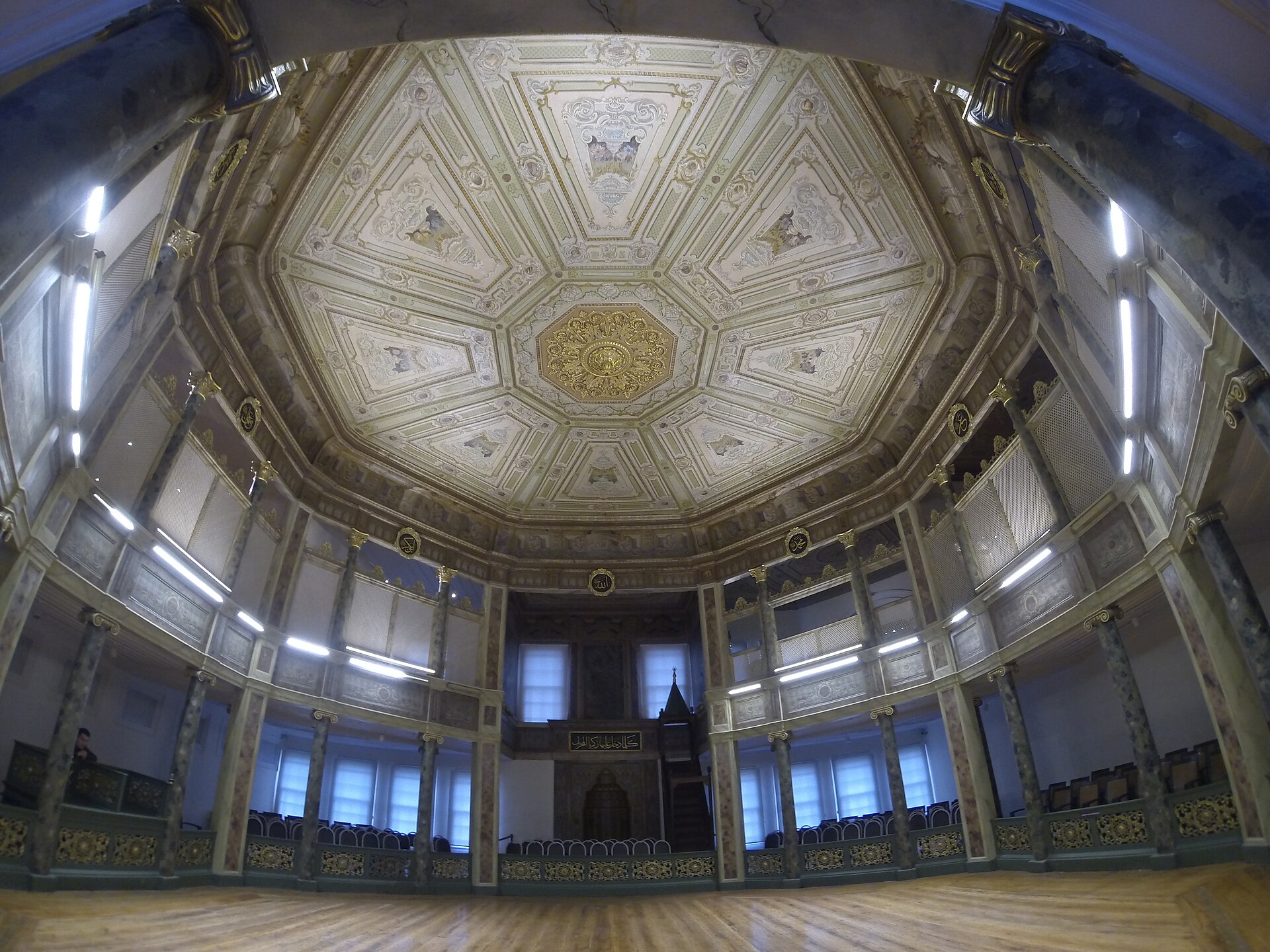
† The first of these works was carried out in 1819 by Hâlet Efendi, one of the well-known figures of the reign of Mahmud II. Hâlet Efendi had the present main gate built, together with the sebilküttâb beside it – made up of a sebil, a fountain, a timekeeper’s room (muvakkithâne) and a library-school – and his own tomb, which adjoins the gate. He also had the courtyard paved with marble and the dervish cells repaired, and rebuilt the tomb in which Sheikh İsmâil Rusûhî Dede of Ankara and Sheikh Galib Dede are buried. Not content with this, he donated 813 works to the library and endowed lands and farms, most of them in Greece, for the care of the books, the running of the library, the salaries of its staff and the welfare of the dervishes of the lodge. In 1824 another fire burned nine cells, the mescid and the kitchen to ashes. Four years after the fire the dervishes were still sheltering in worn-out tents, and Sheikh Seyyid Kudretullah Dede wrote a petition to the grand vizierate describing the situation and asking for it to be put right. Mahmud II first had the tents renewed and then, in 1835, had the lodge rebuilt. In 1847 his daughter Âdile Sultan had a cistern, an ablution fountain and a laundry added. Abdülmecid had the Hasan Ağa Fountain in the courtyard repaired in 1851-52 and the matbah-ı şerif rebuilt the following year; in 1859-60 he had the main building – which contains the semâhâne, the selâmlık and the dervish cells – rebuilt in its present form. The lodge underwent further repairs in the reigns of Abdülhamid II and Mehmed V Reşad.
Visiting the convent to see the whirling dervishes’ ritual (“sema”) was popular amongst the 19th century travelers who came to Istanbul. Edmondo de Amicis, the famous Italian novelist who visited the city in 1874, wrote the following about the dervishes in Galata Mevlevîhânesi:
“What I did see among those men, and they were of all ages and aspects, was a grace and elegance of movement that might well be envied by some of our drawing-room dancers.”
The land of the convent was once larger than today. In 1899, some part of the land was used for building the German High School. After the closure and illegalization of the religious lodges in 1925, the main building was turned into a social community house (“halkevi”), and the sebilküttâb was transformed into a police station. A part of the burial ground on Şahkulu Bostanı Street was reclaimed between 1945 and 1947 to construct the Beyoğlu Marriage Office on it. The wooden tombs at the entrance of the sema house, the seraglio, the matbah-ı şerif (kitchen and novitiate in a dervish lodge), and other annexes were demolished in the process.
Galata Mevlevîhânesi – at least, a part of it – has survived until today thanks to the efforts of the Turkish Touring and Automobile Foundation, and especially of Reşit Saffet Atabinen and Hamdullah Suphi Tanrıöver. The dervish lodge was turned into a museum with a 20 year delay: After four years of comprehensive restoration work, the building opened doors to public in 1975 as the Museum of Divan Literature.
The headstone of İbrahim Müteferrika’s grave, found in Hasköy, is now in the courtyard of the lodge. Also, French army officer Claude Alexandre de Bonneval – who entered into the service of Ottomans in 1729, and changed his name to Humbaracı Ahmet Pasha – was buried here. Ahmet Pasha had worked for the reformation of the Ottoman army and established a military engineering institution.
Following the restorations between 2007 and 2011, the building was reopened in November 2011 – this time as the Galata Mawlawi House Museum. Today, various musical instruments and dervish articles from different eras, poems of divan poets, and the handwritten manuscripts of famous personalities raised in the lodge (Sheikh Galib, Sheikh İsmâil Rusûhî Dede of Ankara, Esrar and Fasih Dedes, and the women poet Leylâ Hanım) are exhibited in the museum. The museum is open for visits every day except Mondays; it is also closed half day on the first days of Ramadan and Sacrifice holidays. The sema rituals (the performance of whirling dervishes) are on Sundays; also, Şeb-i Arûs ceremonies (the Night of Union which marks the anniversary of the death of Rumi) are held on 15th, 16th, 17th, 29th, 30th, and 31st days of every December.
Part of these themes: Ottoman Galata: Tophane and Azapkapı · Taverns, music and entertainment
Source: Akdoğan Özkan, A Traveler’s Guide to Galata (Nar Turizm, 2016), translated by Volkan Ersoy. Obvious misprints in the printed edition have been corrected. Paragraphs marked † appear only in the 2017 Turkish edition of the book (Galata Gezi Rehberi) and were translated for this site.
Last updated: · Last checked: (address, map position, opening hours and admission)
Spotted a mistake or something missing on this page? Suggest a correction