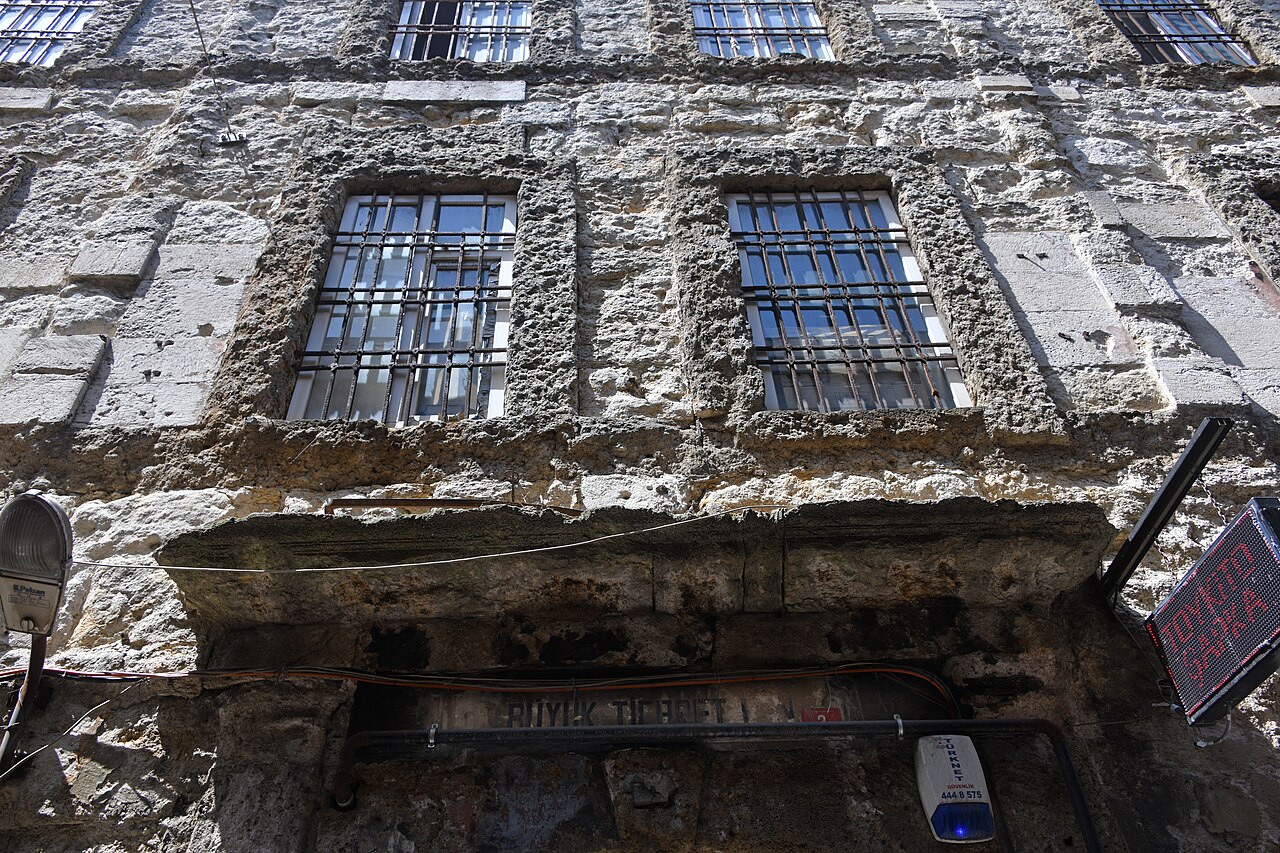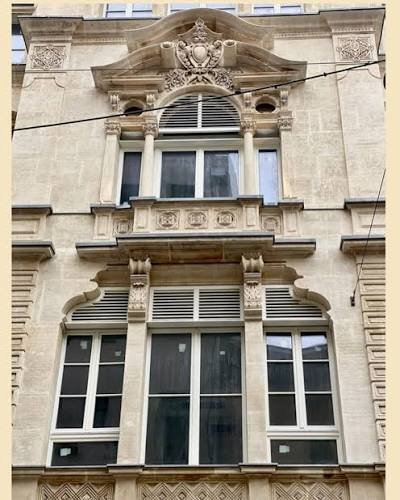
Like the Ottoman Bank building, Hezaren Han was designed by Alexander Vallaury, and it opened doors in 1903 after a record-breaking construction period of 5 months. Not counting the basement and the ground floor, the building has 4 floors. Three floors of the building were rented by Société du Tombac (Tobacco Company), and the other floor was occupied by Banker Eugenidi. Hezaren Han features one of the most eye-catching façades on Bankalar Street. The motifs on the facade are in a dynamic flow, with a certain Art Nouveau style. As a whole, it represents a mixture of Art Nouveau, Baroque and Neoclassical styles. The windows on each floor have a different design. The oriel bay that projects above the ground floor is supported by corbels decorated with acanthus leaves. Similar Baroque-style corbels can also be found on the 1905-built Varış İş Hanı up the street (at no.32). The three-part window group on the second level of the oriel bay features neoclassical style plasters of Ancient Greece and Rome architecture.
Philanthropist Banker: Christakis Zografos
Christakis Zografos (1820-1898) was born in the small village of Kestorat in the Northern Epirus region of Albania. After graduation he came to Istanbul to work for his father. After a while, he opened with a partner a small currency exchange office in Galata. This was young Christakis’ first introduction to the finance market.
In the course of time, Christakis Zografos became a banker. Between 1854 and 1881, he was amongst the prominent bankers who help the Ottoman government finding loans from the international finance markets. He was now known as Christaki Efendi. In 1864, he became one of the founding partners of Societe Generale de L’Empire Ottoman, a bank that came to be known as “Societe Generale” (or, in Turkish pronunciation, “Sosyete Jenerali”). In 1870, he also became a partner of the newly founded Istanbul Tram Company.
Through his close relations with the court, he had a voice in the financial policies of the state. Christaki Efendi earned the trust of, and was awarded by, three successive Sultans.
He also acted as the chairman of the Greek community’s Mixed National Council (Muhtelit Milli Meclisi) for long years, and made numerous donations to the community. In his home place in Epirus he founded a male and female teachers college. He donated 10 thousand gold liras for the construction of a six-storey school in Beyoğlu (Zografeion Lyceum). He had only two conditions for this donation: It should be a science lyceum, and its running costs should be covered by the Beyoğlu Community who would also be responsible for administration of the school. The Zografeion Lyceum opened doors for education on 19 September 1893.
Christaki Efendi was also a prominent name in Yeniköy district. In 1870 he founded a girls’ high school in Yeniköy. This school was burnt down in 1950, and evacuated in 1954. From then until recent times, the building, a property of the Greek Orthodox Church, was allocated to the service of poor families. In 2012 it was rented to the Kadir Has Foundation to be used as a college.
Christakis Zografos was also the first mayor of Yeniköy municipality. La Turquie newspaper of 24 January 1874 informs its readers that Yeniköy Municipality, headed by Christaki Efendi Zografos, was established with a decree of the Sultan.
The Cite de Pera – known also as Christaki Passage, or today, as Çiçek Pasajı (Flower Passage) – was also built by Christaki Zografos, in place of Naum Theater that was burnt down during the 1870 Great Fire of Pera. It was designed by Cleanthe Zonno, and opened doors in 1876 after two years of construction. The ground floors of the passage were occupied by the flower shops and flower auctioneers. The building is a three-storey structure including the ground floor. In 1908, the Grand Vizier Said Pasha bought it from Christaki Efendi. In the following years, the children of the Grand Vizier lived in the flats of the upper floor. During this period the passage was known as “Said Pasha Passage.”
From the 1940s, beerhouses and taverns were opened in the passage, causing the residents and flower shops to gradually abandon the place. After some time, only the name “flower” remained from those shops.
Zografos’ son Yorgo Christakis Zografos (1863-1920) completed his doctorate in 1888 in Paris Law School, and became a diplomat. In 1914, he temporarily acted as the state president of the Autonomous Northern Epirus Republic. With the outbreak of the World War I he went to Greece and took an assignment as a bank director, and then, as the Minister of Foreign Affairs.
Father Christaki Efendi, although earning the trust of the Sultans, was also one of the important names behind a court plot concerning some jewelry. The beginning of the story dates back to 1876, a difficult year for the Empire. At the time, the Ottoman government had declared bankruptcy because of the piling domestic debts during and after the period of Tanzimat (Reformation), as well as because of the foreign debts caused by the Crimean War of 1853-1856.
In 1876, Sultan Abdülaziz had been deposed and the new Sultan Murad V was receiving loans from Christakis Zografos since the time when he was just a prince. He had already owed a large sum of debt to Christaki Efendi.
After Sultan Abdülaziz’s dramatic dethronement in 1876, his assets in cash and bonds were seized, while some of the court jewelry was confiscated by Şevki Efsar Valide Sultan, the mother of the new Sultan, and by her chief ally Damat Nuri Pasha, who was appointed by Sultan Murad V as the new Mabeyn Müşiri (Lord Marshall). The confiscated jewelry also included trays of diamonds and gold coins given to the court as gifts for Murad’s ascension. The pieces of jewelry were counted and documented one by one, before being stored in chests. Seized cash money was reserved for the costs of Murad’s ascension ceremony. Bonds with a worth of 7.4 million lira, and 3,106 equity shares of Rumeli Railways were transferred to the Bank-ı Osmani (Ottoman Bank) in return for the debts of the Treasury.
As for the jewelry, it was pledged to Christos Efendi (who wanted to collect the loans he had made to the Sultan as soon as possible), because he had proposed to grant “a new loan of 247.5 thousand Ottoman gold liras” to the indebted Treasury. However, he would hold back 211.5 thousand gold liras out of this loan for the debts of Murad V from his princehood time. “I will also hold the jewelry in pledge until the repayment of the debt,” he said.
Apparently, Christaki Efendi had understood that the instability in the Empire would last a long time, while the reign of Sultan Murad V would be short-lived: After a while he transferred the personal debts of the Sultan onto the Treasury, and took the pledged jewelry with him to Europe. According to the researchers, with this last move, Christaki Efendi aimed to prevent any future lawsuits against him for the jewelry which actually belonged to the Ottoman dynasty. Murad V was deposed after reigning for only 93 days, and his successor Sultan Abdulhamid II too found himself in need of money to be able to secure his power. By the way, Christaki Efendi’s agreement with the previous Sultan was about to expire on 27 August 1877, and he would earn the right to put the jewelry on sale within one month of its expiration. Therefore, Sultan Abdülhamid proposed a new agreement to Christaki Efendi, who was in Paris at the time. With this agreement, and under the guarantee of Banker Zarifi, 37 real estate properties in and around Istanbul were pledged to Christaki Efendi, and the jewelry were returned to the Ottoman dynasty.
However, during the 31 March Incident (13 April 1909 on the Gregorian calendar) Abdulhamid II was deposed, and a group of insurgents ransacked the Yıldız Palace. The jewelry remaining from the pillage was auctioned and sold abroad by the Committee of Union and Progress (İttihat ve Terakki).
Part of these themes: Banks and hans · Architects and apartment buildings
Source: Akdoğan Özkan, A Traveler’s Guide to Galata (Nar Turizm, 2016), translated by Volkan Ersoy. Obvious misprints in the printed edition have been corrected.
Last updated: · Last checked: (address and map position)
Spotted a mistake or something missing on this page? Suggest a correction