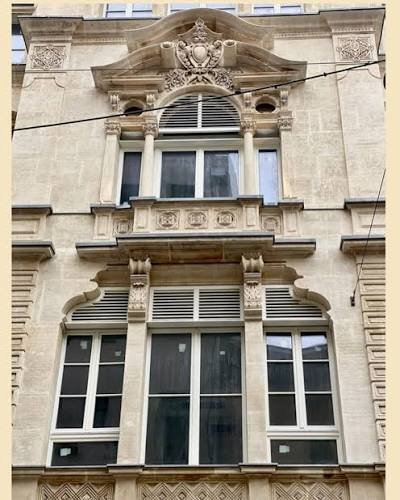
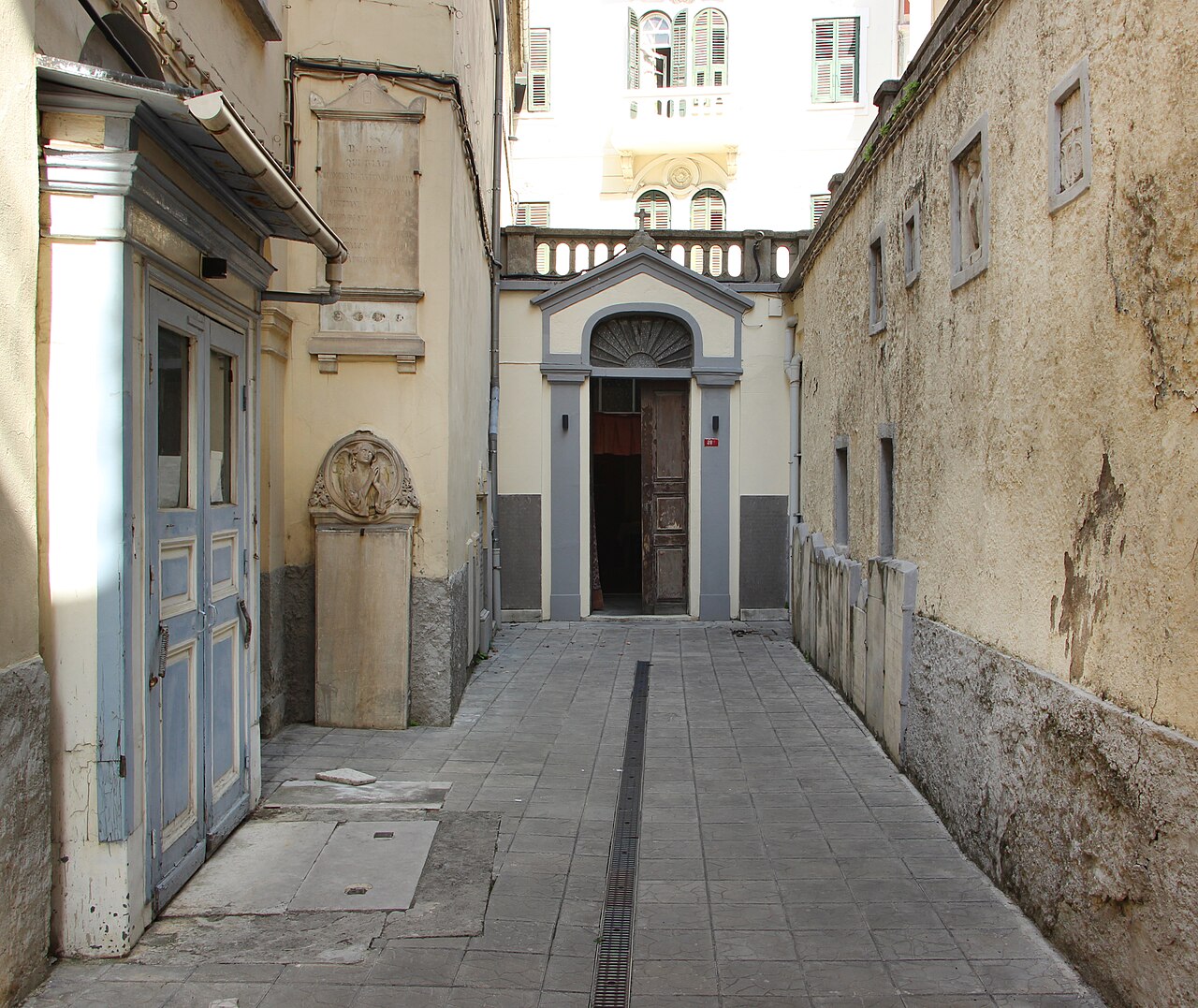
The Saint Pierre Han was built in 1771 upon the request of François-Emmanuel Guignard, the Count of St. Priest, and France’s envoy to Istanbul between 1768 and 1785. His purpose was to establish a bank and a lodge in Galata.
Built with bricks and cut-stones using the drywall method, the façade of the building bears the insignia of the Kingdom of France and the Count of St. Priest. A marble plaque on the same façade reads that Andre Chenier, a poet beheaded during the French Revolution, was born in the building. However, its accuracy is doubtful because Chenier was born 9 years before the construction of the building. The historians argue that the poet might be born in one of the buildings of the Dominican monastery, which was located on the same plot before St. Pierre Han, but burnt down during a fire in Galata.
During the second half of the 19th century, Saint Pierre Han was mostly occupied by French capital investors. However, the administration office of the “first” Ottoman Bank, founded in 1856 by British capital, was also located here. In 1863, it was merged into the new Bank-ı Osmanî-i Şahane (the Imperial Ottoman Bank), which was financed by British and French capital. For this reason, the Oriental Trade Directories issued after 1868 do not list the Ottoman Bank among the tenants of Saint Pierre Han.
More importantly, the building was the heart of the Empire’s architecture circles. Between 1910 and 1921, eight architect’s offices were opened in the han. When the building was rented out room-by-room, the total number of the architect’s offices operating from the han increased to 23 within 37 years. The architects who had an office in Saint Pierre Han included Marco G. Langas, Giulio Mongeri, and Emilio Faracci. One of its longest-staying tenants was Alexandros Yenidünya (from 1913 to 1931), an architect who is known with his unique Art Nouveau approach. Alexandre Vallaury, one of the period’s most important architects in Istanbul, also had an office here between 1920 and 1921.
Also, Saint Pierre Han became home to two architects’ associations – “Association des Architectes et Ingénieurs en Turquie” and “OMANIA (Association Ottomane des Architectes et Ouvriers Maçons)” – between 1911 and 1921.
The other tenants of the han included Mayer Amschel Rothschild’s “Societe Generale d’Orient” (1896-1897), Chamber of Commerce of Italy, Chamber of Commerce of Greece, Küçük İstikraz Sandığı (Small Loans Fund; 1930-1942), and some insurance companies.
Later, Saint Pierre Han fell from grace and became home to various manufacturers and workshops for long years. Recently, it was rented to Bahçeşehir University. As of mid-2014, it is waiting for restoration to be converted into a cultural center.
An interesting fact about Saint Pierre Han is that Turkey’s first blue jean fabrics (i.e. denim) were produced here during the 1950s.
Blue Jean Production at Saint Pierre Han
An interesting fact about Saint-Pierre Han is that Turkey’s first blue jean fabrics (i.e. denim, or “kot” in Turkish) were produced there. In fact, “kot” is the last name of Muhteşem (Kot) Bey, a businessman of Albanian origin who first introduced this fabric into Turkey by manufacturing it in his facilities at Saint-Pierre Han. In other words, it is a typical case of a brand name becoming a generic category name – like it happened with Gillette, or Jeep.
Muhteşem Kot was born in 1925 in Kosovo and his family moved to Edremit in Turkey when he was a young boy. During the first half of the 20th century, he went to Paris with eight gold lira inherited from his father, and studied tailoring. On his return to Turkey, he settled in Istanbul and begun working as a tailor, making a name for himself with his high quality products. During a visit to France in late 1940s, Kot saw garments made of blue jean fabric. This textile, made of indigo warp threads and natural color (white) weft threads, was already getting popular in Europe. Fascinated by the strength and stitching of the textile, Kot decided to produce it in Turkey.
It’s a pleasant coincidence that Kot had first seen the blue jean textile in France, and chosen Galata, an old Genoese colony, to establish his manufacturing facilities – because, blue jean takes its name from the color of the clothing worn by the Genoese sailors: “Blue de Gênes” in French, or “Genoa blue.”
The story of denim itself is also interesting. The protagonist of the story, Levi Strauss was a German immigrant who came to USA in 1853, when he was 24 years old. Strauss was producing canvas trousers for miners during the Gold Rush period, but decided to change its textile upon miners’ complaints that it was too coarse and hurting their legs. So he replaced canvas with a sturdy cotton warp-faced twill textile from the Nimes city in Southern France. This fabric with diagonal ribs was called “serge de Nimes” (fabric with diagonal ribs from Nimes). Once it crossed the Atlantic, its name was first shortened to “de Nimes,” which became “denim” in the course of time.
Ironically, the city of Nimes was first introduced to the ancestors of this fabric by the Ottomans in the 18th century. Nimes had developed this style of weaving by importing blue and white cotton fabric from Turkey. It is not surprising though, because in the 15th and 16th centuries the Ottoman textile and weaving industry was only second to the Indian textiles.
According to İnalcık, “The first prototypes of blue jean were produced in the southern provinces of the Ottoman Empire, and then the fabric was adopted by the Spanish as a type of clothing worn by plantation workers. Then, it spread to the world.”
In other words, Muhteşem Kot, probably without being aware of its roots in Anatolia, reintroduced a contemporary version of the fabric to Turkey. As soon as he returned from France, he began the trials to manufacture the same kind of denim at his facilities in Saint-Pierre Han in Galata. He first tried to sell it through door-to-door marketing in the commerce centers of Galata. In time, the pants made of his denim fabric became the sought-after products of many clothing shops all around Turkey. When Muhteşem Kot died in 1958, his company was producing 200 denim pants per day. After his death, his business was inherited by his wife, his brother-in-law, and his son Aytaç Koç – who, like himself, studied tailoring in France, at the “Institut Ladevèze-Darroux.”
In 1960, the family applied for a trademark registration, and registered their denim products under the brand name “Kot.” Now very popular amongst the workers and farmers, the “Kot” brand participated in 1978 to the first Blue Jean Fair in Europe: the times were changing and giving way to the era of stone-washed denims. Kot followed the suit and used pumice stones to wash their denims.
1980s was a period when Prime Minister Turgut Özal abandoned protective policies and opened Turkey’s doors to the free market economy. In this period, the sales of foreign brands boomed and Kot Company began to have difficulty competing against them. When business took a turn for the worse, Kot stopped production in 1992, and rented their factory building. This would be the end of Kot brand’s journey in Turkey.
Maybe Kot was successful enough to give its name to a generic category of fabric, but, as Aytaç Kot confesses, they “failed to make consumers aware that ‘kot’ is not a type of textile but a brand.”
Aytaç Kot attempted to create consumer awareness by using the marketing motto “kot is not Kot,” but without much success. Consumers went on thinking that blue jean was a type of fabric developed by Americans, and “kot” was simply the Turkish translation of the word.
Ultimately, Kot Company was erased from the history, but its name slipped into the everyday Turkish language in sentences such as “I bought a Levi’s kot today.”
Part of these themes: Banks and hans
Source: Akdoğan Özkan, A Traveler’s Guide to Galata (Nar Turizm, 2016), translated by Volkan Ersoy. Obvious misprints in the printed edition have been corrected.
Last updated: · Last checked: (address and map position)
Spotted a mistake or something missing on this page? Suggest a correction