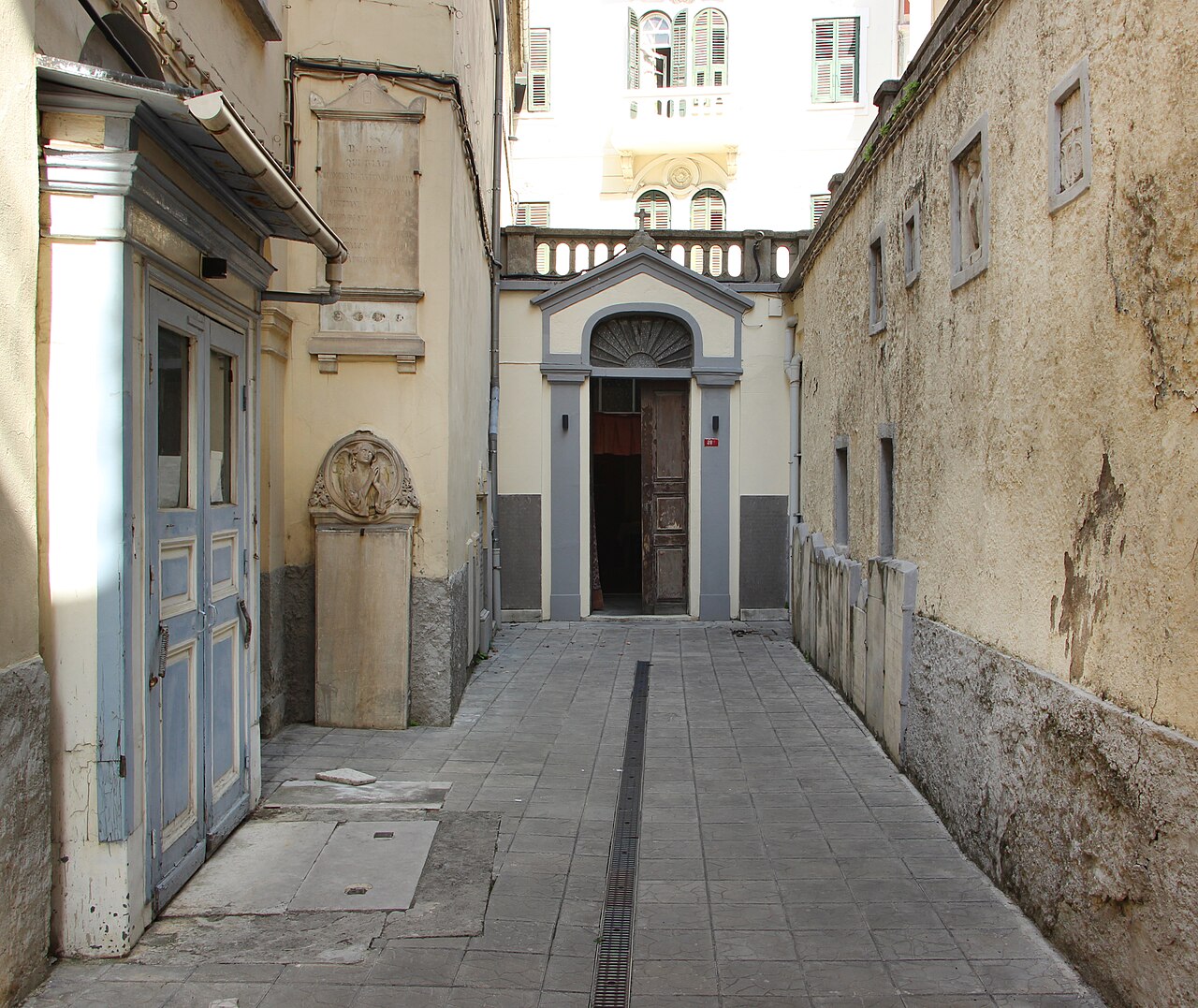
The Latins had built 9 churches in Galata by the end of 18th century. Amongst them, only three medieval Latin-rite churches are still standing. Saint Pierre Church is one of them and it is located in Bereketzade neighborhood, near Saint Georges Church.
When the Dominican St. Paul Church in Galata was converted to a mosque (Arap Mosque) after the Conquest, its Catholic community lost their sanctuary. However, Angelo Zaccaria, a Venetian nobleman, donated his own land – which was adjacent to the lot of Arap Mosque – to the Dominican priests.
It is believed that the priests moved to this lot in 1475. P. İnciciyan writes that since 1525 the priests had on this lot a small masonry church, named as Sen Piyer and Sen Paul (Saint Pierre and Saint Paul). The Genoese frequented this church and used the attached monastery until 1603. Later, they built on the same lot a new and more functional church. However, it was burnt down during the fire on 11 April 1660, with only the iron door remaining. Only seven of 20 houses in the vicinity have been saved. Although the community had a new wooden church built here, it was, too, burnt down in the fire of 1731. The building suffered the same fate several times until the 19th century, and it was repaired each time. Finally, the Dominicans decided to commission the famous architect Gaspare Fossati (1809-1883), because he had restored the Hagia Sophia and had the experience to be able to build the most robust church for them. Fossati designed a basilica-type church adjacent to a section of the old Genoese walls. The construction of the new Saint Pierre and Saint Paul Church was completed in 1843, and it is this building that we see at 28, Galata Kulesi Sokak.
The single-nave church is a 35 meter long, 14 meter high and 8-10 meter wide edifice in the neoclassical style, built on a rectangular site. It was built in neoclassical style and has altars on four sides. The dome is worth seeing with stars painted against a sky-blue background. Immediately behind the high altar is a painting depicting the meeting of Saint Paul and Saint Peter, and it was done in 1847 by the Dominican Friar Serafino Guidotti.
In addition to the main altar, there are also four small altars in the church. The first features a painting on canvas by Guidotti depicting the death of Saint Dominic. The altarpiece facing it was made by Francesco Mauro and it portrays Saint Vincent Ferrer. The other two altars are the work of Giovanni Isola, canonized in 1847. One of the altars holds a polychrome painted statue of the Virgin Mary, entirely sculpted in wood, sent from Genoa to Galata in 1856.
But, without any doubt, the greatest treasure of the church is the famous icon of Mary Odighitria (the guide) in the fourth altar. It depicts Virgin Mary, pointing at the child Jesus in her lap. According to Carbognano, the icon was painted on an old piece of wood in Italy. On the other hand, Ernest Mamboury says that it was brought in 1475 from a Dominican church in Kefe (Crimea) to the St. Mary Church (probably to the church in the Cankurtaran neighborhood), and then transferred to this church. The icon was saved from the fire of 1731. A silver bas-relief covers the surface of the icon (except for the faces), in order to protect the painting on it. The scene was copied from an icon by St. Luke (Lucas), the author of one of the gospels.
The church possesses the holy relics of St. Renatus, St. Pierre, St. Paul, as well as St. Thomas and St. Dominic.
† In the 14th century the Church of Saint Francesco stood on the site of the Hırdavatçılar Çarşısı (Hardware Dealers’ Market), about 100 m from this building. On the land of this church, which burned down in 1660, a large mosque known as Yeni Cami was first built by Emetullah Rabia Gülnuş Valide Sultan (1647-1715). The mosque was demolished in 1936, and in the late 1950s the Hırdavatçılar Çarşısı was established on its site. On the shore side of this market there used to be a church dedicated to Saint Michael, the patron saint of the Pera colony, which was also the religious administrative centre of Genoese Galata. When it was demolished in the mid-16th century, the Rüstem Pasha Caravanserai, known as Kurşunlu Han, was built on its site.
Part of these themes: Genoese Galata · Galata's communities
Source: Akdoğan Özkan, A Traveler’s Guide to Galata (Nar Turizm, 2016), translated by Volkan Ersoy. Paragraphs marked † appear only in the 2017 Turkish edition of the book (Galata Gezi Rehberi) and were translated for this site.
Last updated: · Last checked: (map position)
Spotted a mistake or something missing on this page? Suggest a correction