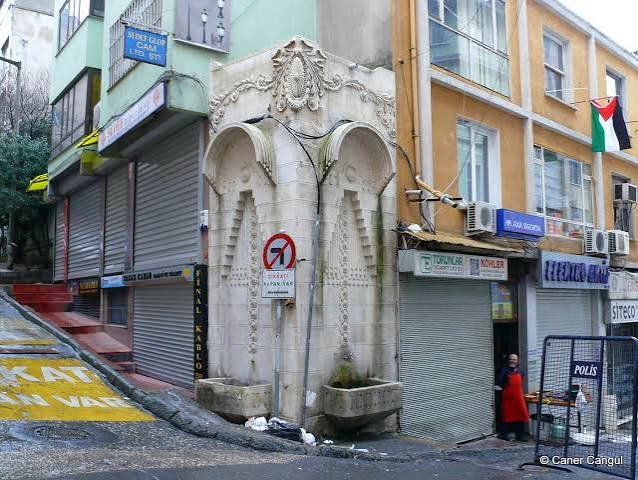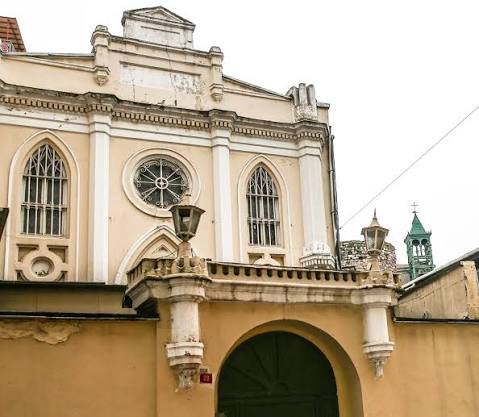
The Genoese sanctuaries in Galata are not limited to Catholic churches, because the region was also inhabited by a large Italian Jewish community. One of their synagogues in Galata was Kal de Los Francos Synagogue, today known as Italian Synagogue.
† According to a memoir note thought to have been written in May 1931 by Leone Piperno, a former secretary general of the community, the history of the synagogue and of its congregation goes back to 1862.
According to the information collected from the community archives and other sources, the synagogue was constructed as a result of a dispute on a steep fee asked from the Italian Jews for a wedding (or burial) service. Reportedly, the Italian Jew community appealed to Comm. Cerutti, the representative of the Italian Kingdom in Istanbul, to ask permission for leaving the central Jewish community. On 16 April 1862, the Italian government officially announced its decision to recognize - and to protect the religious freedom of – the separated Italian Jewish community, on condition that they preserve their Italian nationality.
† What, then, was the official name of the Jewish community in question? The official Latin-Hebrew seal on a document dated 1 February 1859 and certified by the French Consulate in Istanbul refers to the community as “Comunita Israelitico-Straniera di Rito Spagnuolo Portoghese di Constantinopoli,” that is, the “Foreign Jewish Community of the Spanish-Portuguese Rite.” In other words, the Jews who left the central community were at first called the “Community of Foreigners.” The name “Italian Jewish Community” came later.
The Italian Jews first used the synagogue on the Zülfaris Street. Following its destruction, they temporarily rented a place on Küçük Hendek Street, while starting the construction of a synagogue on a plot of land bought on Şair Ziya Pasha Street (formerly, Kuledibi Şahsuvar Street). In 1885, the Ottoman government granted an official permit for the synagogue.
This first synagogue was demolished in 1931, but the Italian Jewish community built in its place the current one. In 1980 it was renovated. The synagogue is worth seeing with its gothic façade and marble stairs. On its wall is an elaborate hand-drawn “shiviti,” probably by a local calligrapher.
Only about 100 Italian Jewish families are estimated to remain in Istanbul today. The synagogue once had an attendance of 300-400, but lately, the attendance is only 25-30 even on special religious days. Ceremonies such as Bar Mitzvah, Bat Mitzvah and weddings are very rare. Although the synagogue belongs to the Italian community, it is open to all Jews.
Rıfat Behar, one of the leading members of the community, talked to the Şalom newspaper longingly about the old days:
“Our favorite pastime was touring around from Tozkoparan up to Galata Tower. All neighborhood shops were closed for Kippur. Sweets used to be sold on the streets during the festival of Purim. On Simchat Torah, the streets were full of lanterns. The synagogues were also full. In our tradition we sprinkle oil in the synagogues, and three barrels of oil used to be brought here on Kippurs. Now nobody does it.”
Part of these themes: Galata's communities
Source: Akdoğan Özkan, A Traveler’s Guide to Galata (Nar Turizm, 2016), translated by Volkan Ersoy. Obvious misprints in the printed edition have been corrected. Paragraphs marked † appear only in the 2017 Turkish edition of the book (Galata Gezi Rehberi) and were translated for this site.
Last updated: · Last checked: (address and map position)
Spotted a mistake or something missing on this page? Suggest a correction