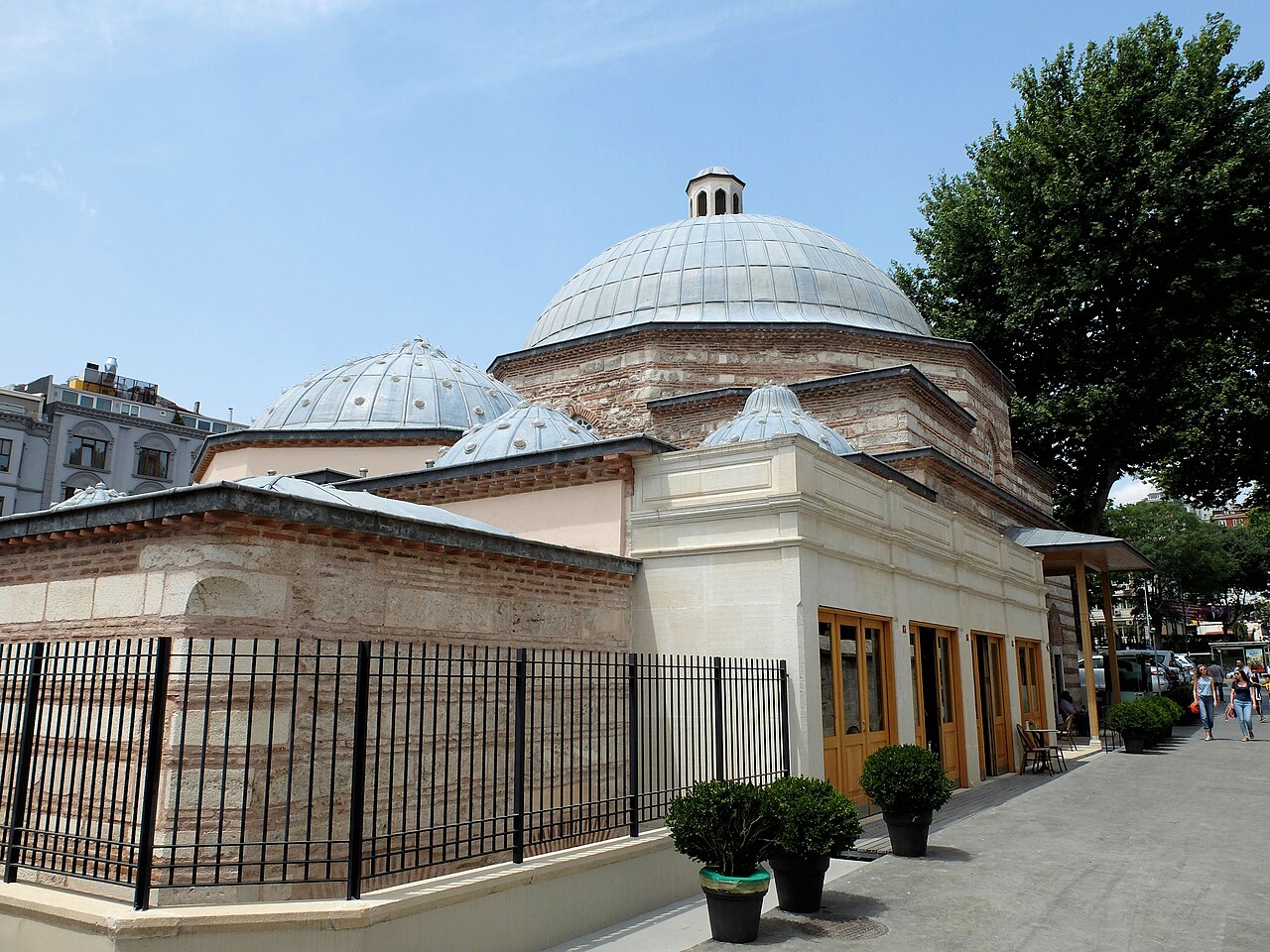
Once located outside the Galata walls, Kılıç Ali Pasha Mosque bears the name of an Ottoman seaman of Italian origin, who has been the Grand Admiral of the Ottoman fleet between 1571 and 1578. Although it is a wharf-side mosque like the Azapkapı Mosque on the west side of Galata, it is the center of the külliye, which is composed of a medrese (Muslim theological school), türbe (tomb), and a hammam. The Kılıç Ali Pasha Mosque, the hammam, and a large part of the Tophane Square were built on land reclaimed from the sea. Kılıç Ali Pasha brought Christian slaves from the shipyard to work for land reclamation, and then, on made ground, he had Imperial Architect Sinan built the complex in 1580.
The plan of the mosque resembles that of Hagia Sophia. Having carefully examined the plan and superstructure of the Hagia Sophia, Sinan applied his own interpretation to Kılıç Ali Pasha Mosque, in a smaller scale and with a different architectural approach. Illuminated by 147 windows, including the 24 windows in the drum of the dome, Kılıç Ali Pasha Mosque gets more light than the Hagia Sophia. As only the Sultan held the right to have mosques with more than one minaret built in the Ottoman Empire, Kılıç Ali Pasha Mosque has only one minaret. For the same reason, its dome is also smaller than the mosques commissioned by the Sultan.
Against the possibility that the slaves might be summoned back to the shipyard before the completion, Kılıç Ali Pasha had also an edict issued for the construction of a church for them in the vicinity. This church was built at the corner of the Galata walls facing the mosque, with bunkhouses around it. The church was later lost to a fire, but reportedly its altar had survived by the end of the 18th century.
The birth name of Kılıç Ali Pasha is Giovanni Dionigi Galeni – referred to as Occhiali, or Ouloudj (Uluç) Ali in the Italian sources. He was born in 1500 – or, in 1519, according to some sources – in a Calabria village as the son of a poor fisherman. Reportedly, he fell captive to Barbary pirates of Algeria in his teens, when he was on his way to Naples to be trained as a priest. He was forced to serve as galley slave for years. Later he converted to Islam, gained his freedom, and took the name Ali. When he became a pirate, he was called as Uluç, a name given to non-Barbary pirates.
He came to Istanbul in 1551 to work at the shipyard; he joined the siege of Malta, and then was promoted to the rank of sancakbey (military governor) of İzmir. He took back Tunisia from Spanish in 1569. In 1571, upon the news that the crusaders set sail against Ottomans, he argued in the War Council to confront them in the open sea, but this idea was rejected by Ali Pasha, then the Grand Admiral. The Battle of Lepanto was held in Naupactus (İnebahtı) Gulf and Uluç Ali Pasha commanded the left flank of Ali Pasha’s fleet. He outmaneuvered the Maltese Knights on the left flank and captured their flagship. When the Ottoman defeat became obvious, however, he succeeded in extricating his ships, and gathered up the scattered remaining ships of the Ottoman fleet along the way and returned to Istanbul with 80 vessels. Sultan Selim II appointed him as Grand Admiral, and gave him the honorary title of “Kılıç.” His career as Grand Admiral continued with victories in various battles.
Kılıç Ali Pasha was married to Selime Hatun, but remained without children. He died on 21 June 1587, and buried to his tomb at Kılıç Ali Pasha Mosque. His fortune, estimated to be worth around half a million gold coins, was remitted to the state treasury.
† It is said that, although he was nearly 90, he died in the arms of a concubine. Since 1989 a statue of Kılıç Ali Pasha by the sculptor di Dinami has adorned the largest square of La Castella, his birthplace in the Calabria region of Italy. Its inscription describes him as the famous Ottoman seaman and grand admiral born there.
Based on the endowment registers of the mosque, it is claimed that the name Miguel de Saavedra Cervantes, author of Don Quixote, was amongst the Christian slaves who worked for the construction of the mosque. Although there is no information in Cervantes’ works to verify this claim, it is known that he fell captive to the Turks of Algeria during his trip in 1575 from Naples to Marseille, until his ransom was paid by Spanish in 1580.
Part of these themes: Ottoman Galata: Tophane and Azapkapı
Source: Akdoğan Özkan, A Traveler’s Guide to Galata (Nar Turizm, 2016), translated by Volkan Ersoy. Obvious misprints in the printed edition have been corrected. Paragraphs marked † appear only in the 2017 Turkish edition of the book (Galata Gezi Rehberi) and were translated for this site.
Last updated: · Last checked: (map position)
Spotted a mistake or something missing on this page? Suggest a correction