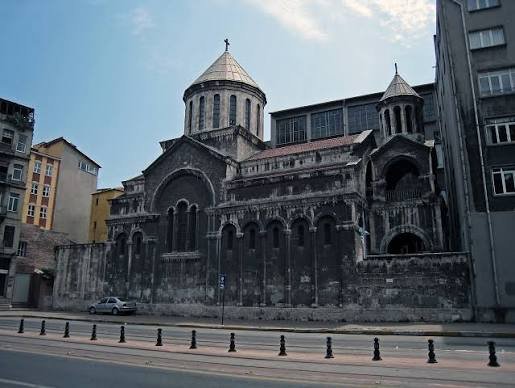
After the foundation of the Armenian Patriarchate of Istanbul (1461), 55 Armenian churches have been built in the city. Some 30 of them are still open to worship, and Surp Krikor Lusavoriç is the oldest in Istanbul still in existence today. Situated on Kemeraltı Street, the church is said to date back to pre-conquest era. Eremya Çelebi, who claims that it was built by merchants from Kefe, gives the construction date as 1436, while some other sources date it back to 1360, 1361, or 1391.
However, historian Ğugas İnciciyan objects that 1391 is the date when the land was bought. In fact, a more plausible conclusion can be drawn from the dates of the artifacts found in the church: until 1953, the ground floor had a headstone and a statue of Virgin Mary from 1431, and a bible - handwritten by Mağakya Apeğa – from 1440. So the construction date should have been 1431. From 1431 up until the conquest, the church has functioned as the only sanctuary and community center for the Armenian community of Istanbul. During the Ottoman era, it continued this function until the church in Samatya was assigned to Armenians and became a Patriarchate. Also, Armenian Catholic clergymen conducted liturgy here, until Surp Pırgiç Church was opened in 1834.
The building was renovated after being seriously damaged in the Great Fire of Galata in 1660. It was burned down again in 1731, but renovated to a better-than-before state within only 3 months by the famous imperial architect Sarkis Kalfa who adorned it with Kütahya ceramic tiles. Following another fire in 1771, it was rebuilt by Minas Kalfa in 1800, and then served long years as the main religious and cultural center of the Armenian community.
In 1958, during the road expansion works on Kemaraltı Street, the church was demolished after a part of the land was expropriated. It was re-built on the remaining land between 1962 and 1966. Today, the church is 10 m in width and 14 m in length, and its height is 23 m to the top of the dome. The basement floor includes a sanctuary where colophons, valuable ceramic tile remains, and 18th century headstones are kept.
Part of these themes: Galata's communities
Source: Akdoğan Özkan, A Traveler’s Guide to Galata (Nar Turizm, 2016), translated by Volkan Ersoy.
Last updated: · Last checked: (address and map position)
Spotted a mistake or something missing on this page? Suggest a correction