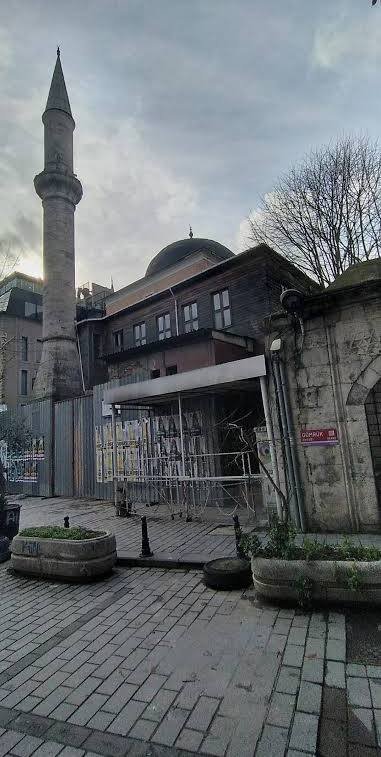
The han has an entrance from the Yemişçi Sokak, but the main entrance is on Halil Pasha Sokak, next to a crowded pedestrian area around Karaköy ferry terminal.
It was built in 1909-10 by Alexandre Vallaury, a famous Levantine architect of the time, on the order of Arab İzzet Pasha, first chamberlain of Sultan Abdülhamid II. The first residential electricity system in Istanbul was tested at İzzet Pasha’s mansion – which was near Yıldız Palace – with equipment brought from Germany.
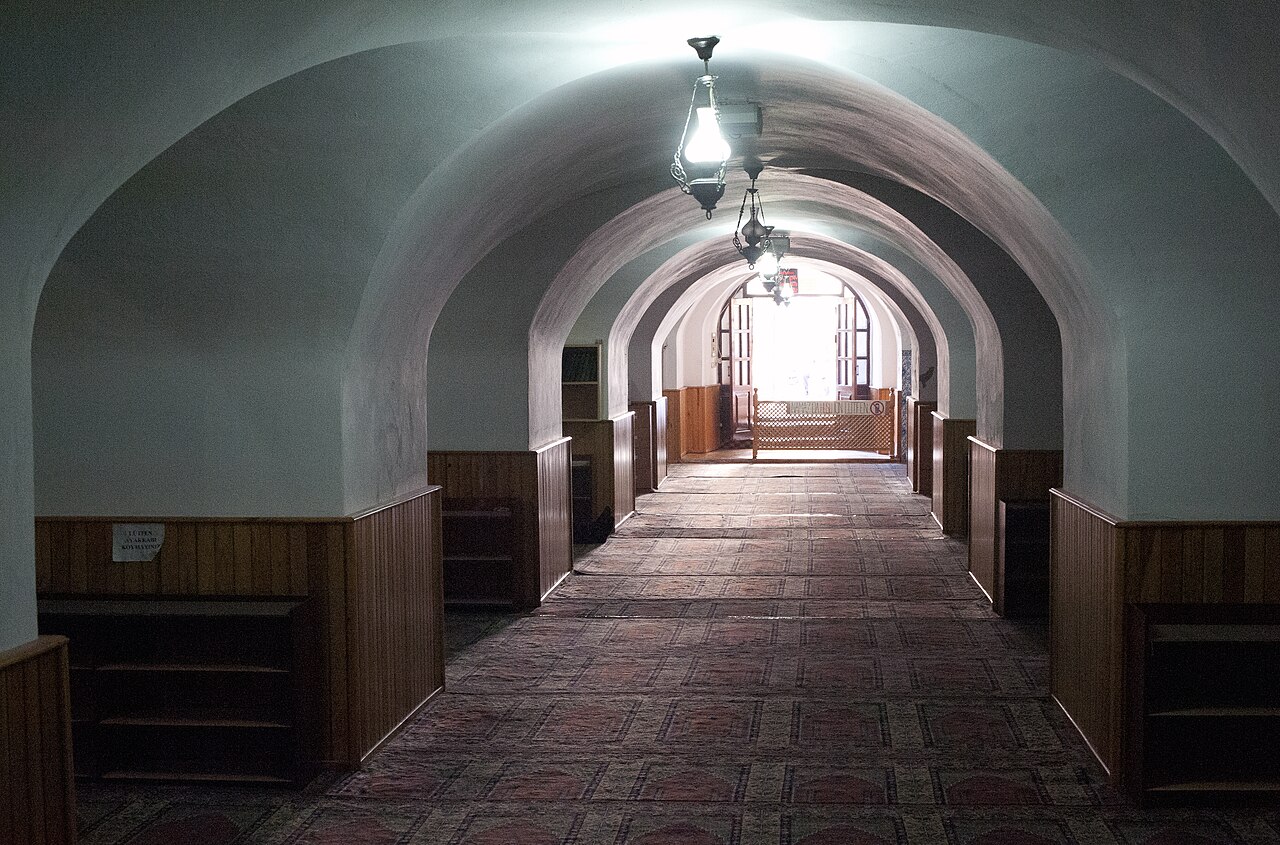
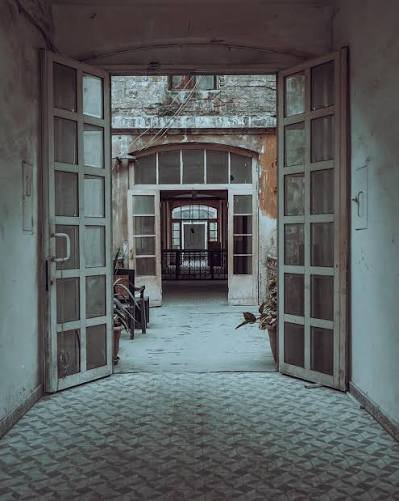
Built on 1040 piles for being close to the sea, and featuring a central heating system, Ömer Âbid Han was a modern building for its time. The architect Vallaury is said to be inspired by Turkish residential architecture, applying a synthesis of eastern and western styles in most of his post-1895 works. However, Ömer Âbid Han was seemingly an exception. The façade, having rather a western style, is adorned with decorative elements borrowed from the baroque, renaissance, and classical periods. The four-storey building sits on a plan area of 1,183 sqm, making it one of the largest hans in Istanbul. However, it doesn’t feature a courtyard, and it is composed of interconnecting rooms. Each room has at least one window that opens either to the street, or to the halls. The Mansard style roof offers a larger living space.
During its first years, Ömer Âbid Han was used as the grain bourse, inhabited by millers, brokers, ship owners, maritime agents, lawyers, and insurance companies. In 1992, it was evacuated for demolition and reconstruction as a hotel, but the plan was abandoned because of its historical value. Today, it is mostly inhabited by electronic parts shops.
A Guinea Pig for Electricity: Arap İzzet Pasha
While Istanbul’s introduction to electric power was during the reign of Sultan Abdülhamid II, he was also responsible for its delay because of his deep concerns of safety. At the end of 1890s, Germans who were in good terms with the Ottoman throne believed that it’s time for Istanbul to have electric power. Prince Bernhard Von Bulow, the German State Minister for Foreign Affairs, describes in his memoirs how he and German Emperor Wilhelm II visited Istanbul, trying to talk the Sultan round to it. Although they reminded Siemens’ proposal to illuminate Istanbul, von Brulow says, they were unsuccessful in persuading the Sultan, as he was too concerned about the dangers of electric sparks.
On the other hand, there were many people and entrepreneurs who believed that Sultan Abdülhamid should have at least started this journey of electricity from his own Yıldız Palace. A German Jew named Weinberg, who was a photographer and the owner of an imported merchandise store in Beyoğlu, led the way by importing the required equipment from Germany. Abdülhamid was still unsure of the results, however, and he was reluctant to take the risks by being a test subject for the first trials. Fortunately, Arap İzzet Pasha, who was in good relations with the foreign companies, came to his rescue.
Arap İzzet Pasha was born in Damascus during mid-19th century as the son of Holo Pasha, one of the wealthiest feudal lords in Syria, and a Crimean woman named Fatma. After receiving a good education, he came to Istanbul in his young ages and entered into the service of Sultan Abdülaziz. During the reign of Sultan Abdülhamid, he gradually rose in ranks to become one of the most powerful of the Ottoman statesmen.
Foreign companies which demand prerogatives to produce and sell electric power in Istanbul have already convinced Arap İzzet Pasha, the Second Chamberlain to the Sultan at the time: equipment imported from Germany would be installed at his mansion in Yıldız neighborhood of Istanbul. İzzet Pasha’s wooden frame mansion, which used to be situated on the right hand side down today’s Barbaros Boulevard, next to Said Çiftçi Dispensary, would be a guinea pig for electric power trials.
The electric equipment was installed in the mansion by another German Jew engineer named Otto. The generator was placed in the garden, and power cables were run from the generator to the mansion. Once the tests were complete, the switch was turned on one night to supply the mansion with power. İzzet Pasha’s mansion was now the only place bathed in light during the dark Istanbul nights.
Quick to adapt to this innovation, İzzet Pasha even went on to install a cinematography machine in his mansion to watch with his friends the latest films sent from Europe. One night, however, overheated cables caused the current to arc, and the resulting sparks set the mansion on fire. Despite the efforts of the fire brigade, this beautiful mansion was reduced to ashes.
What’s worse, a young maid of the mansion, sleeping unaware of the situation, lost her life to the fire.
Sultan Abdülhamid II was informed of the fire when he was in meeting with the French ambassador in Yıldız Palace. Believing that electricity might turn his palace into ashes even from long distances via a cable, Sultan Abdülhamid was proved right in his concerns.
After the fire, İzzet Pasha took his family and moved to Şehremini (Governor) Reşit Pasha’s (his son’s father-in-law) waterfront residence in Bebek. However, the main damage was to the people of Istanbul. They had to wait until Abdülhamid’s deposition to have electricity. Budapest-based Ganz Company established the Ottoman Electric Company Inc. in 1911. The same year, a land was bought at the mouth of Kağıthane and Alibeyköy rivers to build the Silahtarağa Power Station. The power plant was put into service on 11th February 1914, supplying initially the tram network, followed shortly by the city network, private facilities, and establishments. Electric powered street lighting came to Istanbul in the 1920s.
From recent research
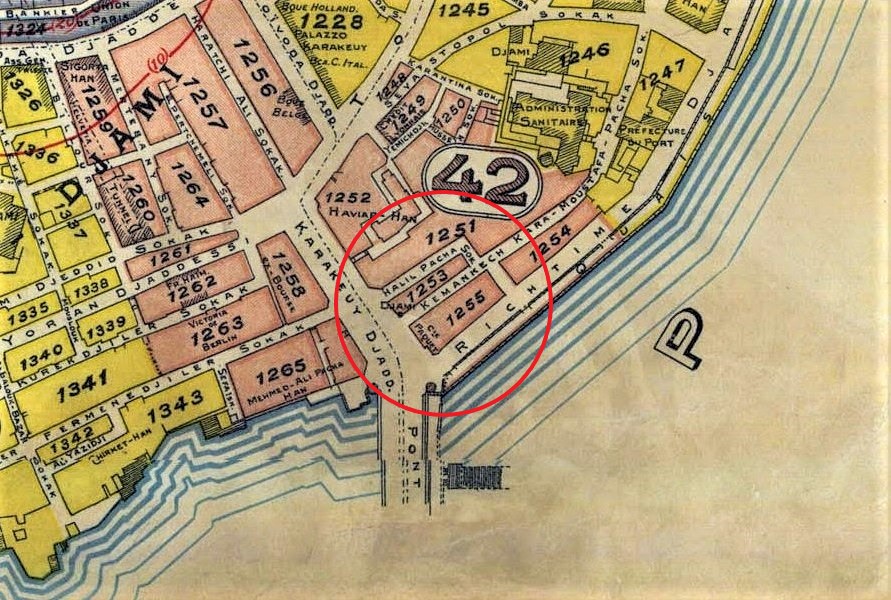
A Karaköy plot from Halil Pasha Han to Ömer Âbid Han
On the plot where the maps of 1876 and 1905 show Halil Pasha Han, Ömer Abed Han (today’s Ömer Âbid Han) was built in 1909–1910. Figen Orçun Kafesçioğlu compares plans of different dates for the same block.
Source: Figen Orçun Kafesçioğlu (2016), 19. Yüzyılın İkinci Yarısından Günümüze Galata/Karaköy’de Kent Morfolojisi ve Yapı Türlerinin İncelenmesi, pp. 198–199, commercial buildings and hans.
Part of these themes: Banks and hans
Source: Akdoğan Özkan, A Traveler’s Guide to Galata (Nar Turizm, 2016), translated by Volkan Ersoy.
Last updated: · Last checked: (address and map position)
Spotted a mistake or something missing on this page? Suggest a correction