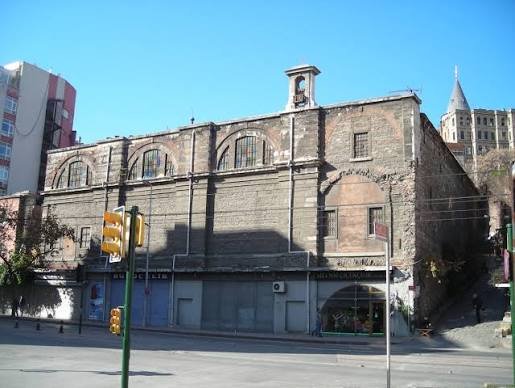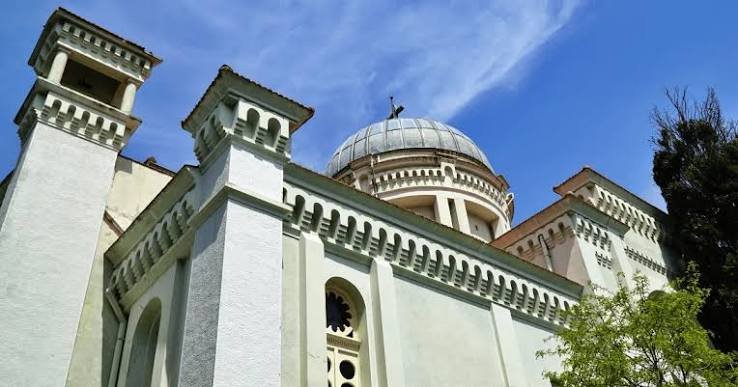
The Church of Saint Benoit is situated in a land surrounded by high walls on Kemeraltı Street. It is the oldest active Roman Catholic Church in the region.
Although its construction date is uncertain, it is claimed to be built during the rule of Byzantine Emperor Kantakuzenos, and the papacy of Urbanus V (1362-1370) of the Benedictine Order. In 1427, the church was placed under the control of the Benedictine monks, changing its name to “San Benedetto.” For this reason, some sources indicate its construction date as 1427. In summary, Saint Benoit is originally an Italian institution rather than a French one. The church is under the rule of Benedictine Order since the Genoese era of Galata. Although the building underwent many changes through time, its door and bell tower retained their original forms. Also, a monastery was built on the foundations of the adjacent old city walls. Gyllius, a historian who wrote on Medieval and Byzantine periods, notes that the premises of the monastery used to comprise a 300-column large cistern. According to him, the roof of the cistern had collapsed during his time and the priest were taking water from the cistern to water their vegetable garden. (This also hints at why this place was called “Çukurbostan” (low elevation garden) during the Ottoman era.)
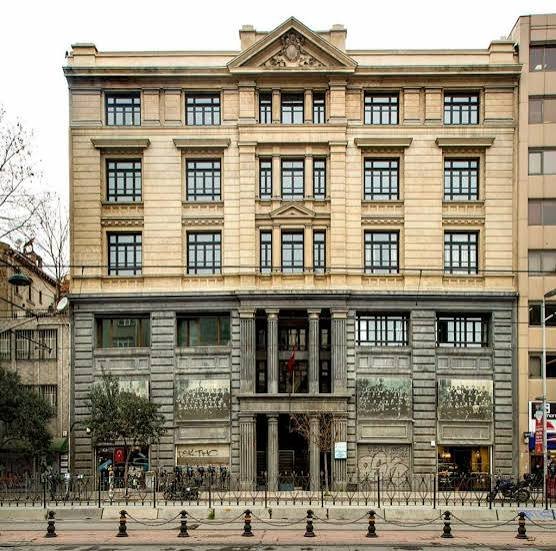
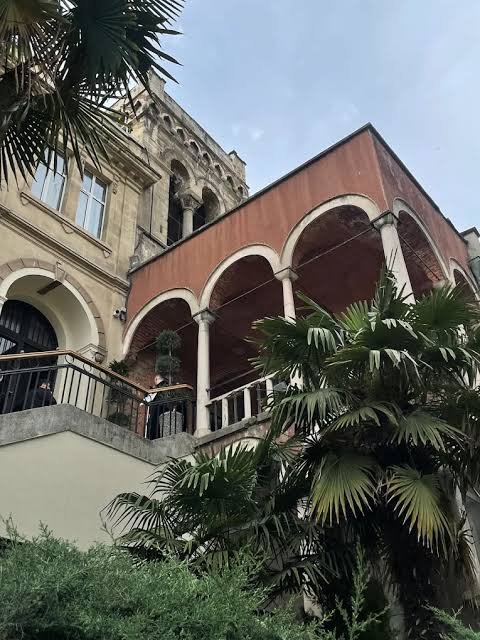
The church comprises several Levantine tombs from the 17th and 18th century. Next to the church is the Saint Benoit Private High School (Lycée Français Privé Saint-Benoît). Although the school’s official establishment date is 1783, it was reportedly constructed on the foundations of Santa-Maria della Misericordia (Monastero della Cisterna de Pera - Monastery of Pera Cistern), which was built by Genoese nuns of Benedictine Order. The bell tower at the entrance of the school is the only relic from that era.
According to Monsignor Pietro Cedulini (1577-1633) who visited Istanbul in 1581, Sultan Süleyman the Magnificent had first wanted to convert the Saint Benoit Church into a mosque, but later donated it to the Kingdom of France. In 1583, upon the request of King Henri III of France, Pope Gregorius XIII transferred the monastery from Benedictine Order to the Jesuit Order. Following the abolishment of the Jesuit Order, the church passed to the Lazarists for a while, but the French ambassador drove them out during the French Revolution. When the French Revolution ended, a group of Lazarist priests arrived from Marseilles to take their church back in 1783. It is this date which is acknowledged as the official foundation date of the school. While the school was at first accepting only the students of French origin, it later started to accept also the Ottoman students with a 1831-dated edict of Sultan Mahmud II.
In the 19th century, the students of Saint-Benoit were mostly composed of the children of foreigners and Levantine families, but later the number of Ottoman non-Muslim children grew. During this period, however, the school mostly attracted Armenian Catholic and Bulgarian Catholic communities.
In 1844 a pharmacy, and in 1862 a dispensary were added to the school. The school also became the scene of the Ottoman Empire’s first scientific meteorology measurements, conducted by Fr. Jean Régnier between 1848 and 1853. After suffering many fires and the wear of time, the school buildings were demolished and rebuilt to their current state between 1875 and 1880.
As in all the schools of foreign origin in Turkey, Saint-Benoit also underwent many changes with the 1924-dated Act of the Unification of Education, as well as with the 1935-dated Act of Private Educational Institutions.
There is no remaining nun in the school since Sister Monique Geins, the former vice-principal and a teacher of French language, left for France in 2009, after years of service.
Part of these themes: Genoese Galata · Galata's communities
Source: Akdoğan Özkan, A Traveler’s Guide to Galata (Nar Turizm, 2016), translated by Volkan Ersoy. Obvious misprints in the printed edition have been corrected.
Last updated: · Last checked: (address and map position)
Spotted a mistake or something missing on this page? Suggest a correction