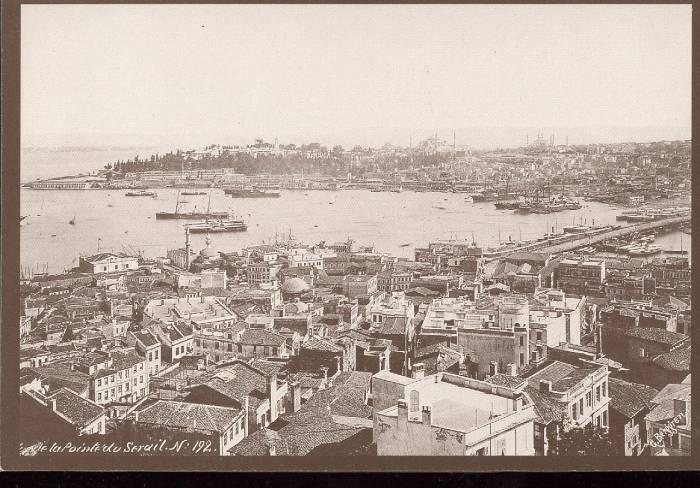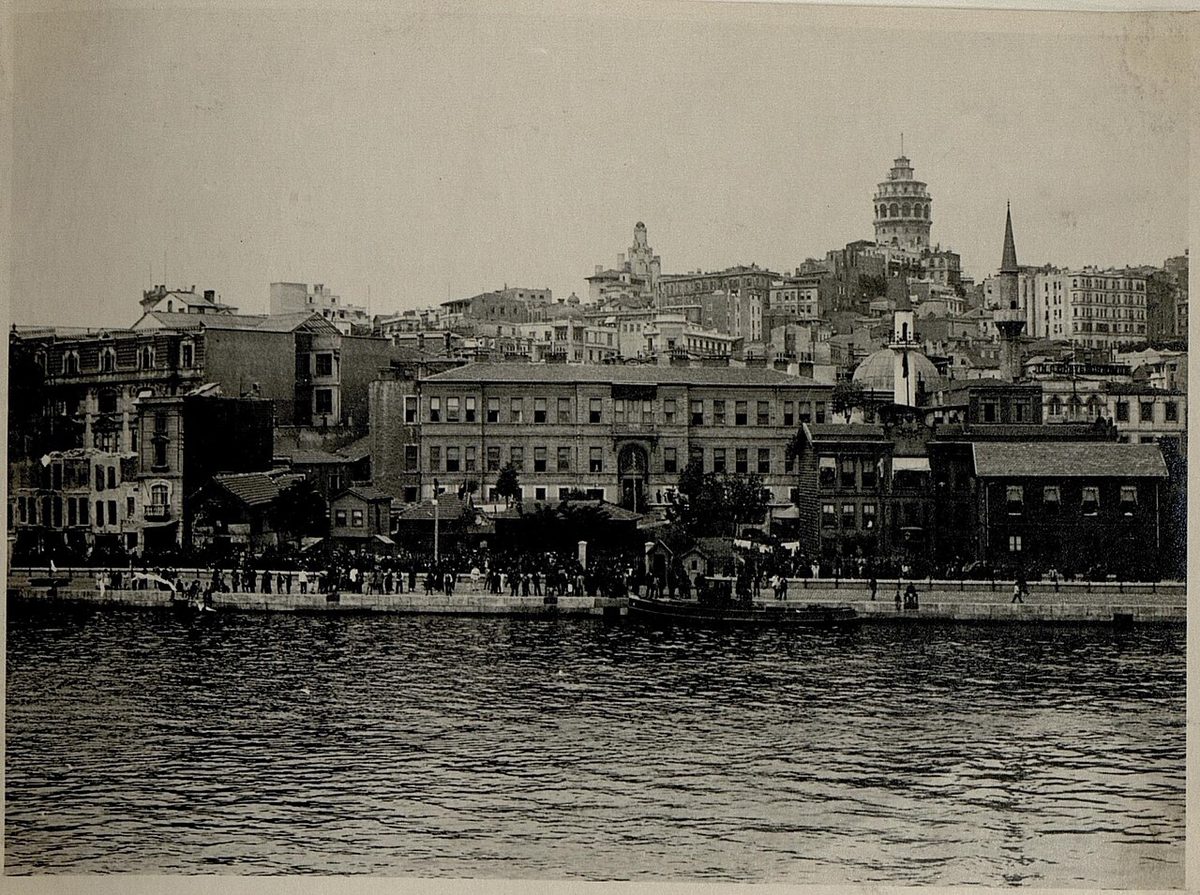
Galata’s table was the table of a harbour district: merchants and sailors coming ashore, the tavern at the head of the pier, the fishmongers right beside it. This article draws the district’s history of eating and drinking from sources beyond the book. The book’s own account of how wine reached Galata and of its old taverns is on the Şarap İskelesi Street and Galata’s Old Taverns page.
The city’s tavern district
According to İhsan Erdinçli’s study of tavern food in Ottoman Istanbul, after the conquest taverns (meyhane) were first known in the city in Galata. [1] Tax registers of the 1840s counted 434 taverns in all of Istanbul. 54 per cent of them were in the judicial district of Galata; 25 per cent were inside the walls, 13 per cent in Üsküdar and 8 per cent in Eyüp. [1]
Galata’s ties to Europe played a part. İlber Ortaylı writes that the embassies in Galata had to be supplied with pork and wine, and that these were exempted from the tax on pork and wine (“hınzır ve hamr”). [2]
Taverns facing the sea, and the fish market
Simeon of Poland, who came to Istanbul in the first quarter of the 17th century, describes large taverns of three or four storeys facing the sea in Galata. From here, he says, all kinds of fish, caviar, lobster and mussels “flow”. [1]
Fish was right beside the tavern. Evliya Çelebi says that for the regulars of Galata’s taverns there were “hundreds of kinds” of fish in the Balıkpazarı market. [1] According to Reşad Ekrem Koçu’s İstanbul Ansiklopedisi, the Galata fish market stood on Kardeşim Sokağı in the Yenicami quarter, with small taverns among the fishmongers’ shops. The market no longer exists. [3]
Friedrich Shrader, who lived in Istanbul between 1891 and 1918, writes that bluefish, grey mullet, mackerel, red mullet, bluefin tuna and swordfish were sold on large wooden trays or in baskets at the Galata fish market. [1] Galata’s meze sellers offered lakerda (salted bonito), çiroz (dried mackerel), likorinoz, salted sardines, caviar, pastırma, cheeses and pickles. [1]
Istanbul had two fish markets: one at Eminönü inside the walls, the other in Galata. Sources sometimes confuse which famous taverns stood by which; this article keeps only what can be tied firmly to Galata.
Coffeehouses and beer houses
The coffeehouse was part of everyday life in Galata too. According to Ahmet Yaşar’s entry in the TDV İslâm Ansiklopedisi, orders closing coffeehouses under Süleyman the Magnificent were also sent to the judge (kadı) of Galata; in the 19th century European-style cafés opened in Galata and Pera. [5] The Çeşme Meydanı article shows that in Galata a coffeehouse could even serve as an address.
In the 19th century taverns became more visible. Erdinçli notes that Muslims who could now go to taverns without fear of punishment contributed to meze culture, and that the Treaty of Balta Limanı brought European foods to the table. [1] Koçu’s encyclopaedia describes Kosti’s beer house, open in Galata in 1890–95, the first stop for foreign sailors coming ashore. [4]
The nargile of Tophane
Tophane was famous for its nargile coffeehouses. In the Lüleciler Çarşısı, the pipe-makers’ market running from the Kılıç Ali Pasha Mosque to the foot of Kumbaracılar Yokuşu, pipe and nargile bowls, tobacco bowls, and coffee and sugar boxes were made; by the first quarter of the 20th century only one shop was left. [6] The market’s story is on the Lüleci Hendek Street page.
Related pages
- Şarap İskelesi Street and Galata’s Old Taverns
- Lüleci Hendek Street
- A Coffeehouse as an Address on Çeşme Meydanı
- Trades Written into the Street Names of Perşembe Pazarı
- Theme: Taverns, music and entertainment
Source: Galata HUB’s own text, based on: [1] İhsan Erdinçli, “16. Yüzyıldan 20. Yüzyıla Osmanlı İstanbul'unda Meyhane Mezeleri ve Yiyecekleri”, Tarih Araştırmaları Dergisi 42/73 (2023), pp. 151–180 (esp. pp. 153, 155, 161, 163, 169, 177) · [2] İlber Ortaylı, “Galata”, TDV İslâm Ansiklopedisi, vol. 13 (1996), pp. 303–307 · [3] “Galata Balık Pazarı”, İstanbul Ansiklopedisi (Reşad Ekrem Koçu), vol. 11, p. 5886 · [4] “Kostinin Birâhanesi”, İstanbul Ansiklopedisi (Reşad Ekrem Koçu) · [5] Ahmet Yaşar, “Kahvehane”, TDV İslâm Ansiklopedisi, suppl. 2 (2019), pp. 3–5 · [6] Akdoğan Özkan’s guide to Galata (Nar Turizm, 2017), pp. 207–208
Last updated:
Spotted a mistake or something missing on this page? Suggest a correction